New Arrival Procedures at Chek Lap Kok

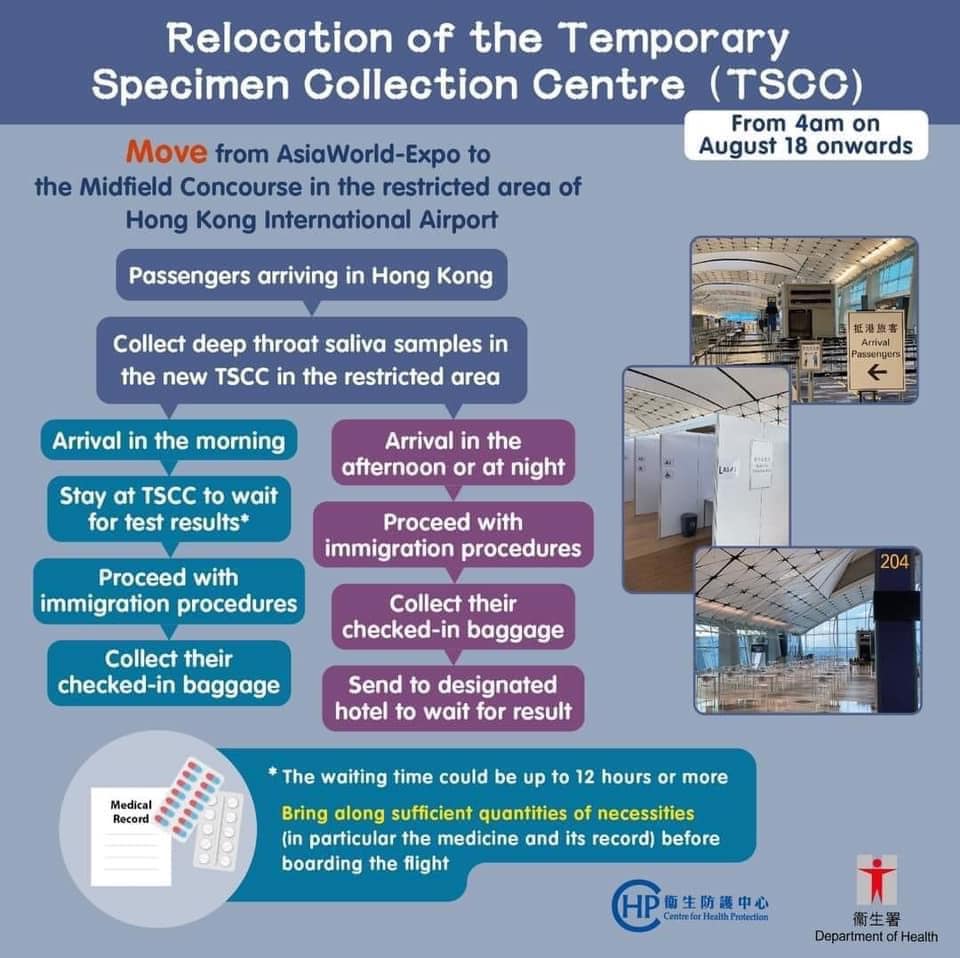
As from the 18 August 2020, arrivals at Chek Lap Kok will undergo Wuhan virus testing inside the airport before passing through immigration.

No information has yet been provided from the Centre of Health Protection as to whether those testing positive will be allowed to enter Hong Kong.

For information and personal experiences of the testing procedure and lots of information about quarantining in Hong Kong check out the excellent and informative facebook group: HK Quarantine support group

Note: Information, flight requirements and procedures change regularly so check the CHP website before flying.

Hong Kong National Security Law: Article 43

The Implementation Rules for Article 43 of the Law of the People’s Republic of China on Safeguarding National Security in the Hong Kong Special Administrative Region (Implementation Rules) were gazetted 6 July and will take effect on 7 July 2020.

The Implementation Rules have the force of law, and details are as follows:

1. Search of Places for Evidence

The relevant rules are formulated with reference to various existing ordinances regarding the permission to conduct urgent search under exceptional circumstances, including the Firearms and Ammunition Ordinance (Cap. 238) and the Import and Export Ordinance (Cap. 60). For investigation of an offence endangering national security, a police officer may apply to a magistrate for a warrant to enter and search a place for evidence. Under exceptional circumstances (for instance, in urgent situations), a police officer not below the rank of Assistant Commissioner of Police may authorise his officers to enter the relevant place to search for evidence without a warrant.

2. Restriction on Persons under Investigation from Leaving Hong Kong

With reference to provisions under the Prevention of Bribery Ordinance (Cap. 201) which restrict a person under investigation from leaving Hong Kong, the rules authorise police officers to apply to a magistrate for a warrant to require a person who is suspected to have committed offences endangering national security to surrender his travel document, and to restrict that person from leaving Hong Kong, lest some of the persons involved in the case abscond overseas. A person who has surrendered a travel document may make application in writing to the Commissioner of Police or to a magistrate for its return and for permission to leave Hong Kong.

3. Freezing, Restraint, Confiscation and Forfeiture of Property Related to Offences Endangering National Security

The arrangements concerned are formulated with reference to the existing powers and provisions under the Organized and Serious Crimes Ordinance (Cap. 455) and the United Nations (Anti-Terrorism Measures) Ordinance (Cap. 575). If the Secretary for Security has reasonable grounds to suspect that any property is property related to an offence endangering national security, he may, by notice in writing, direct that a person must not deal with the property. The Court of First Instance may, on the application by the Secretary for Justice, order the confiscation of the property related to the offence. Anyone who knows or suspects that any property is property related to an offence endangering national security is obliged to make a disclosure to the Police Force as soon as is reasonably practicable, and must not disclose to another person any information which is likely to prejudice any investigation which might be conducted following that first-mentioned disclosure. In addition, the Secretary for Justice may make an application to the Court of First Instance for a restraint order or charging order to prohibit any person from dealing with any realisable property, or impose on any realisable property that is specified in the order a charge for securing the payment of money to the Government. Furthermore, the Secretary for Justice may also make an application to the court for confiscating the proceeds arising from an offence endangering national security and ordering the amount due be paid within a fixed period.

4. Removal of Messages Endangering National Security and Request for Assistance

If the Commissioner of Police has reasonable grounds to suspect that an electronic message published on an electronic platform is likely to constitute an offence endangering national security or is likely to cause the occurrence of an offence endangering national security, he may, with the approval of the Secretary for Security, authorise a designated police officer to request the relevant message publisher(s), platform service provider(s), hosting service provider(s) and/or network service provider(s) to remove the message; restrict or cease access by any person to the message; or restrict or cease access by any person to the platform or its relevant part(s). It is a reasonable defence if the technology necessary for complying with the requirement was not reasonably available to the publisher or relevant service provider; or there was a risk of incurring substantial loss to, or otherwise substantially prejudicing the right of, a third party.

If the publisher fails to cooperate immediately, and the relevant information on the Internet will continue to seriously affect members of the public, police officers may apply to the magistrate for a warrant to seize the relevant electronic device and take any action for removing that information as soon as practicable. Relevant officers may also apply to the magistrate for a warrant under specific circumstances to authorise police officers to request the relevant service provider to provide the identification record or decryption assistance as the case requires.

5. Requiring Foreign and Taiwan Political Organisations and Agents to Provide Information on Activities Concerning Hong Kong

If the Commissioner of Police reasonably believes that it is necessary for the prevention and investigation of an offence endangering national security, the Commissioner of Police may, with the approval of the Secretary for Security, by written notice served on a foreign political organisation or Taiwan political organisation, or a foreign agent or a Taiwan agent, require the organisation or agent to provide the Commissioner of Police with the prescribed information (including the activities, the personal particulars, as well as the assets, income, sources of income, and expenditure of the organisation in Hong Kong) in a prescribed manner within the specified period. The relevant rules are formulated with reference to the prevailing provisions of the Societies Ordinance (Cap. 151) under which Societies Officers may request the provision of information from societies.

6. Application on Authorisation for Interception of Communications and Covert Surveillance

To effectively prevent and detect offences endangering national security and protect the confidentiality of information related to national security, all applications for interception of communications and covert surveillance operations must be approved by the Chief Executive. Applications for the less intrusive covert surveillance may be made to a directorate officer of the Police Force designated by the Chief Executive. The authorising authority has to ensure that the covert operation concerned satisfies the proportionality and necessity tests before granting the authorisation. According to Article 43 of the National Security Law, the National Security Committee shall be responsible for supervising the implementation of the stipulated measures by the Police Force. On the other hand, the Implementation Rules provide that the Chief Executive may appoint an independent person to assist the National Security Committee in performing the aforementioned supervising responsibility. Furthermore, the Secretary for Security issues Operating Principles and Guidelines for the purpose of providing operating principles and guidance to officers of the HKPF regarding the making of relevant applications and the exercise of powers. Officers of the HKPF are required to comply with the provisions in the Operating Principles and Guidelines when performing any function under the relevant rules. The Operating Principles and Guidelines will be gazetted at the same time with the Implementation Rules.

7. Requirement to Furnish Information and Produce Materials

For the purpose of assisting an investigation into an offence endangering national security or the proceeds obtained with the commission of the relevant offence, the Secretary for Justice or police officers may apply to the court for an order to require the person concerned to answer questions within a specified time period, or to furnish or produce the relevant information or material. The provisions are formulated with reference to the relevant powers and provisions under the Organized and Serious Crimes Ordinance (Cap. 455) and the United Nations (Anti-Terrorism Measures) Ordinance (Cap. 575) currently.

Penalties

To ensure the effective implementation of the above relevant measures, there is also a need to provide in the Implementation Rules relevant penalties for contravention of the requirements.

For instance:

  • If a person who published a message fails to comply with the requirement of the police to remove the message endangering national security without reasonable excuse, the person is liable on conviction to a fine of $100,000 and to imprisonment for one year.
  • If a service provider fails to comply with the requirement to remove messages endangering national security, or to restrict or cease access to messages or platforms, or the request to provide assistance, the service provider is liable on conviction to a fine of $100,000 and to imprisonment for six months.
  • Furthermore, a foreign political organisation or Taiwan political organisation, or a foreign agent or a Taiwan agent, who fails to provide information as requested by the Police is liable on conviction to a fine of $100,000 and to imprisonment for six months unless it can prove that it has exercised due diligence and there have been reasons beyond its control.
  • If any information provided is false, incorrect, or incomplete, the person who provided the information is liable on conviction to a fine of $100,000 and to imprisonment for two years, unless the person has grounds to believe that the relevant information was true, correct and complete.

As for other items, the relevant offences and defence (if specified) are largely the same as the existing provisions in the laws that the Implementation Rules have made reference to.

The provision of defence provisions under appropriate circumstances provide appropriate defence for people who fail to comply with the requirements.

The above Implementation Rules are in compliance with the requirements concerned under the National Security Law and the Basic Law, including the requirements concerning the respect and protection of human rights.

Updated with the official translation 00:12, 7 July, which can be read here

World Sports Photography Awards 2020

This beautiful shot by Stefan Wermuth for Reuters of the Hong Kong Women’s Artistic Swim Team in the ‘Team Free Competition’ at the 18th FINA World Championship, took Gold in the Precision category of the World Sports Photography Awards 2020.

The championships took place during July 2019 in Gwangju, Republic of Korea and Hong Kong were 25th in the Team Free.

Congratulations to Stefan on his gold medal. You can see all the awarding photos at the World Sports Photography Awards website.

HK Bar Association: NSL Erodes High Degree of Autonomy

Statement of the Hong Kong Bar Association:
The Law of the People’s Republic of China (“PRC”) on Safeguarding National Security in the Hong Kong Special Administrative Region (“HKSAR”)

1. The Law of the PRC on Safeguarding National Security in the HKSAR (“NSL”) was endorsed and adopted in the Mainland on 30 June 2020 and then promulgated by the Chief Executive so as to come into force in the HKSAR at 11 pm on the same day. The Hong Kong Bar Association is gravely concerned with both the contents of the NSL and the manner of its introduction.

2. Nobody in the HKSAR had seen so much as a draft or accurate summary of the NSL before its entry into force. In addition to the total absence of meaningful consultation, lawyers, judges, police and Hong Kong residents were given no opportunity to familiarise themselves with the contents of the new law, including the serious criminal offences it creates, before it came into force.

3. The NSL has so far only been published in Chinese language, rendering its contents inaccessible to many interested stakeholders. The omission of a contemporaneous authentic English version of the law is unusual given that a bilingual legal system operates in Hong Kong.

4. The NSL is a national law adopted under the Constitution of the People’s Republic of China (“PRC”) and the Basic Law. As stated in the instrument of promulgation signed by the Chief Executive, the NSL has been applied in Hong Kong under Article 18 of the Basic Law. The choice of this procedure, rather than any amendment to the Basic Law under Article 159, indicates that the Basic Law continues to operate with full force and effect. Yet the NSL contains numerous provisions that appear to be inconsistent with the provisions of the Basic Law.

5. Article 62 of the NSL states that the NSL shall prevail in the event of any inconsistency with the “local laws of the HKSAR”. This would appear to embrace all Hong Kong Ordinances, including the Hong Kong Bill of Rights Ordinance (Cap. 383), the function of which is to implement the International Covenant on Civil and Political Rights. The Basic Law itself, however, is a national law adopted by the National People’s Congress (“NPC”) under the PRC Constitution. It should be assumed that the NSL will be applied in a manner that is fully consistent with the Basic Law. How this is to be achieved, given the apparent inconsistencies between the NSL and the constitutional guarantees laid down in the Basic Law, is a matter that needs urgently to be addressed by the HKSAR Government.

6. It is incumbent upon the Chief Executive, who says that she was also in the dark about details of the law until yesterday, to clearly, fully and quickly explain to the general public how she sees the NSL working and what areas of life it may encroach upon.

7. A thorough study of the new law is needed to see how it may work and what effect it will have on existing laws and the justice system. However, the following issues and Articles of the NSL are of particular concern and it is right to address them now, albeit provisionally.

8. Where the central authorities decide to exercise jurisdiction in a given case, suspects can be removed to face trial in Mainland China. This is not extradition (where a person is removed to face trial for an offence in the receiving jurisdiction), and the usual judicial controls over extraditions appear not to apply. Mainland criminal procedures will be applied in such cases, in accordance with Articles 55-57, and this raises concern as to whether the rights of the accused to fair trial will be adequately protected or respected.

9. The power of interpretation is vested in the Standing Committee of the NPC. This has the potential to undercut the independent exercise of judicial power by the Courts of the Region (Articles 80 and 85 of the Basic Law).

10. The independence of the judiciary is undermined. The Chief Executive designates a list of approved judges for national security cases (Article 44). Appointment is on a yearly basis. Judges chosen by the executive can be removed from the list if their words or deeds endanger national security (Article 44).

11. Some people are held out to be above the reach of local law. The personnel of the Mainland National Security Agency (“NSA”) are meant to perform duties in accordance with law and not infringe the rights and interests of people and other organizations (Article 50), but the conduct of NSA and its personnel in the execution of their duties in accordance with law is not subject to local jurisdiction (Article 60).

12. The Special National Security Police Unit (“Special NS Unit”) is meant to apply the current law in carrying out its duties (Article 43), but then it enjoys a range of powers that go beyond those available under the existing laws (Article 43). Judicial control over covert surveillance is removed.

13. There is a reversal of presumption of bail (Article 42). The provision of mandatory minimum sentences strips away judicial discretion in sentencing. The right to trial by jury can be taken away by the Secretary for Justice on certain grounds without any residual discretion in this regard being left with the Courts of the HKSAR (Article 46).

14. The newly established National Security Council is said to be exempt from judicial review (Article 14).

15. Four groups of criminal offences are created. These are widely drawn and absent a clear and comprehensive array of publicly accessible guidelines and basic safeguards as to legal certainty and fair treatment, are capable of being applied in a manner that is arbitrary, and that disproportionately interferes with fundamental rights, including the freedom of conscience, expression and assembly:

(1) Secession (Article 20) can be committed with or without violence. This gives rise to concern whether this might operate to prohibit mere speech or any peaceful advocacy.

(2) Subversion (Article 22) requires the threat or use of force or “other unlawful means” (such as an unlawful assembly) to do one of the defined acts, which include serious interference with or obstruction of the authority of the HKSAR (Article 22(3)), and attacking government facilities rendering them unable to perform their functions normally (Article 22(4)). This gives rise to concern whether media criticisms or picketing might be caught under these provisions.

(3) Terrorist acts (Article 24) are vaguely defined. Supporting terrorists or terrorist activities (Article 26) is widely drawn and covers any person providing materials, labour services, transport, venue support, assistance and convenience to terrorist organisations or terrorist acts. It is uncertain whether the prosecution must prove that the accused knew that the person receiving such services is a terrorist.

(4) Colluding with foreign forces (Article 29) is vaguely defined. It covers directly or indirectly accepting a subsidy or support from a foreign organization with a view to carrying out hostile actions against the HKSAR (Article 29(4)). This gives rise to concern whether certain existing activities of academics, NGOs and media organizations which were lawful or not unlawful in the past might now be outlawed by these provisions.

16. Taken together, these and other provisions of the NSL operate to erode the high degree of autonomy guaranteed to the HKSAR under the Basic Law and the Sino-British Joint Declaration, and to undermine core pillars of the One Country Two Systems model including independent judicial power, the enjoyment of fundamental rights and liberties, and the vesting of legislative and executive power in local institutions. The Hong Kong Bar Association calls on the Chief Executive to reaffirm these foundational values of the HKSAR, and to commit her Government to applying the NSL in a manner that is fully consistent with the Basic Law and Hong Kong Bill of Rights.

Dated 1 July 2020

Hong Kong Bar Association

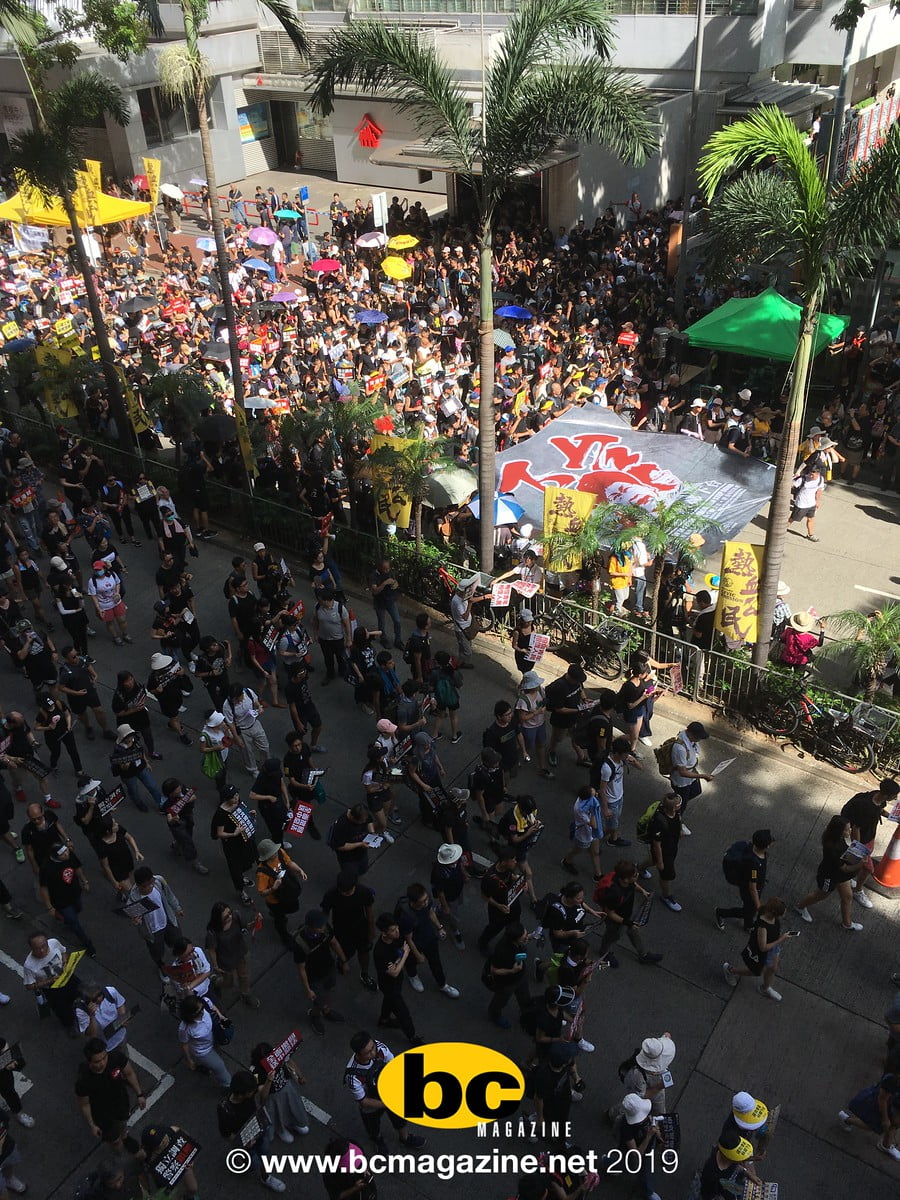
No Extradition Protest March – 21 July, 2019

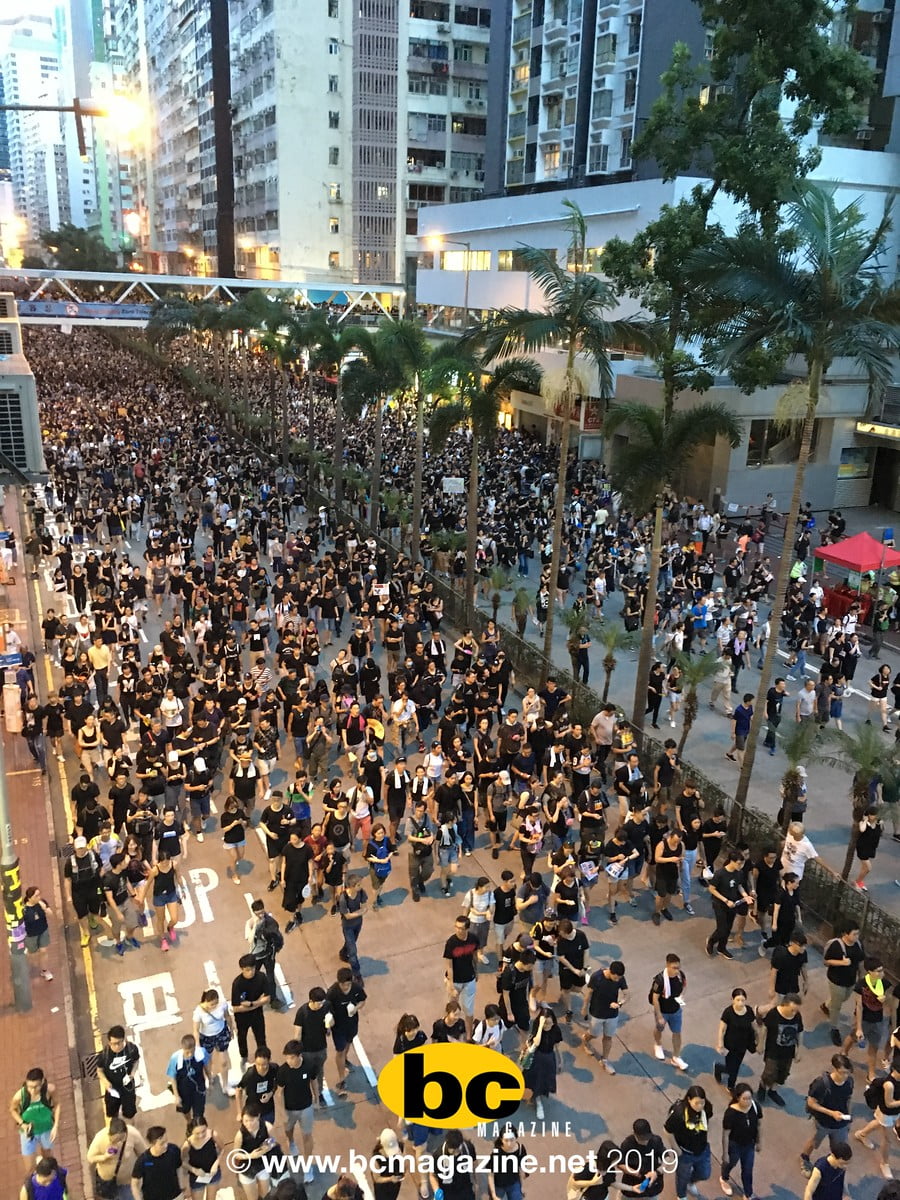
When does a massive protest march seem small?

After the enormous So No to China Extradition protest marches of June which saw millions of HongKongers protesting. Today’s march which had around 350,000 participants seemed small – but it wasn’t! It was another blunt statement of anger at Chief Executive Carrie Lam and her disfunctio0nal and corrupt administration.

https://bcmagazine.smugmug.com/Bcene-photos/2019/No-Extradition-Protest-March-21-July-2019/i-z3cLGdp

https://bcmagazine.smugmug.com/Bcene-photos/2019/No-Extradition-Protest-March-21-July-2019/i-pp7N8jN

https://bcmagazine.smugmug.com/Bcene-photos/2019/No-Extradition-Protest-March-21-July-2019/i-6QzdLq9

The Regime That Devours It’s Young Souls – Testimony of a Journalist

I was one of the journalists stationed at the Legislative Council last night. As I write, the government has just called a press conference at 4 am. It is not hard to imagine how, by the morning, public opinion would sway against their favour thanks to the propaganda machine, and young protestors that occupied LegCo will have been labelled as “rioters”. Therefore, allow me to document here what I witnessed so that the public could gain a different perspective of the events.

https://www.facebook.com/RTHKVNEWS/videos/353449915337426/

At around 9 pm, the doors of LegCo’s main entrance were pried open. As we walked into the building, the stench of rotten eggs wafted through. Scattered on the ground were shattered glass and miscellaneous items. The young people and the journalists swarmed in, both going for the first floor by the escalator.

Located on the first floor of LegCo are the chamber and the ante-chamber, where lawmakers usually rest during work days. The sofas made for legislators had then become a place for the young people to rest their heads. Graffiti can be seen across the walls, there is a display within the cupboard.

One of the protestors reached for those items and was at once stopped by another who shouted, “Really, stop messing around!” “We are here to occupy, not to do damage,” said another as they went down the stairs. The first protester, as if they had been misunderstood, replied: “I just thought that it’s already damaged”. Others quickly retorted, “and that’s exactly because someone did it! Seriously, don’t touch anything!”

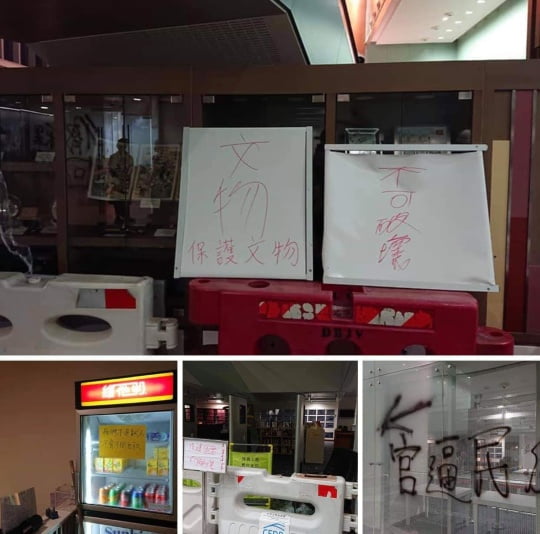
After a while, when we went back to the ante-chamber, there were four notes on the cupboard, which read “DO NOT DAMAGE”, and the items inside were totally unscathed. The same thing happened in the restaurant located on the foyer. Some of them took drinks from the fridge and left cash, careful to indicate with memos on the fridge that it was not a theft.

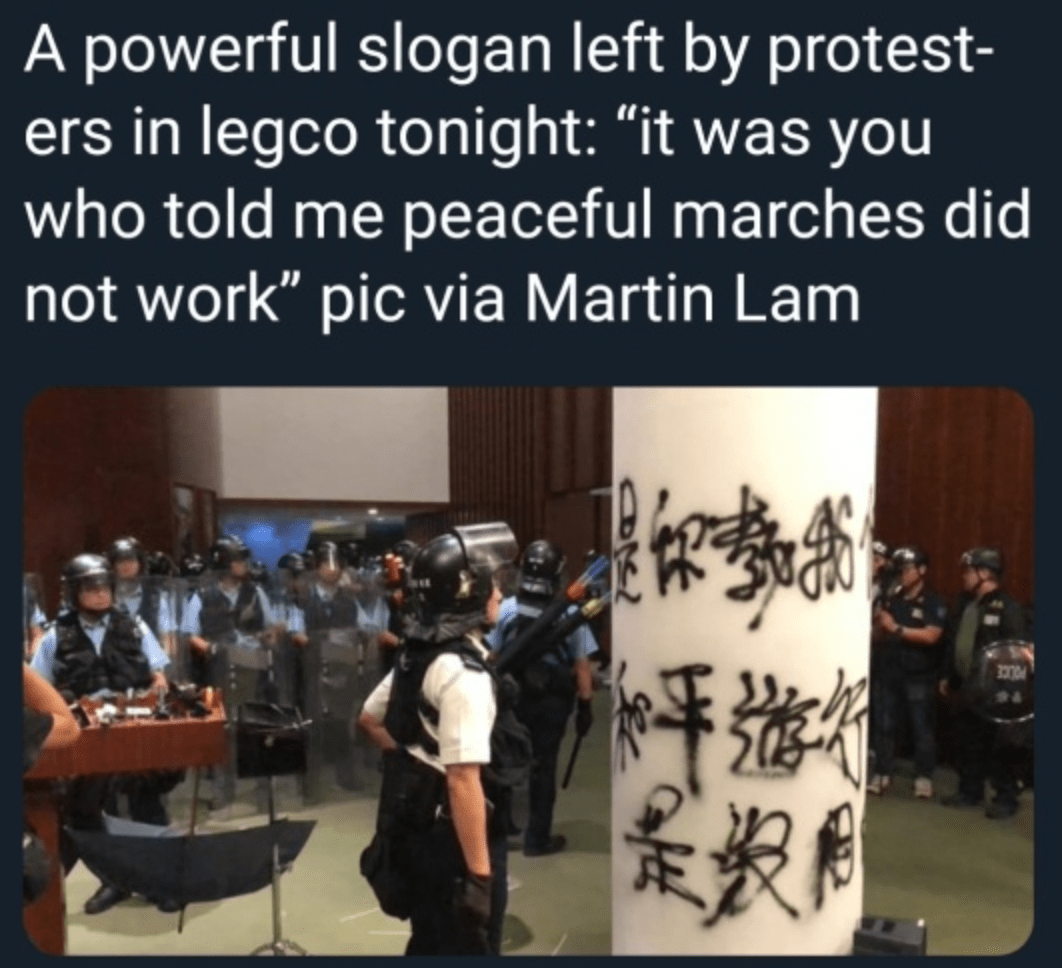
There was never a large crowd in the chamber—half of them were journalists, and some others were lawmakers. Fernando Cheung was there all night. And then it was what you see on the TV—graffiti, words in black spray paint. Outside the frame, someone dropped what appeared to be a metal plank, letting out a loud clang, but was immediately reminded “not to recklessly damage things”.

Amongst the portraits of LegCo Presidents, those of Andrew Leung, Jasper Tsang, and Rita Fan were taken down. Taking their places on the wall were the words of “YOU ASK FOR IT”. While the portraits Andrew Wong and John Joseph Swaine were, by some stroke of luck, left intact on the wall.

Deep into the night, debates and discussions on whether to leave or stay intensified. Pan-democrat legislators returned to the chamber, hoping to communicate with the young people there. The latter expressed clearly that they wanted to replicate Sunflower Movement, while others mentioned that they hoped the presence of lawmakers or other “adults” with certain leverage, who could stay with them and watch over them, would deter the police from taking disproportionate actions. They had indeed planned to occupy the chamber for an extended period of time at first, some even proposing setting up “scouts” and lines of supplies, or seeking help from “tech-saavy protesters who could operate the mics in the control room”.

They weren’t fearless. When someone shouted “the police are here” from the outside, they would panic and start running. After a while, when they realized it was a false alarm, they would start shouting “stay calm” and “don’t spread fake news” among themselves.

What really got the discussion going was a young man. Before that, there were already constant debates in the room on whether to leave or stay, but then this young man stood up and took off his mask. He yelled to the crowd things like, “We can’t afford to back down anymore”, “if we leave now, we are affirming CCTVB’s denunciation of us as ‘rioters'”, “we will be relentlessly hunted down and arrested; once we fall everyone will gloat”, “civil society will regress by 10 years”. He called for people to stay, while others applauded. When protesters reminded him to put his mask back on, he responded, “I took off my mask because there is nothing more to lose”.

But then shortly after this, there was a change of plans. Another young person spoke up, saying that help from prominent figures and lawmakers were vital to the Sunflower Movement, whereas the Hong Kong legislators here wouldn’t help them. “They care about their votes next year so much that there is no way they are going to help us”, “we’re the underdogs here, why should we sacrifice just so that they could capitalize on our moral appeal?” As this went on, another round of discussion kicked off. They had reached a certain level of consensus in the end, such as leaving after reading out the manifesto. But after reading out the manifesto, they drifted back to discussions, being extremely conflicted as to whether they should stay or leave.

The final decision was, 12 am would be the deadline for evacuation, as those at the frontline outside had negotiated with the police. Other than the several young people that insisted to stay, others would leave by then, while the frontline outside would buy them as much time as possible. Those who chose to stay gathered in front of President Podium and waited to be arrested. At that moment, it seemed that the dust had settled. Some of those who were prepared to get arrested took off their masks and were interviewed by the press.

But the discussion didn’t end here. They were still ongoing in the chamber, where someone proposed “If we leave, we leave together”; “we can’t leave them behind for the police”, while some said “I don’t care if this makes you think that I’m a ‘traitor’, but I’m going to say it anyway, why should we wait here to be arrested, why shouldn’t we leave”. Not only one but several young people started crying as they ask “why”.

Meanwhile, there were others coming in from outside LegCo, and there were reports saying that the cops were ready and people should leave. As crowds of protestors left, only those who braced themselves for the police remained.

The turning point came at around 10 minutes before 12am. Everyone thought this is going to be how things end, but all of a sudden, a dozen young people stormed into the chamber, chanting “we leave together, we leave together”. They grabbed those who had chosen to stay and dragged them out. StandNews’ live feed bore witness to this moment, in which one can hear the journalist asking several girls among the squad, “the 12am deadline is looming, aren’t you scared?” And the girls went, “all of us here are scared. But we have to get the four of them out, even if we’re scared because what we are more afraid of is not being able to see them again the next day”.

https://www.facebook.com/ThingsAtHongKong/videos/2147533238677447/

Although LegCo was cleared (only lawmakers and journalists remained), the police still behaved as if they were prepared for confrontation; I could smell the tear gas before I even left the building. Without goggles and face mask, I started coughing as I inhaled the gas. A girl who was retreating passed by and shoved a slice of lemon into my mouth (I didn’t know then that lemon could help one cope with tear gas).

The pan-democrats were present the whole time. When the police were clearing the scene, Roy Kwong was talking to the press in Harcourt Road, pleading the police not to go too far. Alvin Yeung was also in Admiralty Centre, helping to get people into the MTR station and leave. Au Nok Hin was running around with a loudspeaker…and some other pan-democrats were there, too.

The police cleared the scene with extreme restrained manner. They even asked if the journalists would like some water when they were pushed forward.

Above are my observations overnight. Are these young people rioters? Why did they charge? Had they acted wantonly or caused significant damage? You can decide for yourself.

But below is my take on this, which is totally subjective.

They have used force, damaged the building, and broken the law. But they had not caused wanton damage. All the damage they did was an expression of their deep dissatisfaction towards the norms, the establishment, and the regime. Many may say that they should not have done this because there were other alternatives. But to them, this was the last resort. Even if they never stop searching for a new way out, it’s only a matter of time before they could only turn to more perilous means. No one would ever storm into the LegCo Building for fun. People need to stop always accusing them of being incited. If you have ever listened to their discussions once, you’d realize they have really put thought into everything they did. They might be rough and imperfect ideas, but they were not easily manipulated by others either.

Before putting the blame on them, shouldn’t we first ask, why has a city that takes pride in being “civilized” driven a whole generation into the brink of mental collapse? Even deaths? Hope was slowly extinguishing before their eyes. They have done almost everything, from civil disobedience to forceful break-ins, even death for the cause. They have done what we as adults wouldn’t do or wouldn’t dare do.

But the regime stands unmoved and has shown no sign of mercy. It shuts its eyes to all their demands, knowing clearly that its unresponsiveness will only further anger the young people, pushing them towards more radical extremes. So when finally the young stormed into LegCo, and the government decided to issue a condemnation at 4am, to emphasize “the Rule of Law”, manipulate public opinion through mass media, and brand the young as rioters. What kind of regime is this, hiding behind a fig leaf called “the Rule of Law”? It knows that standing by idly and unleashing the police onto the young people will only end up in casualties and hatred on both sides, and yet it chooses to turn a blind eye to all this, using this deepening feud between the two as bargaining chips to prolong its stability. What kind of regime is this that exploits its peers and treats the future of our society like this?

For the young, freedoms, human rights, democracy, the Rule of Law, civil society, all these metaphysical values are, in reality, what they value as everything. Some would mock them, saying that they’ve buried their heads in books to the extent they’ve lost their minds. But please think further; every generation has its own unique pursuit. The last generation sought stable livelihoods and therefore worked frantically to improve their lives. This is a decent pursuit. But this is also exactly why, after the last generation’s hard work, when living conditions have improved tremendously, our children have embarked on the journey to seek ideals more than bread and butter. This is social progress.

Yet, they pursue these ideals in the face of merciless backlash from the last generation. The latter accuse the young of going onto the wrong path, as they fervently wish for the young to copy what they had done in their times to reach success. Isn’t this impending social progress?

On this night I honestly couldn’t see the young “rioting” (of course, the regime has also refrained from recklessly further defining the event). What I saw were simply kids willing to sacrifice themselves for the future of Hong Kong. They risked their careers. They didn’t go on trips or dates even though it’s summer, they chose to come out knowing that they might since then live forever in the shadow of being arrested, for they wish to defend what we as adults had failed to defend well. The means they resorted to might be immature and unrefined, sometimes reckless even…but whatever more mature means there are, they’ve already tried them. And we all bear witness to how effective it’s been.

As a 30-year-old, I am ashamed. We are supposed to protect our children, and yet now we are in their protection. They might be foul-mouthed, not gracious enough at times, and they might get into arguments when they see things they deem unjust. But this is because they really care. They really care about this place.

Lastly, to all the 30, 40, 50-year-old friends out there, before the young takes this city on as their responsibility, it should first be ours. The truth is, the society is largely run by the middle-aged and the elderly (just take a look at the ruling class). Can we promise ourselves? When the day comes that we take over this society, that we will not let it feed on our children any further?

Original: Kris Ching HKCnews.com
Translation: anonymous

Handover Anniversary Protest March – 1 July, 2019

It’s become a tradition to celebrate the handover of Hong Kong to China and the birth of the Hong Kong SAR on the 1 July with a march to raise awareness of freedom of speech, human rights etc.

A march of 500,00+ people, which closed both sides of Hennessy and Lockhart roads, is an impressive statement. Including the couple of hundred thousand already in Tamar Park and at Legco, this year’s Handover Protest was probably at least 5 times the average turnout.

But in truth, after the protest marches earlier in June when 1 million and 2 million + 1 respectively turned out to protest the extradition law. The Handover March felt small! There was space around you as you walked, the march rarely stopped and the pavements were empty.

It was a massive turnout – but sadly Chief Executive Carrie Lam (who boasted when accepting the job that she would listen to the people and resign if she felt they didn’t approve of her) has already shown that the only people she listens to and cares about are those Beijing.

https://bcmagazine.smugmug.com/Bcene-photos/2019/Handover-anniversary-protest-1-july-2019/n-7XvDvj/i-phLRQMm

https://bcmagazine.smugmug.com/Bcene-photos/2019/Handover-anniversary-protest-1-july-2019/n-7XvDvj/i-jxG58xD

https://bcmagazine.smugmug.com/Bcene-photos/2019/Handover-anniversary-protest-1-july-2019/n-7XvDvj/i-sGJxhtq

https://bcmagazine.smugmug.com/Bcene-photos/2019/Handover-anniversary-protest-1-july-2019/n-7XvDvj/i-S4wzPjP

Wanna One – ONE:THE WORLD

K-pop band Wanna One brought their <ONE:THE WORLD> tour to a packed AsiaExpo on the 29 July. The eleven piece band – Kang Daniel, Park Ji-hoon, Lee Dae-hwi, Kim Jae-hwan, Ong Seong-wu, Park Woo-jin, Lai Kuan-lin, Yoon Ji-sung, Hwang Min-hyun, Bae Jin-young and Ha Sung-woon – created via the Produce 101 TV show debuted in 2017 and kept a passionate audience happy with hits and a snappy show.

https://bcmagazine.smugmug.com/Bcene-photos/2018/Wanna-One-World-Tour-2018/i-Xbc2CVH

https://bcmagazine.smugmug.com/Bcene-photos/2018/Wanna-One-World-Tour-2018/i-KfvWfWN

https://bcmagazine.smugmug.com/Bcene-photos/2018/Wanna-One-World-Tour-2018/i-BX5zsft