Hongkong Post today (22 August) announced that all post offices will resume their normal business hours starting from 24 August 2020.
Mail collection from posting boxes and mail delivery service (including that for Speedpost items) will also resume.
For buildings with confirmed COVID-19 cases within the past 14 days, delivery to the letterboxes in lobbies will be three times a week, but door delivery service will remain suspended until the building concerned is removed from the list of buildings with confirmed cases within the past 14 days.
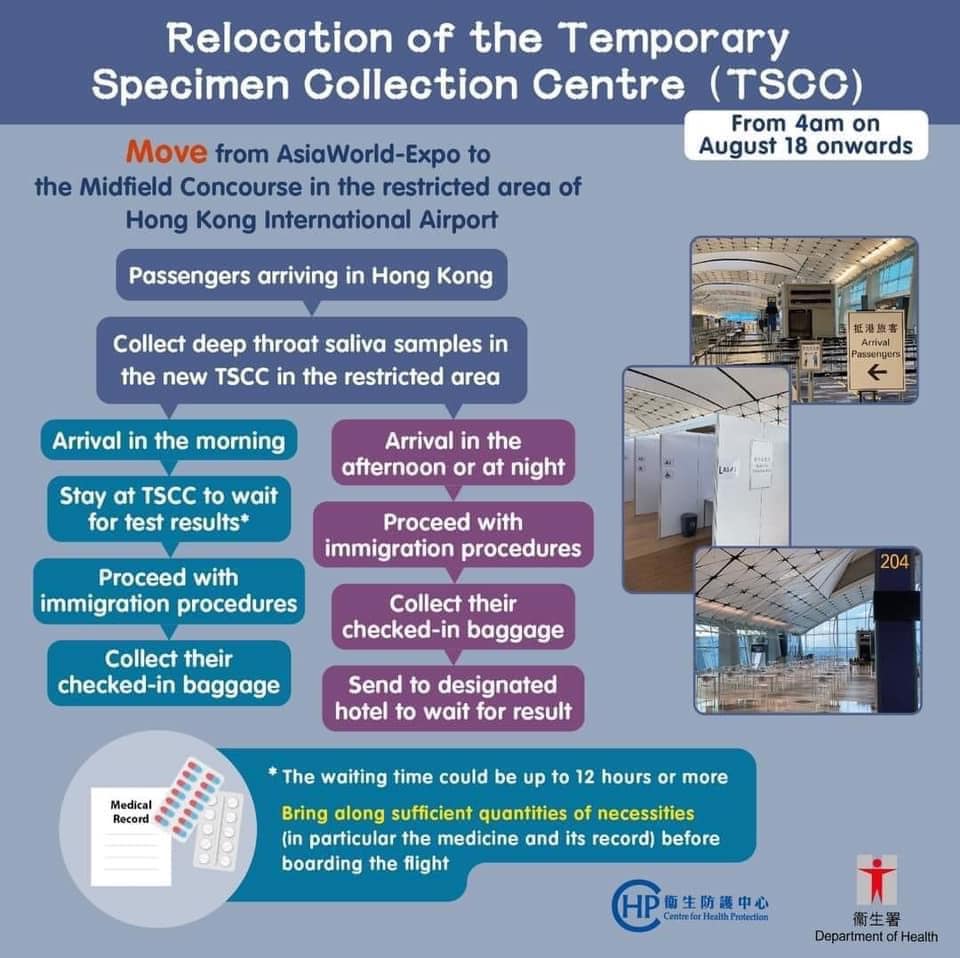
As from the 18 August 2020, arrivals at Chek Lap Kok will undergo Wuhan virus testing inside the airport before passing through immigration.
No information has yet been provided from the Centre of Health Protection as to whether those testing positive will be allowed to enter Hong Kong.
For information and personal experiences of the testing procedure and lots of information about quarantining in Hong Kong check out the excellent and informative facebook group: HK Quarantine support group
Note: Information, flight requirements and procedures change regularly so check the CHP website before flying.
Since the anti-extradition bill protests began last year, Hong Kong protesters have evolved quickly by learning from experiences elsewhere. For example, they dressed in the style of the black bloc, which originated in Germany, shouted slogans from their apartment windows at night, following Iranians’ tactics in protests against a curfew, and formed grand human chains, paying homage to the “Baltic Way.”
Yet, in addition to multifarious techniques which bring hope to success, it is no less important to learn from the depressing facts about how hard tomorrow can be.
Life cannot be more insulting than when free expression becomes a criminal act. Hong Kong officially entered the age of insult this year.
Thousands of kilometers away in a secluded square, there stands a world-famous wall, which has witnessed the rise and fall of totalitarianism, and displays the traces of resistant will…
Originally published in the Taipei Times 23 July, 2020. Continue reading the full article by Chu Ming-hon here
“Up until now, the biggest difference between being a journalist in Hong Kong and mainland China was that there is such a thing called ‘illegal news coverage’ in the mainland while covering the news in Hong Kong had always been a right,” said Eric Poon, associate professor of practice at the School of Journalism and Communication at the Chinese University of Hong Kong and a former producer of [RTHK’s] Hong Kong Connection, which has been covering news in mainland China for many years.
During its colonial era, Hong Kong enjoyed a relatively free and open environment. After its transfer of sovereignty in 1997, Hongkongers remained protected by the Basic Law. Hong Kong reporters have continually relied on this special identity to travel all over China and report the changes occurring within to the outside world. Many Hong Kong journalists who cover mainland news said that even if they encountered dangers locally, they felt a sense of relief once they had crossed the Shenzhen River.
Times have changed. After the implementation of the national security law in Hong Kong, there does not seem to be much difference between the two sides of Shenzhen River. Is there still space for Hong Kong media to cover news? What risks must journalists bear in the future?
Stand News interviewed multiple senior correspondents in China as well as former journalists. Some believe that the current situation has become more desperate than the Tiananmen Square Massacre but still want to wait and see in hopes of dancing on the proverbial knife’s edge. Some remind the reporters not to self-censor and to better equip themselves to keep reporting. Others candidly express that fear is pointless as it is “impossible to know where the line is drawn. You may as well continue as before and do what we know well.”
Bottom Line: Don’t be Reduced to a Political Propaganda Mouthpiece
On 21 May, the National People’s Congress (NPC) announced the authorisation of the NPC’s Standing Committee (NPCSC) to enact the Hong Kong national security law. The sky that afternoon was as dark as the night in Beijing. Torrential rain, thunderstorms and even hail hit the city. Severe thunderstorms also befell Hong Kong that day. K (alias), a veteran correspondent in China, was at his Hong Kong office at the time. He felt nothing when he heard the news and only wondered why there was a single vote against the motion. “Actually, with the Anti-ELAB movement last year and the CCP’s [Chinese Communist Party] Fourth Plenum on top of that, it’s expected.”
Well-versed on China’s political climate, K was well aware that, under these circumstances, the Hong Kong national security law was just an interlude that would occur sooner or later. “Stuck in the same sinking boat, Hong Kong will definitely be destroyed. Ever since China became ‘powerful’, it’s obvious that this trend would appear… So it wants a [Chinese] Communist Revolution, how can Hong Kong be tolerated? What’s more terrifying is that the Communist Revolution previously tolerated Hong Kong because it was poor and had no money. Now that the nation’s power has grown, this kind of stuff is even more frightening than before.”
K started his career right at the beginning of China’s Reform and Opening. He covered news on the special economic zones, experienced Deng Xiaoping’s economic reform, witnessed the drafting of the [Hong Kong] Basic Law and the Tiananmen Square Massacre. Until Hu Jintao and Wen Jiabao took power, China’s trajectory seemed to be heading towards democracy and freedom. Who knew that the rise of Xi Jinping in 2012 would lead to an abrupt turn for the worse? K laments over how the current situation has become more “desperate” than 4 June 1989, “Now that he took power and tells everyone to learn the Communist Manifesto… you know you’re going to die. It is totally in the style of fundamentalist Soviet communism.”
K also points out that journalists on assignment in China have always seen Hong Kong as a “safe haven”. They believe they have greater freedom of the press under the protection of Hong Kong’s legal system. “If you overstep (the mainland’s red line) and are charged [with a crime], you may feel safer in Hong Kong. But once the HKSAR government implements (the national security law), even Hong Kong will not make you feel safe.”
K, who works at the management level, says that his colleagues have genuine concerns about the national security law but problems with their assignments have yet to arise. He thinks that journalists have to take their personal safety into account while working. The enactment of the Hong Kong national security law, he believes, must have caused a “chilling effect” in the local media. “Is Taiwanese news off-limits? Is news about the [Taiwanese] Democratic Progressive Party off-limits? Are Xinjiang’s re-education camps and the rift over Tibet off limits?”
“I won’t set a limit. If it must be like that, I would rather not work.”
K makes it clear that his bottom line is not to speak against his own conscience and become reduced to a political propaganda mouthpiece. “It gets depressing at times. Being this far set back, I might not think about how to report more news at all, but how to speak with a clear conscience. It’s not just about being a journalist. It’s about basic human principles. Otherwise, why not become someone else’s publicity tool?”
He also points out that journalists are used to be able to contact East Turkestan independence movement organisations or supporters of Tibet and the Dalai Lama for the latest local news. Even though details with respect to anti-sedition laws were not yet introduced at the time the national security law was enacted, he is still concerned about overstepping the red line. “These kinds of cases touch on ‘subversion’ and ‘secession’ crimes. Like the crime of ‘picking quarrels and provoking trouble’ (see note 1), it can be extended indefinitely. Often, the decision to prosecute is based on politics.” He also uses the live broadcast Liu Xiaobo’s memorial service in mainland as an example. K admits that broadcasting sensitive material in Hong Kong may one day transgress the red line.
During Ching Cheong’s imprisonment, legal professionals in Hong Kong gathered to proclaim that his case was unjustified. From the right: Johannes Chan, Ong Yew-kim (Chinese legal expert), Priscilla Leung. (Photo source: My 1000-day Ordeal ─ A Spiritual Journey by Ching Cheong)
As for the situation in mainland, many actions that should not qualify as “subversion of state power” still end up being tried as such. “Do you believe that the 709 (crackdown)(see note 2) was [related to] subversion?” K asks rhetorically. As part of the crackdown, human rights lawyer Wang Quanzhang was sentenced to more than four years in prison for “subversion of state power”. Afterwards, the agency that K worked for would frequently send reporters to accompany Li Wenzu, Wang’s wife, during prison visits. Each time, they had to talk about how to coordinate. “In the eyes (of the government), we are likely one of them so the line is extremely blurred, especially in the mainland.”
Journalists reporting in mainland were arrested and imprisoned in China in the past, like Ming Pao reporter Xi Yang. He was convicted of “spying and stealing state secrets” in 1994 and was sentenced to 12 years in prison. In 1997, he was released on parole. The Straits Times correspondent in China, Ching Cheong, was charged with espionage at the beginning of 2005 after obtaining a manuscript of interviews with the late Zhao Ziyang. He was sentenced to 5 years in prison and was released in 2008. K reflects on his profession of having to jump through hoops over many years. This time, there are no previous cases for reference [under the Hong Kong national security law]. “You can only refer to fellow colleagues in the mainland. They were either arrested, fled or dead.”
K is not afraid to say that the worst-case scenario is that the news organisation where he is employed will “close up” but he speculates that, at least at the beginning of the implementation [of the national security law], there would be little impact on reporters’ news coverage. He likens news assignments in China to “dancing on the edge of a knife” and “walking on a tightrope”. Now that the “safe haven” of Hong Kong is on the verge of shutting down, reporters must change tack and carefully explore the limited space in which they can report. “Now that the blade is thinner and the tightrope is sharper, you have to choreograph a new dance and think about how to walk the tightrope, unless you no longer work. But if you do, you will have to explore new ways. This is a totally new situation that I’ve never encountered in my decades of work.”
Eric Poon – Stand News
Professionals: Be Water, Be Versatile
Eric Poon was a senior producer of Hong Kong Connection who frequently travelled back and forth to mainland to film sensitive livelihood and political issues, documenting the social changes between Hong Kong and mainland. At the end of 2012, he left RTHK for the Chinese University of Hong Kong. He currently works as an associate professor of practice at its School of Journalism and Communication.
In the 1980s, the Sino-British negotiations on the future of Hong Kong opened the door for the journalists in Hong Kong to gather news from the mainland. More often than not, they represented Hongkongers in raising questions about the future of the city with government dignitaries. Such questions were only made possible by the “protective talisman” that was their “foreign correspondent” status.
Deng Xiaoping’s southern tour uncovered the prelude to China’s economic reform. Poon went to Shenzhen, Shekou and other special economic zones to report about Hong Kong businesses investing in mainland factories and the livelihood stories between the two places. Considered “illegal news coverage” without official approval by the mainland officials, his many years of entry to mainland to gather stories required formal applications with the Hong Kong Liason Office (i.e. Xinhua News Agency at the time). These applications provided heavy-duty protection if fault was found and allowed him to explore all avenues of reportage. During the era of Jiang Zemin and the Hu-Wen administration, China was relatively relaxed about media coverage. “They weren’t completely rigid. Sometimes, they (government officials) would say, ‘right now is not good, don’t come over yet’… Around the time of June Fourth (anniversary), there’s no point in applying to report in Beijing because everyone knows what you’re trying to do… The internal dynamic is: if you don’t cause trouble, I won’t cause trouble either.”
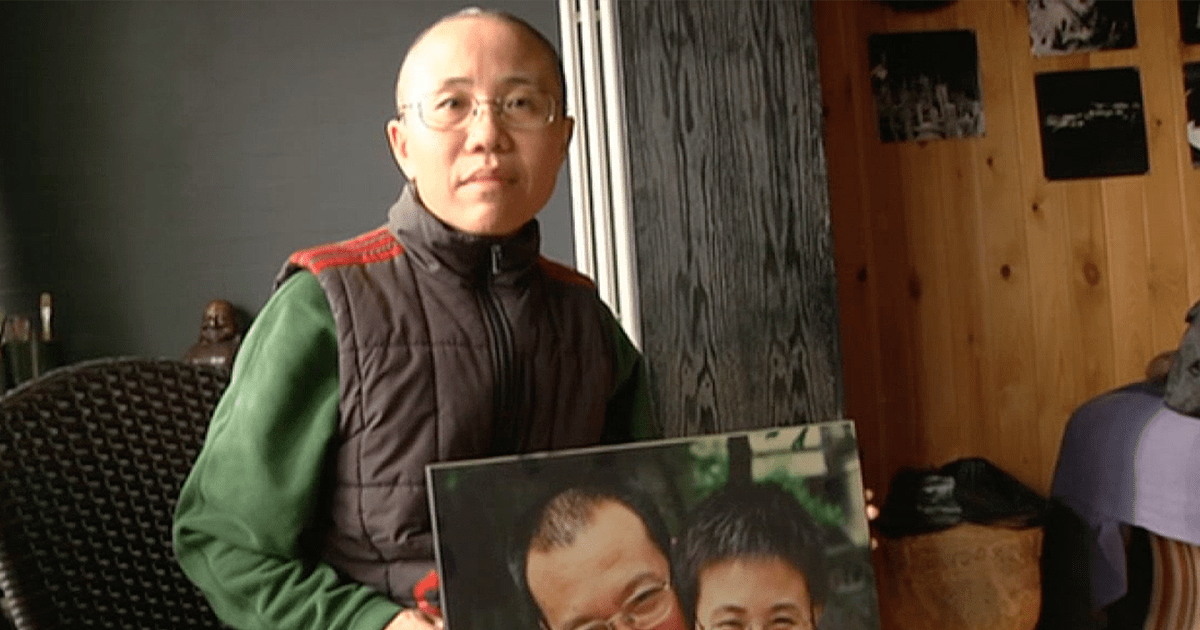
Liu Xia, photo source: DW video still frame
In addition to people’s livelihood stories, Poon often covered politically sensitive topics in the mainland under very narrow restrictions. An example was the jailed 2010 Nobel Peace Prize laureate, Liu Xiaobo, and his wife, Liu Xia, who was placed under house arrest. Poon looked for a middle-man to make contact, but they evidently had no opportunity to reach Liu Xia. When asked about the educated dissident, Chen Ziming, they said there was “a tiny bit” of manoeuvrability. Based on these words, Poon headed straight for the mainland. He successfully avoided public security and weaselled his way into interviewing Chen Ziming, Guo Yushan, Zeng Jinyan and other dissidents. Poon’s record of the events went on to win the Hong Kong Journalists Association’s Human Rights Award; the news boosted the morale of dissident circles.
Poon doubts that “foreign correspondents” would retain their protections after the implementation of Hong Kong national security law. “When (the CCP) increasingly emphasises ‘one country’, you’re no longer a ‘foreign correspondent’ but a regular journalist under ‘one country’.
“Are your actions now considered ‘picking quarrels and provoking trouble’? Will I get screwed over for ‘inciting subversion of state power’ through the national security law? … A dreadful question of this day and age is whether or not this type of interviews are still possible in the mainland.”
He advises reporters in Hong Kong not to limit themselves first. “Self-censorship works. The point is to make you guess the rules of the game. It’s like a boss who doesn’t clearly specify what you’re not allowed to do and just says, ‘Be careful. Sometimes you need to be wary to keep your job.’ If you have to pay rent, you’re going to start guessing: what you can do, what you can’t do… naturally, you’ll end up doing more work.”
Poon describes that common sense, professionalism and ethical values have become distorted in this era. Reporters need to “be water” and become more versatile in response. Besides raising reportage quality, preserving independent thought and investigation work, he makes some other suggestions, “For example, build your social capital or join forces with your peers. ‘Be water’ is all about that.” The goal is to stand firm our ground and keep reporting.
When the situation takes a turn for the worse, each person will need to reflect on their bottom line in the end. “It seems that we have quite literally experienced what Yin Haiguang described in [his book] The Meaning of Life. Each person needs to contemplate… the situation in Hong Kong, its sense of helplessness is far beyond my imagination. I have never seen this before.”
Forbidden Areas: Political Leaders’ Privacy, Military Affairs, Economic Insider Knowledge
Jack (alias), a former senior Chinese division journalist, has been covering news all over China for more over a decade. He describes that many of the red lines reporters cross tend to be “unexpected”. For instance, reporting national statistical figures can violate the National Security Law at any time. An example is when Le Keqiang mentioned that the “monthly income of 600 million people was barely a thousand yuan” at the Chinese People’s Political Consultative Conference. This information had the potential to draw associations with the CCP’s internal discord. Should a reporter document this? “The band-tightening sutra(see note 3) will invariably get tighter.”
He indicates that for the owners of mainstream media organisations or businesses are their primary concern. If relatively sensitive news – like the Panama Papers from a few years ago – reappear, he fears that opportunities to report will drastically decrease after the law’s enactment. “After its legislation, journalists will have much to take into consideration. If you want to fulfil your duty as a journalist, a knife will be on your neck for a long time. They’ll make a few cuts whenever they want.”
The national security law does not even have to directly harass journalists. Interviewees and relevant figures can be targeted to indirectly obstruct the interview. As an example, when interviewing for the case of Li Wangyang, “they didn’t bother the reporter, but those beside him [Li]. They dragged them to sit on tiger chairs(see note 4). Didn’t this affect the news collected?” Another instance was when the news agency Jack worked for live-broadcasted Liu Xiaobo’s burial at sea after his passing in 2017. Afterwards, at least 13 people were arrested in the mainland. Did this overstep the red line of “national security”? It was never specified.
Jack believes that after the implementation of the national security law, amongst the forbidden areas the most important to the media will primarily be political leaders and their privacy followed by China’s military affairs and economic insider knowledge. In his eyes, the Causeway Bay Books incident had trodden on the “red line”. “The privacy of political leaders and matters concerning their family members overseas have become an issue of national security because it involves contradictions within the party and stability within the regime. The stability of the regime is national security.”
Jack laments that journalists in Hong Kong will soon suffer the same fate as the human rights lawyers in mainland, “dancing with shackles on their feet”. “If (the CCP) forces you to dance, you must dance within these confines.” He predicts that the substance of the news in Hong Kong will diminish over time. In particular, the amount of news involving political figures, commercial bigwigs and collusion between the government and businesses will dwindle. Even investigative reports will decrease, “like Lantau Tomorrow [Vision], which involves Chinese-funded institutions among which are some powerful insiders. Are you going to report that? And if you do, you may implicate yourself in the national security law.”
When the Hong Kong national security law comes into effect, what advice does Jack have for currently employed and student reporters? He stresses the importance of following one’s conscience to do as much as possible. “In these dark times when even the candle is dim, the most important thing is to not let its fire go out. Eventually, you will see the end of the tunnel. The global situation has changed beyond our imaginations. We are facing the world’s biggest challenge since World War II. Compared with the Soviet’s 1991 August Coup and the Revolutions of 1989, this is a much more significant juncture… In this tiny place that is Hong Kong, each reporter must do all they can to not let this feeble flame extinguish.”
In the past two or three decades, Hong Kong served as a major “window” into thornier news subjects on the mainland. Jack mentions that the era of the national security law could see Hong Kong journalists assimilating and becoming more like their mainland counterparts. They would essentially export the news – gathered anonymously and passed on to foreign agencies or foreign media to release. “Exclusivity is no longer a priority for the media with a strong sense of duty and for those journalists who are in pursuit of justice. Freedom of the press is about right or wrong and exclusivity is no longer relevant.”
Frame of Mind: Pessimistic, but Persevering in One’s Duty to Report
Alvaro (alias) is a mainlander and has been working in the Hong Kong media industry for five years as a journalist in the mainland Chinese division. He remarks that China has prioritised its safety over everything else. Ever since Xi Jinping rose to power at the 18th National Congress, there was a definite shift in the CCP’s foreign policy on Taiwan and even their hands-off approach to Hong Kong. Add that to the Anti-ELAB movement last year and the appointment of Xia Baolong, as well as the overhaul of high ranking officials in the Hong Kong Liason Office and the Hong Kong and Macau Affairs Office, there was actually a lot of foreshadowing leading up to the national security law.
He believes that the remediation of Hong Kong is just the first step; Taiwan is next in line. “China has clearly become more politically restrictive in the past few years. They can’t tolerate the type of street protests and political expression seen in Hong Kong… They’re making it explicit: Hong Kong is a Special Administrative Region under one country. It holds no special privilege, especially in politics.”
In his view, the attitude behind the CCP’s heavy-handed mandate of the national security law is to suppress Hong Kong. The “harshness” of its written words is not as important. “The way the provisions is written won’t change the CCP’s relentless pursuit for total control and the destruction of ‘one country, two systems’.” The CCP never follows its own rules, in any case. Even if the law is written to agree with Basic Law and human rights protections, they can still interpret or re-write it to meet their needs… Don’t forget that Beijing’s legislators and political leaders never keep their promises.”
Alvaro is blunt about his pessimism towards the age of the national security law because the regime’s way of suppressing human rights activists and lawyers may have nothing to do with the national security law. Majority of the charges pertain to “tax evasion, unlawful business operations” and other types of financial crimes. Since its legislation, he believes that even if the exposure of Hong Kong’s dark side and injustices is not politically motivated, the authorities will still deem such action as “antagonistic” to allow for its suppression. Pan-democrats and localists will likely be targeted first, followed by the legal community and the media.
Alvaro points out that society in Hong Kong is used to being open and free. Its correspondents in China know “the state of the country” better than its Western counterparts. The news in Hong Kong on China has always been an important “window” that allows the West to peer into the nation’s changes. Although there has yet been any tangible impact, this special role has already turned to dust.
He also indicates that the media in mainland has been wilfully reporting and commentating on the Anti-ELAB movement as it was happening, essentially clamouring for attention. With the termination of RTHK’s show, Headliner, he holds a bleak view of the future of Hong Kong’s media. “The CCP keeps a close eye on dominant discourses… it will not (take action) overnight, but gradually infiltrate.”
As he frequently shuttles between Hong Kong and mainland to gather news, Alvaro stresses that he could not reveal too much detail to protect the safety of his fixers and interviewees as well as his family and himself. However, he does mention that he has been beaten up, stalked, monitored and deprived of his personal freedoms while working in the mainland. The people responsible were not necessarily part of national security. Sometimes, they did not wear uniforms or show their credentials. They would only verbally claim to be the police, making it difficult to verify their identities. He also encountered situations where the interviewee or fixer was arrested for agreeing to work with him. Cyberattacks, telephone bugging, location tracking and other surveillance methods have occurred countless times.
Even with these experiences, Alvaro underscores that the CCP never talks about rules. Even if reporters censor themselves in fear of the national security law, it would not make the media any safer. “The CCP has always seen it as them versus us; there are no nuances.” He feels that in the face of the regime, journalists should uphold professionalism and not shrink back in fear.
However, he has a bottom line as well – if his family members in mainland get harassed, he will consider changing his line of work. “There’s no other way. I still have to work and can’t think too much, but I also know I need to protect myself… I must mentally prepare for the worst. But worrying alone doesn’t do anything because you still have no way of knowing where the red line is drawn. Fear will only tie you down. It’s not the same as before. Just keep doing your work well.”
Source: Stand News, July 2020 read the original article in Chinese here
Note 1: Picking quarrels and provoking trouble is a crime under the law of the People’s Republic of China and carries a maximum sentence of five years. As this is an ill-defined crime, it has frequently been used as an excuse to arrest human rights activists, civil rights activists, and lawyers in China, and hold them in detention pending more serious charges such as inciting subversion of state power.
Note 2: The 709 crackdown was a nationwide crackdown on Chinese lawyers and human rights activists that began on 9 July 2015.
Note 3: The band-tightening sutra is in reference to how Tang Sanzang disciplined Sun Wukong with a tightening headband in the Chinese classic, Journey to the West.
Note 4: A tiger chair is a torture device used in Chinese prisons.
The Implementation Rules for Article 43 of the Law of the People’s Republic of China on Safeguarding National Security in the Hong Kong Special Administrative Region (Implementation Rules) were gazetted 6 July and will take effect on 7 July 2020.
The Implementation Rules have the force of law, and details are as follows:
1. Search of Places for Evidence
The relevant rules are formulated with reference to various existing ordinances regarding the permission to conduct urgent search under exceptional circumstances, including the Firearms and Ammunition Ordinance (Cap. 238) and the Import and Export Ordinance (Cap. 60). For investigation of an offence endangering national security, a police officer may apply to a magistrate for a warrant to enter and search a place for evidence. Under exceptional circumstances (for instance, in urgent situations), a police officer not below the rank of Assistant Commissioner of Police may authorise his officers to enter the relevant place to search for evidence without a warrant.
2. Restriction on Persons under Investigation from Leaving Hong Kong
With reference to provisions under the Prevention of Bribery Ordinance (Cap. 201) which restrict a person under investigation from leaving Hong Kong, the rules authorise police officers to apply to a magistrate for a warrant to require a person who is suspected to have committed offences endangering national security to surrender his travel document, and to restrict that person from leaving Hong Kong, lest some of the persons involved in the case abscond overseas. A person who has surrendered a travel document may make application in writing to the Commissioner of Police or to a magistrate for its return and for permission to leave Hong Kong.
3. Freezing, Restraint, Confiscation and Forfeiture of Property Related to Offences Endangering National Security
The arrangements concerned are formulated with reference to the existing powers and provisions under the Organized and Serious Crimes Ordinance (Cap. 455) and the United Nations (Anti-Terrorism Measures) Ordinance (Cap. 575). If the Secretary for Security has reasonable grounds to suspect that any property is property related to an offence endangering national security, he may, by notice in writing, direct that a person must not deal with the property. The Court of First Instance may, on the application by the Secretary for Justice, order the confiscation of the property related to the offence. Anyone who knows or suspects that any property is property related to an offence endangering national security is obliged to make a disclosure to the Police Force as soon as is reasonably practicable, and must not disclose to another person any information which is likely to prejudice any investigation which might be conducted following that first-mentioned disclosure. In addition, the Secretary for Justice may make an application to the Court of First Instance for a restraint order or charging order to prohibit any person from dealing with any realisable property, or impose on any realisable property that is specified in the order a charge for securing the payment of money to the Government. Furthermore, the Secretary for Justice may also make an application to the court for confiscating the proceeds arising from an offence endangering national security and ordering the amount due be paid within a fixed period.
4. Removal of Messages Endangering National Security and Request for Assistance
If the Commissioner of Police has reasonable grounds to suspect that an electronic message published on an electronic platform is likely to constitute an offence endangering national security or is likely to cause the occurrence of an offence endangering national security, he may, with the approval of the Secretary for Security, authorise a designated police officer to request the relevant message publisher(s), platform service provider(s), hosting service provider(s) and/or network service provider(s) to remove the message; restrict or cease access by any person to the message; or restrict or cease access by any person to the platform or its relevant part(s). It is a reasonable defence if the technology necessary for complying with the requirement was not reasonably available to the publisher or relevant service provider; or there was a risk of incurring substantial loss to, or otherwise substantially prejudicing the right of, a third party.
If the publisher fails to cooperate immediately, and the relevant information on the Internet will continue to seriously affect members of the public, police officers may apply to the magistrate for a warrant to seize the relevant electronic device and take any action for removing that information as soon as practicable. Relevant officers may also apply to the magistrate for a warrant under specific circumstances to authorise police officers to request the relevant service provider to provide the identification record or decryption assistance as the case requires.
5. Requiring Foreign and Taiwan Political Organisations and Agents to Provide Information on Activities Concerning Hong Kong
If the Commissioner of Police reasonably believes that it is necessary for the prevention and investigation of an offence endangering national security, the Commissioner of Police may, with the approval of the Secretary for Security, by written notice served on a foreign political organisation or Taiwan political organisation, or a foreign agent or a Taiwan agent, require the organisation or agent to provide the Commissioner of Police with the prescribed information (including the activities, the personal particulars, as well as the assets, income, sources of income, and expenditure of the organisation in Hong Kong) in a prescribed manner within the specified period. The relevant rules are formulated with reference to the prevailing provisions of the Societies Ordinance (Cap. 151) under which Societies Officers may request the provision of information from societies.
6. Application on Authorisation for Interception of Communications and Covert Surveillance
To effectively prevent and detect offences endangering national security and protect the confidentiality of information related to national security, all applications for interception of communications and covert surveillance operations must be approved by the Chief Executive. Applications for the less intrusive covert surveillance may be made to a directorate officer of the Police Force designated by the Chief Executive. The authorising authority has to ensure that the covert operation concerned satisfies the proportionality and necessity tests before granting the authorisation. According to Article 43 of the National Security Law, the National Security Committee shall be responsible for supervising the implementation of the stipulated measures by the Police Force. On the other hand, the Implementation Rules provide that the Chief Executive may appoint an independent person to assist the National Security Committee in performing the aforementioned supervising responsibility. Furthermore, the Secretary for Security issues Operating Principles and Guidelines for the purpose of providing operating principles and guidance to officers of the HKPF regarding the making of relevant applications and the exercise of powers. Officers of the HKPF are required to comply with the provisions in the Operating Principles and Guidelines when performing any function under the relevant rules. The Operating Principles and Guidelines will be gazetted at the same time with the Implementation Rules.
7. Requirement to Furnish Information and Produce Materials
For the purpose of assisting an investigation into an offence endangering national security or the proceeds obtained with the commission of the relevant offence, the Secretary for Justice or police officers may apply to the court for an order to require the person concerned to answer questions within a specified time period, or to furnish or produce the relevant information or material. The provisions are formulated with reference to the relevant powers and provisions under the Organized and Serious Crimes Ordinance (Cap. 455) and the United Nations (Anti-Terrorism Measures) Ordinance (Cap. 575) currently.
Penalties
To ensure the effective implementation of the above relevant measures, there is also a need to provide in the Implementation Rules relevant penalties for contravention of the requirements.
For instance:
If a person who published a message fails to comply with the requirement of the police to remove the message endangering national security without reasonable excuse, the person is liable on conviction to a fine of $100,000 and to imprisonment for one year.
If a service provider fails to comply with the requirement to remove messages endangering national security, or to restrict or cease access to messages or platforms, or the request to provide assistance, the service provider is liable on conviction to a fine of $100,000 and to imprisonment for six months.
Furthermore, a foreign political organisation or Taiwan political organisation, or a foreign agent or a Taiwan agent, who fails to provide information as requested by the Police is liable on conviction to a fine of $100,000 and to imprisonment for six months unless it can prove that it has exercised due diligence and there have been reasons beyond its control.
If any information provided is false, incorrect, or incomplete, the person who provided the information is liable on conviction to a fine of $100,000 and to imprisonment for two years, unless the person has grounds to believe that the relevant information was true, correct and complete.
As for other items, the relevant offences and defence (if specified) are largely the same as the existing provisions in the laws that the Implementation Rules have made reference to.
The provision of defence provisions under appropriate circumstances provide appropriate defence for people who fail to comply with the requirements.
The above Implementation Rules are in compliance with the requirements concerned under the National Security Law and the Basic Law, including the requirements concerning the respect and protection of human rights.
Updated with the official translation 00:12, 7 July, which can be read here
Statement of the Hong Kong Bar Association:
The Law of the People’s Republic of China (“PRC”) on Safeguarding National Security in the Hong Kong Special Administrative Region (“HKSAR”)
1. The Law of the PRC on Safeguarding National Security in the HKSAR (“NSL”) was endorsed and adopted in the Mainland on 30 June 2020 and then promulgated by the Chief Executive so as to come into force in the HKSAR at 11 pm on the same day. The Hong Kong Bar Association is gravely concerned with both the contents of the NSL and the manner of its introduction.
2. Nobody in the HKSAR had seen so much as a draft or accurate summary of the NSL before its entry into force. In addition to the total absence of meaningful consultation, lawyers, judges, police and Hong Kong residents were given no opportunity to familiarise themselves with the contents of the new law, including the serious criminal offences it creates, before it came into force.
3. The NSL has so far only been published in Chinese language, rendering its contents inaccessible to many interested stakeholders. The omission of a contemporaneous authentic English version of the law is unusual given that a bilingual legal system operates in Hong Kong.
4. The NSL is a national law adopted under the Constitution of the People’s Republic of China (“PRC”) and the Basic Law. As stated in the instrument of promulgation signed by the Chief Executive, the NSL has been applied in Hong Kong under Article 18 of the Basic Law. The choice of this procedure, rather than any amendment to the Basic Law under Article 159, indicates that the Basic Law continues to operate with full force and effect. Yet the NSL contains numerous provisions that appear to be inconsistent with the provisions of the Basic Law.
5. Article 62 of the NSL states that the NSL shall prevail in the event of any inconsistency with the “local laws of the HKSAR”. This would appear to embrace all Hong Kong Ordinances, including the Hong Kong Bill of Rights Ordinance (Cap. 383), the function of which is to implement the International Covenant on Civil and Political Rights. The Basic Law itself, however, is a national law adopted by the National People’s Congress (“NPC”) under the PRC Constitution. It should be assumed that the NSL will be applied in a manner that is fully consistent with the Basic Law. How this is to be achieved, given the apparent inconsistencies between the NSL and the constitutional guarantees laid down in the Basic Law, is a matter that needs urgently to be addressed by the HKSAR Government.
6. It is incumbent upon the Chief Executive, who says that she was also in the dark about details of the law until yesterday, to clearly, fully and quickly explain to the general public how she sees the NSL working and what areas of life it may encroach upon.
7. A thorough study of the new law is needed to see how it may work and what effect it will have on existing laws and the justice system. However, the following issues and Articles of the NSL are of particular concern and it is right to address them now, albeit provisionally.
8. Where the central authorities decide to exercise jurisdiction in a given case, suspects can be removed to face trial in Mainland China. This is not extradition (where a person is removed to face trial for an offence in the receiving jurisdiction), and the usual judicial controls over extraditions appear not to apply. Mainland criminal procedures will be applied in such cases, in accordance with Articles 55-57, and this raises concern as to whether the rights of the accused to fair trial will be adequately protected or respected.
9. The power of interpretation is vested in the Standing Committee of the NPC. This has the potential to undercut the independent exercise of judicial power by the Courts of the Region (Articles 80 and 85 of the Basic Law).
10. The independence of the judiciary is undermined. The Chief Executive designates a list of approved judges for national security cases (Article 44). Appointment is on a yearly basis. Judges chosen by the executive can be removed from the list if their words or deeds endanger national security (Article 44).
11. Some people are held out to be above the reach of local law. The personnel of the Mainland National Security Agency (“NSA”) are meant to perform duties in accordance with law and not infringe the rights and interests of people and other organizations (Article 50), but the conduct of NSA and its personnel in the execution of their duties in accordance with law is not subject to local jurisdiction (Article 60).
12. The Special National Security Police Unit (“Special NS Unit”) is meant to apply the current law in carrying out its duties (Article 43), but then it enjoys a range of powers that go beyond those available under the existing laws (Article 43). Judicial control over covert surveillance is removed.
13. There is a reversal of presumption of bail (Article 42). The provision of mandatory minimum sentences strips away judicial discretion in sentencing. The right to trial by jury can be taken away by the Secretary for Justice on certain grounds without any residual discretion in this regard being left with the Courts of the HKSAR (Article 46).
14. The newly established National Security Council is said to be exempt from judicial review (Article 14).
15. Four groups of criminal offences are created. These are widely drawn and absent a clear and comprehensive array of publicly accessible guidelines and basic safeguards as to legal certainty and fair treatment, are capable of being applied in a manner that is arbitrary, and that disproportionately interferes with fundamental rights, including the freedom of conscience, expression and assembly:
(1) Secession (Article 20) can be committed with or without violence. This gives rise to concern whether this might operate to prohibit mere speech or any peaceful advocacy.
(2) Subversion (Article 22) requires the threat or use of force or “other unlawful means” (such as an unlawful assembly) to do one of the defined acts, which include serious interference with or obstruction of the authority of the HKSAR (Article 22(3)), and attacking government facilities rendering them unable to perform their functions normally (Article 22(4)). This gives rise to concern whether media criticisms or picketing might be caught under these provisions.
(3) Terrorist acts (Article 24) are vaguely defined. Supporting terrorists or terrorist activities (Article 26) is widely drawn and covers any person providing materials, labour services, transport, venue support, assistance and convenience to terrorist organisations or terrorist acts. It is uncertain whether the prosecution must prove that the accused knew that the person receiving such services is a terrorist.
(4) Colluding with foreign forces (Article 29) is vaguely defined. It covers directly or indirectly accepting a subsidy or support from a foreign organization with a view to carrying out hostile actions against the HKSAR (Article 29(4)). This gives rise to concern whether certain existing activities of academics, NGOs and media organizations which were lawful or not unlawful in the past might now be outlawed by these provisions.
16. Taken together, these and other provisions of the NSL operate to erode the high degree of autonomy guaranteed to the HKSAR under the Basic Law and the Sino-British Joint Declaration, and to undermine core pillars of the One Country Two Systems model including independent judicial power, the enjoyment of fundamental rights and liberties, and the vesting of legislative and executive power in local institutions. The Hong Kong Bar Association calls on the Chief Executive to reaffirm these foundational values of the HKSAR, and to commit her Government to applying the NSL in a manner that is fully consistent with the Basic Law and Hong Kong Bill of Rights.
The Hong Kong Book Fair is by far the SAR’s largest exhibition with over a million visitors attending last year looking for a bargain or three amongst the plethora of books on sale.
This year’s fair is the first ‘big’ public event in the city post Wuhan virus, and quite simply the HKTDC seem more interested in money than the safety of HongKongers attending the event.
The hygiene and social distancing measures leave a lot to be desired and there are apparently no limits on visitor numbers at the fair. A perfect super virus incubator… with no way to track or trace those who come into contact with an infected person.
The “Reading the World • Inspiring the Mind and Refreshing the Soul” themed fair offers a bit of everything from the casual reader looking for a summer/virus page-turner to the parent looking to drag their child away from a screen. Prices are cheap, and there will be lots of special items and box sets.
The new National Security Law will cause problems for sellers, at least one publisher has already decided not to sell some books at the fair. And you can surely expect a high profile smackdown during the fair of a publisher selling books some insecure twat in Beijing finds too truthful for his liking.
We at bc love the Book Fair, but this year our advice is to stay at home the health risks just aren’t worth it.
Hong Kong Book Fair Date: 15-21 July 2020 Venue: HK Convention and Exhibition Centre Tickets: $25 More info:
15-16 July 2020 (Wed-Thur) – 10am-10pm
17-18 July 2020 (Fri-Sat) – 10am-midnight
19-20 July 2020 (Sun-Mon) – 10am-8pm
21 July 2020 (Tue) – 9am-5pm