Regulars and former staff – including Delaney’s first General Manager Micky Doherty who flew in from Thailand specially – raised a glass to 21 years of memories as Delaney’s Wanchai closed it’s doors for the final time.
Click on any photo for the full gallery
August’s Freespace Happening @ West Kowloon took place amidst sweltering temperatures, high pollution and an incoming storm… That didn’t deter a fair sized crowd from turning up to watch the skateboard jam competition, enjoy the live music, explore the craft stalls and sample the pop-up healthy food stands. Something a little different to do on a Sunday afternoon. The next Freespace Happening is on 13th September, entry is free.
Click on any photo to see the full gallery.
A couple of hundred yoga lovers gathered in the cramped confines of the main stage at the Lai Yuen carnival for the second OmfestHK. With the popularity of the inaugural event and the wide open grass spaces of Tamar a few steps away the organisers choice of a 30x30m piece of tarmac was a strange one, the area was far too small. Interested yoga enthusiasts would arrive, see the fenced in space was already full of yoga mats and leave…
Click on any photo for the full gallery of images.
These days, it is almost a cliche to describe the Hong Kong Police as turning their backs on crime to fulfil political, guard duties for CY Leung’s government. But that’s what they were doing last night on Sai Yeung Choi Street.
The back story to what now takes place almost every Saturday, Sunday and public holiday evening in Mongkok looks like this. A group of ‘aunties’ supported by a motley crew of late, middle-aged men congregate to sing and dance to Mainland songs. Regular patrons of Sai Yeung Choi Street have various problems with this newly introduced behaviour.
Firstly, these groups take over the whole street with their dancing and extremely loud music, and if anyone dares to challenge them to turn it down, then they are met with hostile reactions. This kind of behaviour is exasperated when you speak to local musicians who have been playing in Sai Yeung Choi for years.
I have been speaking with these musicians, and they all said that they feel marginalised by the introduction of the Mainland dancing aunties onto the Street. They told me, “those aunties complain that our music is too loud, and the authorities make us turn ours down. But when we complain about their loud music or aggressive behaviour nothing happens, the authorities turn a blind eye.” All of the local musicians lamented that it appears the aunties have the protection of some powerful people and so act with aggressive impunity towards anyone who dares to challenge them. Many were in agreement that there seems to be a concerted effort to introduce this reddest of red communist past time to Hong Kong streets, regardless of the consequences for the local culture. So, while the local artists find themselves being pushed back, the revolutionary aunties and their admirers have expanded.
That was until the Localist groups took an interest in the musician’s plight. With an ability to regularly mobilise 2-300 protesters at any time, Localist groups now have a proven track record of being able to capture the media attention on any topic of their choosing. They revealed to the world the long-suffering difficulties of local communities overrun with swarms of smugglers and the stark contradictions in the government’s policies on street hawkers. The dancing aunties have now become another hotly debated topic that most people know almost nothing about.
For the Localists, the dancing aunties are an alien, cultural invasion that degrades local identity and introduces an unwelcome glorification of the Chinese Communist Party (CCP) into Hong Kong. On top of this and most importantly, what the aunties are doing is illegal. The agreed format for performers on Sai Yeung Choi Street is that space is allotted upon a first come first serve basis. Anyone can perform, but without a license it is illegal to take money from the public. The dark principle behind the aunty’s shows is that the ladies in attendance sing and dance for money, which they receive via red-packets. It’s a form of ‘soft-prostitution’, as the aunties let the men ‘get close’ and they receive hard cash as a reward. The tone and the vibe of the songs may be politically supportive of the Mainland and CCP. But, in essence, this is a monetary transactional relationship, heavily tainted with sexual undertones, taking place on a street allocated for performers. Making it illegal.
To be clear, offering any form of sexual favours on a one-tone basis is not illegal in Hong Kong, but when there is more than one girl involved in the process, then it is. The loop-hole behind this is that there are many single-girl-brothels all over the territory, or when you go to Wanchai, you don’t pay for girls, you pay for expensive drinks. On Sai Yeung Choi Street what is flirting with illegality is bringing groups of dancing, singing-girls together to exchange money for sexually charged encounters. Let’s be clear, no one is having sex on the street, but the men are paying, and the aunty’s are letting them have a feel while dancing. It is undeniably a sexual transaction.
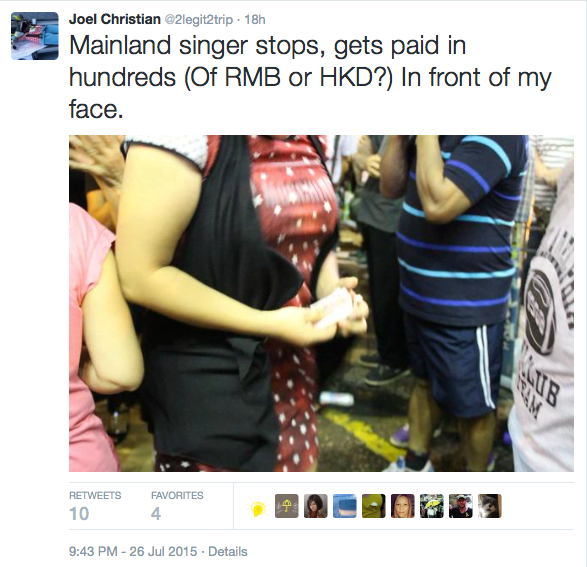
There are many investigative reports on these encounters where old men openly admit spending all of their money on the ‘pretty girls.’ (side note, these women are not pretty). In one such investigation, a video shows singers receiving numerous red-packets from men in Tuen Mun. This accusation of accepting cash for sexual favours and breaking laws covering prostitution is in reality hard to pin unequivocally upon the aunties. But what is clear is that they are taking the money while performing on the street, this is fact and is unquestionably breaking the law. (See pics of tweets of the girls accepting money).
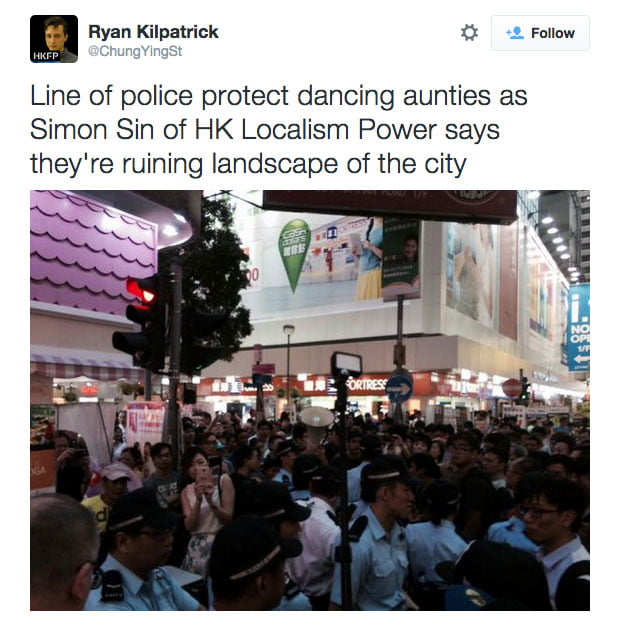
Citizens have filed complaints about this practice. But rather than mobilize the FEHD to investigate, the Mongkok police have instead mobilised its PTU to ensure whatever the aunties are doing, illegal or not, continues unfettered. Presumably under some mistaken notion of protecting freedom of expression and the right to assembly.
So the question arises, in a city where a man fixing people’s bikes for free and taking $10 to cover the cost of parts can be hauled up in front of the magistrate for illegal hawking. Why are the FEHD not investigating and police turning their backs while aunties receive hundreds of dollars a night for offering old men soft-prostitution services on the street in plain sight?
The obvious retorts to this question are that the police are not aware of what is going on. However, this hear-no-evil, see-no-evil approach to law enforcement simply doesn’t hold up in reality. On Sunday night, HK Frontline Media easily took photographs of the aunties receiving payment while a horde of police stood just one metre away.
In plain sight money was changing hands while the police focused all of their attention on the much-vilified Localists who were, in fact, not breaking any laws by being there. If the police turned just one of their cameras on the aunties, they would quickly capture the illegal behaviour everyone is complaining about and just like the friendly bike-mender they would be up in front of a magistrate.
You may then argue, well it isn’t the responsibility of the police to micro manage street performers, this is the job of the FEHD. Yet, I have also witnessed the police closing down would-be buskers within minutes because they tried to collect money. So the police are not blind to what’s happening on Sai Yeung Choi Street. Instead, the only conclusion one can make is they are selectively enforcing the law depending upon who is in favour. Someone up on high has dictated that the aunties are patriotic and therefore they will stay! Regardless of how many police need to be mobilised to protect them and how much evidence there is to show them repeatedly breaking the laws covering street performance.
With the police only motivated to throw more PTU at the street performer’s impasse and the FEHD nowhere to be seen, what may you ask are the Localists plans for the aunties? Their strategy is very succinct. For them, the anti-aunty campaign is a low-cost, economic attack upon the aunties, with the broader goal of keeping the topic of Mailandisation of Hong Kong in the media. Between the groups, the cost of the protests is low. They expend little effort either in manpower or risking arrests, yet eventually they believe they can financially cripple the aunties money channels. The aunties will stop singing on Sai Yeung Choi Street if they don’t get paid, and the old men will stop paying if they don’t get to dance and sexually embrace the aunties. Every day the aunties don’t dance is a victory. The protests are a classic guerrilla tactic that closely mirrors such direct action groups like Sea Shepherd. Who know they can’t match the Japanese Whaling operation dollar for dollar, but they can block it at every turn, making it financially unviable to continue in the long term.
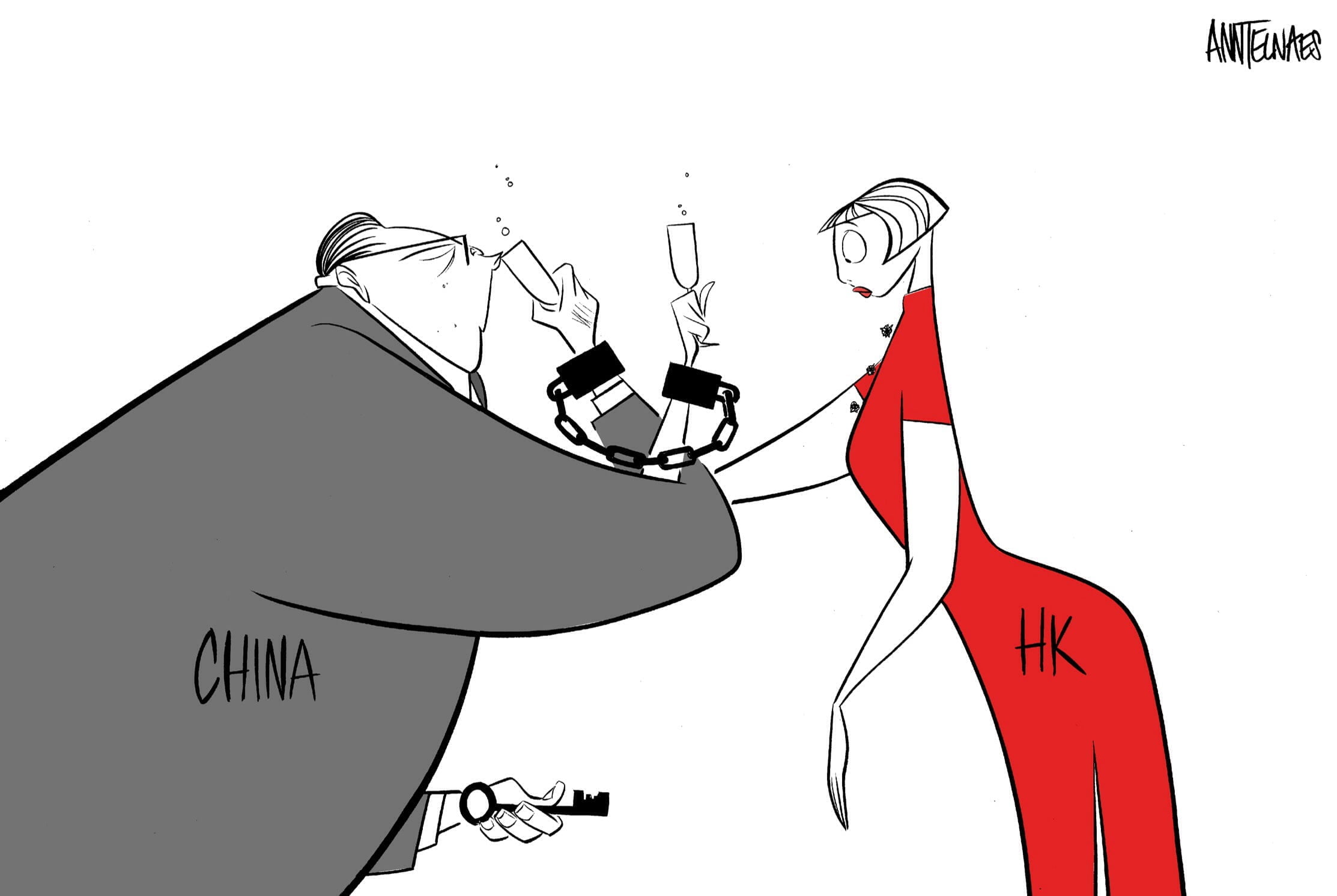
So, rather than being irrelevant bickering over music tastes, the aunty protests show us that Localist protests are not being driven by an irrational hatred of Mainlanders. Instead, they bring into sharp focus the favouring of a policy of Mainlandisation by CY Leung’s Government. The policy is chipping away at Hong Kong’s sophisticated, local culture and works only to the detriment of Hong Kong’s once proud police force and its impartial rule of law.
The Chinese economy is now facing its strongest challenges for a generation and Xi JinPing’s best efforts to create a nationalistic, shareholder, last stand for the stock market seem to have largely failed. What the fall out from this will be we can only speculate, but the enormous economic disaster that is the Chinese economy is not of Hong Kong’s making. Back in the colonial days, if the British economy collapsed, Hong Kong would not be expected to fall on its sword in sympathy. Likewise, given the stormy times ahead for China, Hong Kongers should not be looking at going down with the sinking ship, but instead working on preserving what makes the city different, or the Two Systems part of the Basic Law. Given this, the idea of a Hong Kong City State becomes increasingly more viable and appealing.
The impracticalities of a Hong Kong City State are often premised on the geopolitics of Asia remaining similar to what it has been for the last 30 years. But once you accept the premise that the geopolitics of Asia are heading into turbulent seas, then the question of how best Hong Kong can survive the storm becomes much more pertinent and pressing. More independence and autonomy, and not less, suddenly become compelling.
When you live in the shadow, of the overly jealous and malign CCP, even uttering the word independence under your breath is high treason against The Party. Certainly, there are significant amounts of people who believe the independence debate in Hong Kong was created by the CCP to create social division within the democratic movement and brand everyone who opposes the government as splitists. In China, there can be no worse a traitor than a splitist. However, most of the anti-independence arguments are actually ill-thought out if we work back from 2047. For, when we look at the pros and cons of more independence based on 2047 as a starting point, it starts to make a lot of sense and a much smarter path to follow than blithely accepting whatever bones the CCP wishes to throw Hong Kong erstwhile its own economy and political system rips itself apart.
It’s not too early to ask the question, what will happen come 2047? Does Hong Kong law become superseded by Mainland law? Because if that’s going to be the case, the day this is officially announced, whether it be tomorrow or in ten years time, will be like pulling a plug on the city. Money, resources and people will stampede to safer havens. Those that faithfully pledge their full allegiance to The Party, will be left in a hollow shell of a city as anything that creates real, global value will be gone.
If your argument against greater Hong Kong independence is that HK’s unchangeable destiny is to eventually be fully assimilated into CCP’s China and become a carbon copy of any other CCP city then you must first be clear what these other cities will look like in five years time, or even five months time! Simply pointing out that we need to be more like ‘them’, but having no clue what ‘them’ will look like and having zero control of how ‘they’ are created is no plan at all. Hong Kong certainly has all the tools to make a positive contribution to the place known as China for many years to come. The same can’t be said of the multitude of cites we’re supposed to be more like, and that includes Shanghai. The most likely future for these cities are astronomically high, local debts, huge environmental clean-up bills, violent, social unrest and rampant corruption. None of which Hong Kong suffers from yet. Hong Kong has everything it needs to protect itself from such a bleak future, but unfortunately the current government seems intent on throwing away all the city’s global advantages in a lame attempt to show loyalty to a broken political part that pretends its a country.
No one who advocates greater independence is dreaming that Hong Kong isn’t part of China in a physical sense, but being geographically part of a continent and being ruined by the politically oppressive CCP are not one-in-the-same. The CCP is not China, it is not the country, neither is it the people. It is a shadowy, political organisation with a horrific track record for wreaking havoc upon the peoples of China throughout its very short and violent tenure. There will come a time when the CCP no longer holds power, but there will still be a China and also city in its south called Hong Kong. This is what the independence debate is based on, a practical approach to preservation, and there’s a lot to be protected here in this quasi-City State. This is the true pragmatic path for Hong Kongers now, or how does Hong Kong negotiate the impending disaster that is the CCP’s complete loss of trust in China and not be destroyed with it?
Currently the CCP tirelessly tries to bewitch pragmatists in Hong Kong with the narrative that the only future lies with them, a transient and decaying political entity, motivated by self-preservation and quick gain. However this lie becomes increasingly less convincing with every passing week. Hong Kongers are no stranger in handling inept northern governments. They have played this game for almost two centuries and they know when the winds of change howl, and China looks like a shaky pile of eggs (危如累卵 – Wei Ru Lei Luan), their future lies in protecting their own autonomy and not integrating more into turmoil.
The opinions in this article are of those of the writer, if you agree or disagree feel free to leave a comment here or on our facebook page. The wonders of a free press allow for a discussion and debate of ideas – unlike north of the border.
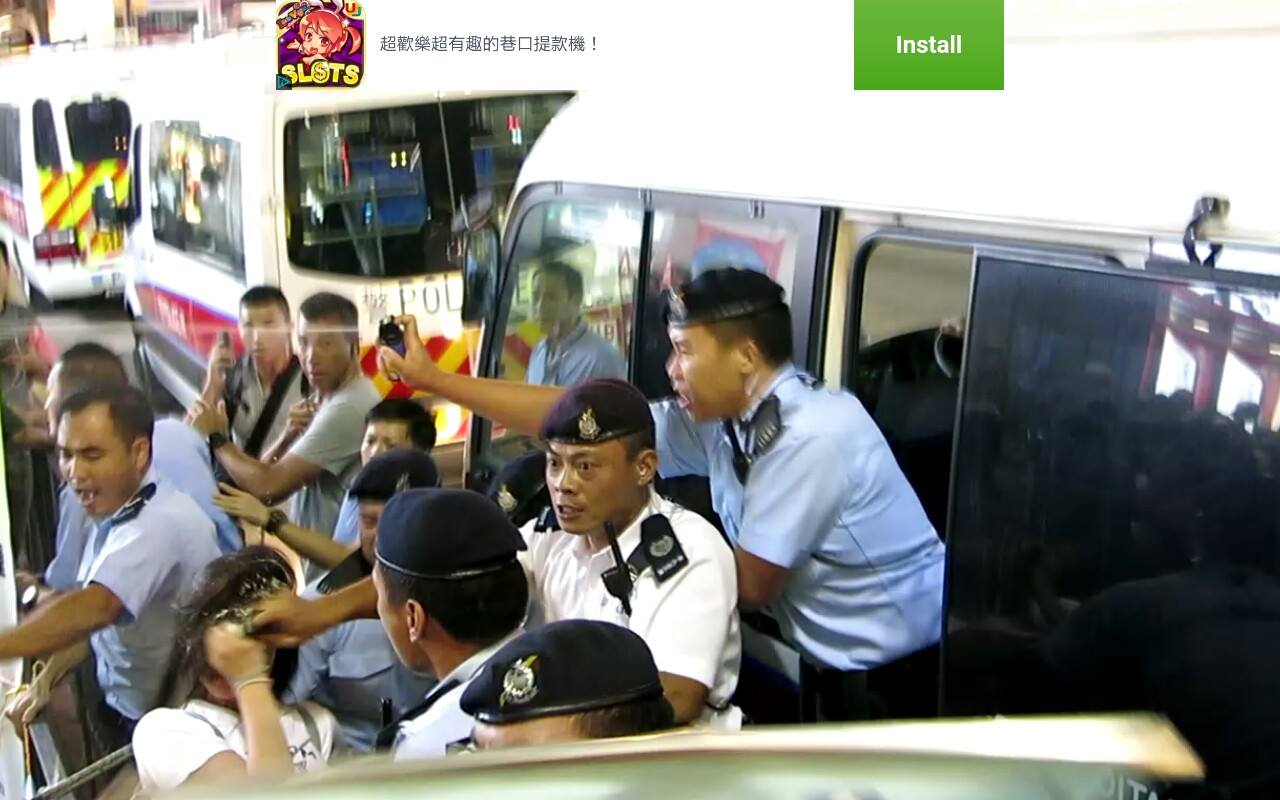
Out of control police pepper spraying and assaulting HongKongers. The plain clothes officers in the background look surprised the actions of the uniformed officers, who are standing behind a road side barrier and in their police van. Why one policeman thinks its ok to rub pepper spray in the face of woman is quite beyond me. Surely these unprovoked actions amount to assault with a weapon and the police involved should be charged and jailed.
Richard Scotford on Sunday night’s protest in Sai Yeung Choi Street where respect for the police amongst law abiding HongKongers hits a new low – if that were possible – as those attacked are arrested and the attackers, protected or ignored by police.
From the very offset, this protest was never really about aunties dancing on the street, but instead a proxy fight for what many believe is the increasing Mainlandisation of Hong Kong. From as early as 18:00 there was a visibly high presence of plainclothes police in the area. The police had clearly mobilised high numbers of officers and it would later become clear to all why that was the case. At 19:30, the main group leading the protest, HK Localism Power, began to set up their speakers and banners.
Just in front of where the Localists planned to speak, a ten metre, empty corral had been created with police barriers. It wasn’t clear what the barriers were doing other than blocking half of the road to both pedestrians and the increasing number of protesters who were now quickly gathering. The protesters, quickly pushed the barriers to the one side and opened up the throughway. These barriers remained at the side of the road for at least fifteen minutes until some police tried to reopen up the corral again.
At this point there were hundreds of Localists in the area, who found themselves both in and outside of the newly created corral. It was all very confusing. No one could figure out why the police were so insistent on making the corral so close to the Localist booth. Needless to say, this action skyrocketed the tensions between both the police and the protesters. The police first moved the barricades out, then moved them back, then out, then back again, but there were just too many confused people in the way. Finally the police dragged the barriers a further twenty metres down the road and made a new corral.
This was when the first scuffle broke out between a police officer and a protester. As in every incident like this, almost everyone has no clue as to why the police have suddenly targeted just one person. The crowd closed ranks and the person was able to scurry away without being detained. Interestingly, and this would set the tone for the rest of the night, the police officer involved in the melee ran nearly a hundred metres down the road after the intended target . At which point the crowd demanded to know why the person was being detained, as is his lawful right, but the police could not answer. They then hogtied the man and violently barged him through the crowd to take him to a waiting van.
I have no problem with this slightly aggressive police, arrest procedure, if the man is found to have committed a serious crime, but bear in mind the enormous effort the police had invested in detaining this single person, and then how hands off they became once things got really serious and laws were blatantly being broken.
This first arrest then went on to lead to the first pepper spraying of the night. This occurred when the police, erroneously stated that their vehicle was surrounded and so needed to use pepper spray to push back the crowds. The reality was that the vehicle was behind a barrier, on Nathan Road with free access to leave at anytime. Protesters were on one side only, standing on the footpath, behind the barrier. There was no reason to indiscriminately pepper spray those on the footpath.
While the first pepper spraying of the night was taking place on Nathan Road, it became clear as to why the police had wanted to create their corral. With a police escort that even a president would be proud of, in came a tiny contingent of Pro-Beijing supporters with flags and a loud speaker. A fifty minute slanging match and flag waving contest ensued between the two groups, divided by a very thick, blue line of police. In this regard, I thoroughly support the idea that the police are there to protect free speech for everyone but once again, we have to see the police orders in context. For this coming July 1st march, booth licenses have been refused on the grounds of security, yet, the police mobilised an entire army to ensure that two Pro-Beijing supporters could stand on a stepladder and shout profanities at an already agitated crowd. The police action was tantamount to mobilizing hundreds of officers to ensure that Joshua Wong could shout abuse at five hundred CCP stalwarts.
If getting the Bejing loyalists in was impressive, extracting them was a military operation to behold as the police effectively made an impenetrable blue tunnel for them to scurry through. It was epic, superstar treatment fit for a king. Needless to say, the tensions were now off the charts and most importantly, the confidence of the Blue Ribbons in the area was at an all time high, as the police had demonstrated in spectacular fashion who they were supporting, and so the fighting began. Not, pushes and shouting like you see at most protests but full on fist fights and assaults with isolated Localists getting the worst of it by gangs of ageing male Blue Ribbons.
All the serious fighting occurred on Nathan Road. As more Localists began to stream of Sai Yeung Choi Street to help those that had been assaulted they easily cornered the attackers. So what did the police do with the assailants? They released them to the great consternation of the crowd. At this point, let’s remember the first Localist arrested, who was chased 100metres down the road, hog-tied and carried onto the police van by six officers, yet now the police were confronted with victims of assault, with obvious signs of injury and there were multiple people wanting to give statements and the police let them go. No hogtying, no violent police take-downs, no pepper spraying. Those accused of the assaults were given the friendly shoulder tap and released out of sight.
But not out of sight enough!
Protesters had seen the police release them and weren’t going to tolerate it.
At this point, the police could have saved themselves a lot of legwork if they’d have treated the Blue Ribbons like the Localists and bundled them into waiting cells in Mongkok Police Station. Instead, rolling battles ensued as the Localists hunted down the released Blue Ribbon assailants, to demand that they be arrested once again.
Serious scuffles continued all the way to Tong Mi Road, which is practically Sham Shui Po, until once again the assailants were cornered on Palm Street. The police then set up another defensive circle around those accused of assault until a police van arrived to finally take them away. To ensure that the police didn’t release them again, Ray Wong, leader of HK Indigenous, went in a police van too to make a statement, escorted by 8 police men, erstwhile the accused attackers sauntered onto the waiting police van with a gentle shoulder tap from the police.
All in all, the night was a sad example of just how much energy the police will spend on detaining Localists, erstwhile going to great lengths to avoid detaining their own so called supporters. The aunties never featured in the night, not even for a minute. The night was never about dancing. The Localists chose the dancing because they knew it would get a rise in the authorities, and true to form, the HK police showed once again that they are now just a paramilitary force set up to defend the Mainland. They’re happy to let clear assaults pass by in plain sight, so long as those doing the assaulting support the Mainland.
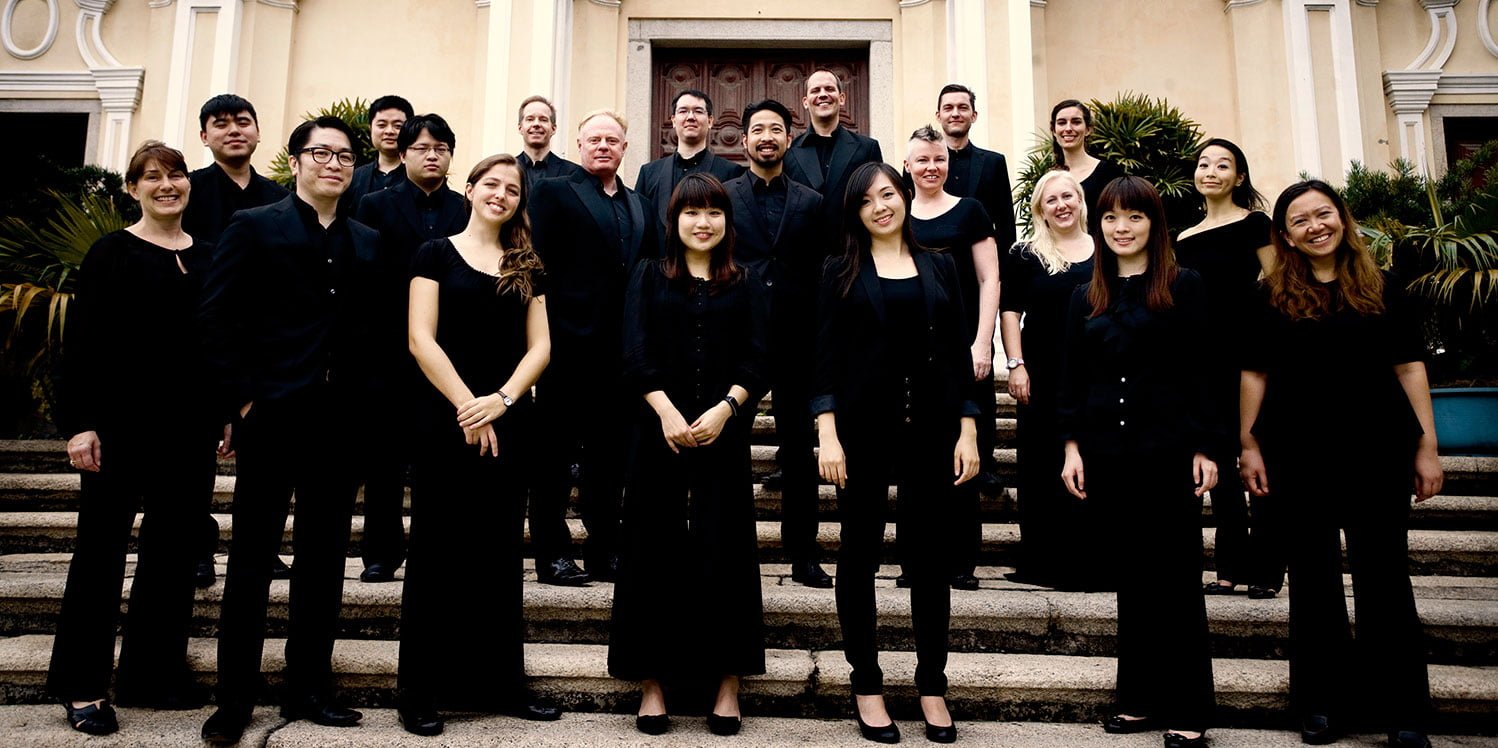
Tomás Luis de Victoria’s Requiem is widely regarded as the greatest masterpiece of Renaissance polyphony. Tallis Vocalis will perform this great work in their second concert entitled ‘In Memoriam’, on 28 June 2015 at All Saints’ Cathedral, Hong Kong.
To commemorate the 70th anniversary of the end of World War II, the concert brings together music written in the Renaissance period and the present day on the theme of remembering those we have lost. Victoria’s Requiem was written for his patron the Holy Roman Empress Maria. This Spanish work sets itself apart from its English and Italian Renaissance contemporaries by its mystical intensity of expression achieved through the simplest musical means.
The Requiem will be interspersed with four contemporary works: Arvo Pärt’s Da pacem Domine (a tribute to those who died in the 2004 Madrid bombings) and The Woman With the Alabaster Box (which references Jesus’ burial); James MacMillan’s A Child’s Prayer (written after the Dunblane massacre in 1996) and John Tavener’s Song for Athene (a tribute to his friend Athene Hariades).
Christopher Watson, of The Tallis Scholars and Theatre of Voices will conduct the concert.
In Memoriam
Tallis Vocalis Date: 8pm, 28 June, 2015 Venue: All Saints’ Cathedral, 11 Pak Po Street, Mongkok, Hong Kong Tickets: $250, online reservation commences 1 June 2015 More info:
Programme
Victoria: Requiem (Officium Defunctorum 1605)
Pärt: Da pacem Domine
Pärt: The Woman With the Alabaster Box
MacMillan: A Child’s Prayer
Tavener: Song for Athene