
Tag: Hong Kong
Hong Kong Crash to Third Asia Cup Defeat
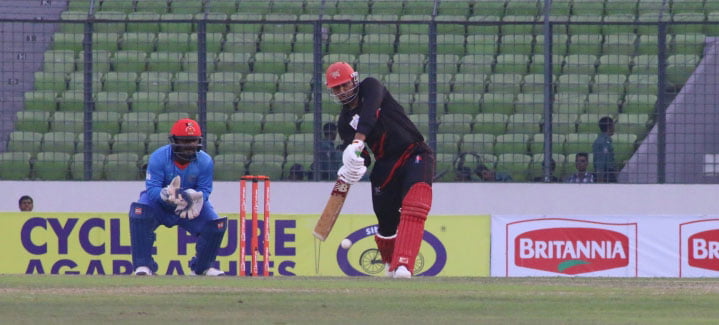
A disappointing Asia Cup Qualifying Tournament ended with a third defeat for Hong Kong against Afghanistan by 66 runs in Dhaka. The bowlers have leaked runs and the batsmen, Babar Hayat apart, have not found any sort of form on what have been pretty good batting wickets.
Captain Tanwir Afzal won the toss and chose to bowl first, but some costly errors in the field saw Afghanistan post 7-178 – including 32 from the penultimate over.
In response, Hong Kong got off to a great start to be 0-55 after 6 overs but the innings then fell apart. Hong Kong lost 9-33 to be all out for 112 – resulting in a 66-run loss. Anshuman Rath top scored with 41 off 38 balls.
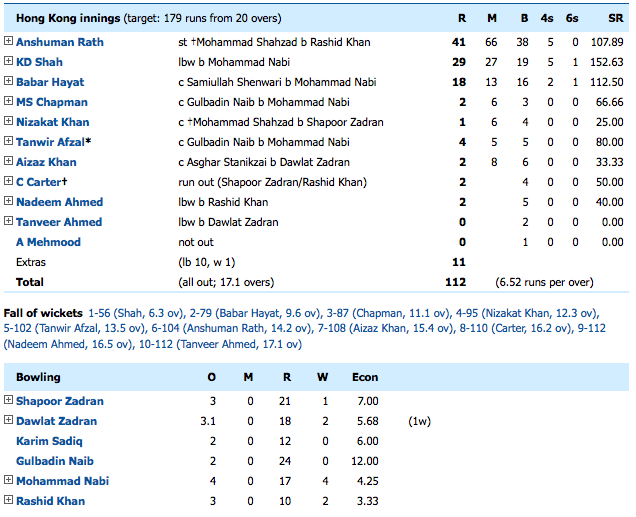 Babar Hayat looked dangerous again but fell for just 18 off 16 balls. The pattern of good starts that went unfinished a sore point for captain Tanwir Afzal when summing up the tour. “The middle order batsmen made the same mistakes in all three games and we didn’t learn from it and that’s disappointing,” Afzal said. “We are a better team than this and we have a couple of players who were missing coming back for the World T20 so hopefully we can prove that.”
In the field, Hong Kong had restricted Afghanistan to 6-138 after 17 overs, but 40 runs off the last three saw the score blow out. Aizaz Khan was the main destroyer and finished with 3-38, while 18-year-old Tanveer Ahmed impressed on debut taking 1-27 from four overs at the death.
“As you could see, Tanveer is a future star of Hong Kong cricket,” Afzal said. “He was very impressive with the ball in death bowling and he just does the basics really well. Everybody is really disappointed with these matches but we will come back strong and do Hong Kong proud at the World Cup.”
Hong Kong will arrive in Mumbai tomorrow tonight to begin a two-week training camp ahead of their World T20 opener against Zimbabwe on March 8.
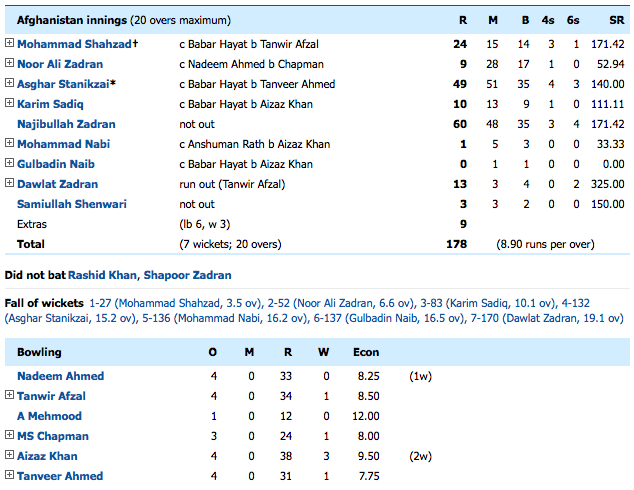 Afghanistan 7-178 (Aizaz Khan 3-38) def Hong Kong 112 (Anshuman Rath 41 Kinchit Shah 29) by 66 runs
Source: HK Cricket Association
5-try Olivia Coady Seals Valley Black’s Unbeaten Season and League Title

In the seven-team Women’s Premiership Valley Black Ladies stormed through the league undefeated for a second straight season, closing out their 2015/16 league campaign with an emphatic 49-12 win over their nearest rivals, Gai Wu Falcons.
Valley was paced by fullback and New Zealand Black Fern Olivia Coady, who scored five tries, four consecutively with two on either side of halftime, in the eight-try rout over Falcons, the last side in the Women’s Premiership to hand Valley a loss – in the 2013/14 season.
Sevens star Stephanie Cuvelier opened the scoring with an early try, but Falcons replied almost immediately through a try from their own sevens sensation, winger Aggie Poon Pak Yan leveling the scoring at 5-all early on.
 After Poon’s tally it was one-way traffic for the league champions with Coady doing all of the driving, scoring two tries for Valley in the second quarter. Bella Milo added a penalty between the first two Coady tries, and a conversion on Coady’s second, to give Valley a 20-5 lead at the half.
Coady completed her natural hat-trick shortly after the re-start – securing the bonus point for Valley – before adding her fourth consecutive score to push Valley out to a 30-5 lead. Sam Scott added a fifth try for Valley, followed by Jen Mackay before Coady collected her fifth with five minutes remaining. Milo’s conversion brought the score to 49-5 before Falcons picked up a consolation try through Chong Ka Yan, the successful conversion bringing the final score to 49-12.
All the weekend’s results here

Source: HKRU
Women’s Rugby Results – 20 February, 2016
Premiership
Tai Po Dragons 0-15 Kowloon
@ King’s Park, Kick-off: 16:30
Gai Wu 12-49 Valley Black
@ Kings Park, Kick-off: 18:00
USRC Tigers 37-10 CWB Phoenix
@ King’s Park, Kick-off: 19:30

National 15s
Valley Red 7-10 CWB Pheasants
@ KGV, Kick-off: 16:30
USRC Tigers v City
@ Tai Hang Tung, Kick-off: 16:30
Gai Wu 12-5 Revolution SRC
@ KGV, Kick-off: 18:00

Tai Po Dragons 14-12 HKFC Fire
@ Tai Hang Tung, Kick-off: 15:00
Police 15-12 HK Scottish
@ Police Boundary Street, Kick-off: 18:00

Hong Kong Lose to UAE by Six Wickets to Crash Out of Asia Cup
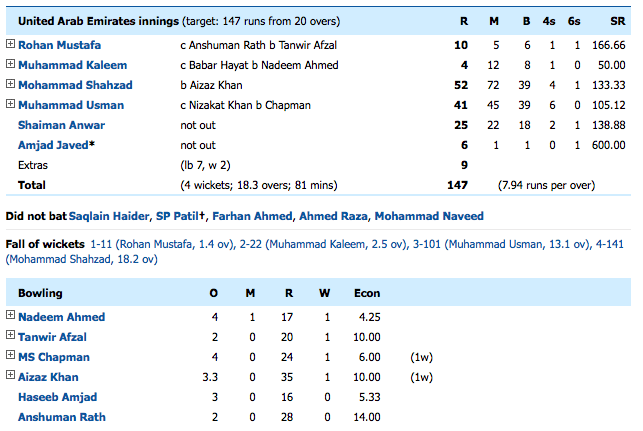
Hong Kong’s hopes of qualifying for the main round of the Asia Cup T20 were extinguished as UAE beat them by six wickets to move to the top of the points table with one game to play.
Babar Hayat’s run of form continued but Hong Kong fell to their second loss of the Asia Cup. Batting first, Hong Kong posted 7-146, with Hayat’s 54 off 45 balls the top score.
In response, UAE lost two early wickets but from there recovered to reach the target with 9 balls to spare.
Hong Kong were in the box seat at one stage with the score at 3-112 with six overs to go and a total of 160-plus looked likely. But the fall of Hayat saw the innings lose momentum, which is an area coach Simon Cook admits needs work.
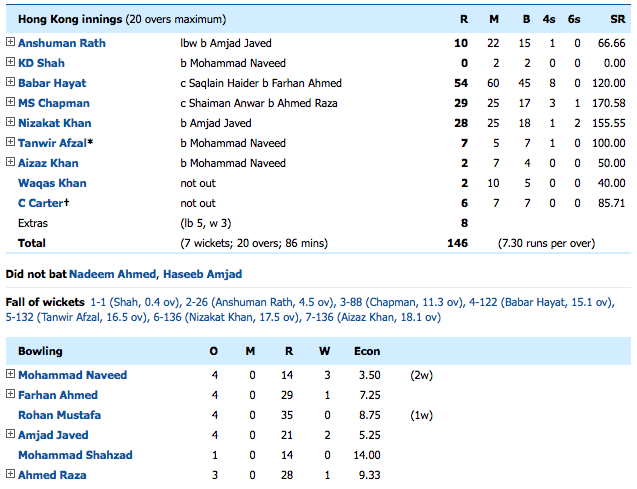
“There is a common theme unfortunately that has cost us two games and that’s our batting in the last six overs,” Cook said “In both games we set really good platforms but unfortunately our lower/middle order hasn’t fired and it’s cost us. It has surprised me because it is normally a strength of ours”
With Hong Kong’s hopes of qualifying for the main stage of the tournament over, tomorrow’s match against Afghanistan will serve a crucial lead-in to the World T20.
“Everyone’s playing for their place in that World T20 team, there are a lot people pushing for places, here in this squad and the two new faces coming in next week.”
Nadeem Ahmed was again the pick of the bowlers for Hong Kong, he finished with figures of 1-17 off four overs. Mark Chapman (29 off 17) and Nizakat Khan (28 off 18) both looked in good form, but couldn’t convert.
The match against Afghanistan will be broadcast live on Star Sports, before the squad fly to India to begin training for the World T20.
Hong Kong’s Future – A Speech by Sir David Tang at the FCC on 18 February, 2016
Sir David Tang KBE, Chevalier de I’Ordre des Arts et Lettres made a lunchtime speech and answered questions at the FCC on the 18 February, 2016. This is the transcript of his speech, watch the video for the post speech questions.
A Martian reading our chief executive’s 2016 Policy Address might be forgiven for believing that all is hunky-dory in town, and that it has landed on the best planet in the solar system.
The policy address mentioned how to innovate for the economy, improve livelihood, foster harmony, and share prosperity. What better headings could there be?
The only problem is that human beings on Earth lie. The Martian will soon find out enough because it is intelligent, and has got eyes and ears.
But in fact, the policy address was a silent contortion on the truth.
Does anyone here really believe that the government, our government, fosters harmony or shares prosperity? Does the government believe that it fosters harmony and shares prosperity? I believe these words are patronising and condescending at best, and at worst, meaningless.
In any event, in the policy address, there was not a half-cedilla on the Umbrella Movement last year, perhaps the single most significant political event in Hong Kong since the riots in 1966; nor a mention on the defeat within LegCo of the introduction of universal suffrage for the election of the chief executive.
Indeed, in the entire two hours spent in delivering his address, the chief executive did not give the slightest hint of an amoeba of political or social dissatisfaction, yet a great deal of dissatisfaction is prevalent. It was no surprise therefore, that even before the chief executive began his address, four members of LegCo were removed for protesting against his favourite past-time of sweeping what he regards as rotten political dust under the carpet.
The supreme paradox for me is the opening line of his address.
“Since taking office, the current term government has focused its efforts on promoting democracy,” so CY Leung smugly said.
This was his first sentence.
Whoever wrote that for the first sentence for the chief executive, if he himself did not write it, must be a comedian; or perhaps a monkey who accidentally typed up those words on a typewriter. What it all means to me is the disingenuousness of our chief executive and government, and the contempt with which they hold us, the citizens of Hong Kong.
But should we have expected anything else? After all, throughout the Umbrella Movement, our chief executive steadfastly refused to meet the protesters. We should remember that even Li Peng, even Li Peng, the hardcore, hardline Chinese Premier at the time received Wu’er Kaishi, and what’s more, in full view of national television.
By comparison, our Chief Executive hid behind the azaleas at Government House and pushed out that diminutive figure of Chief Secretary Carrie Lam, who fluffed around with absurd preconditions and insisted on meeting the students behind closed doors.
You understand how parochial we seem, already.
It all further means that our chief executive does not have the bottle to confront difficult issues, yet that is precisely the one quality that we should demand in our leader.
We certainly don’t want one who totally ignored the heat of our political and social conditions and instead spent half of his speech pontificating the woolly symbols of “One Belt, One Road”, which was mentioned 48 times. Quite apart from the embarrassing unctuousness towards the Chinese president, what on earth would an ordinary citizen of Hong Kong care or understand about One Belt, One Road?
I even doubt that a singular tycoon in Hong Kong could name more than two countries on the original Silk Road that was the inspiration for One Belt, One Road. Is our chief executive really trying to push Hong Kong trade, and our financial services, across Kazakhstan, Uzbekistan, Turkmenistan, Iran, Iraq… and inexorably into the heart of the terrifying Islamic State?
Borat might have been able to get away with it, with humour – but hardly our sombre Chief Executive with any degree of seriousness.
Therefore if I were to hold out any hope for a better Hong Kong, I would first wish for a much stronger, and much more effective chief executive. I know this sounds [like] self-evident truth, but that is what we need to focus on.
By which I mean someone who would least appear to represent the people of Hong Kong, and not fearful of relaying to the Chinese authority those views which are considered to be discordant music to the ears in the north.
But the most preponderant misreading on the part of the chief executive of Hong Kong is to second guess what the Chinese government does not want to hear. These furtive considerations do great damage to the status of the chief executive, because even before asking, he has turned himself into a puppet on a string, dancing obsequiously of the tunes and echoes of Zhongnanhai.
I would even wish for a chief executive who was cunning enough to persuade the Chinese government to hear openly the grievances of Hong Kong, whilst knowing full well that they would fall on deaf ears. But at least under these open circumstances, we will obtain an airing of what those grievances are, then sooner or later people will become conscious for the need of compromise.
And therein lies the secret of civilisation: divergent views being brought closer together openly, through peaceful, intellectual and intelligent negotiations.
That, in a nutshell, is what Hong Kong is crying out for. A mediator, or a group of mediators who could bring those pan-democrats and the stiff establishment around the same table and begin the process of some kind of reconciliation.
As a citizen of Hong Kong, born and bred below Lion Rock, I was really sad to see the anger – or should I say Tourette’s – displayed by those well-meaning legislators who were ejected from the chamber in front of an ossified face of our Chief Executive.
These tribal confrontations exemplify deep bitterness and resentment, and precisely represent the fundamental and symptomatic illnesses of our territory.
They are similar to the rifts between the Shiite and the Sunni, the Arabs and the Jews, and the North and South Koreans. But there is so much more hope of a lasting ceasefire in our case because we have, thankfully, at least not shed any real blood. Not yet.
Indeed, the Chinese authority could simply transform our entire livelihood tomorrow by becoming a mediator of the two opposing sides. The two sides must meet, they must sit down opposite each other; they must start talking. They must carry a modicum of good will on each of their parts.
It is only when the stinging palpitations of our political polarisations are diffused, that we can once again return to a marvellous and civilised legislature that has served Hong Kong well, before its fragmentations and the damaging of the fabric of our society before our own eyes.
If we’re not careful and simply let alone the sour enemies sit inert, in stalemate across each other on the chamber floor at LegCo, then we will be throwing away what we have managed to build, totally against the odds, a solid and banished rock that was once considered merely as barren.
Churchill was supposed to have said “democracy is the worst kind of government, except for those others which have been tried.” I should like to think that Hong Kong is the worst kind of place in which to live, except for those others which have been tried.
My point here is that, given all the problems we have, with a deteriorating administration which half confesses itself to have a legislature that is becoming ungovernable and losing confidence amongst the majority of the population by the day, with a chief executive whose popularity is at a historic low, we must cling on to Hong Kong as our home, but we cannot afford to stand by our status quo.
Our government has been growing apart from the people of Hong Kong and they must anticipate trouble. Already, there are over one million people in Hong Kong who are trapped by poverty, and they cannot be too pleased about the government. It is simply invidious that in a prosperous community such as Hong Kong, over 15 percent of our population should be living below the breadline.
It is a shameful state, scandalous if you ask me. Then there was the Umbrella Movement, which clearly demonstrated the resolution of many ordinary people taking real democratic power seriously, and their dissatisfaction can only be increased by the defeat of the universal suffrage motion in LegCo.
Then the disturbing case of Lee Po and his colleagues and those hawkers openly branded as separatists by the Liaison Office. To compound our problems, the dwindling numbers of visitors from the mainland, financial oscillations in the markets, not to mention the growing number of the aged against a falling number of our workforce, the umpteen cases of abduction in the mainland about which we hear very little, the dark appearances of triads at demonstrations, the thorough incompetence of the government in creating a proper cultural anchor in the city…
There are many more things which need fixing, and most of them could not be achieved given the standoff between the pan-democrats representing the majority of ordinary people, and the establishment, so-called, hugging most of our somnambulant tycoons, and that elephantine Communist Party in China.
Thank God, thank God we still have a decent judicial system and a fairly uncorrupted community and genuine freedom in Hong Kong. This holy trinity – which is what I call it – is the fortunate remains the pride of Hong Kong people.
You think Shanghai, say, with her mainland judicial system and corruption, and lack of freedom, could overtake Hong Kong as China’s premier city? You would have to be utterly insane, and stupid.
Ergo, we must hang on to this holy trinity of a decent judicial system and uncorrupted community and genuine freedom until the bitter end… or 2047, at least. In my moments of fantasy, I even think Hong Kong could play a vital role in shaping the future of China.
Why else would 50 million mainlanders come flooding through Hong Kong every year?
It’s because of our holy trinity. This would make the seven million of us in Hong Kong the greatest and freest de facto Chinese diaspora, which in turn could change the course of Chinese history in our lifetime.
Hong Kong Lose Despite Magnificent Babar Hayat Century
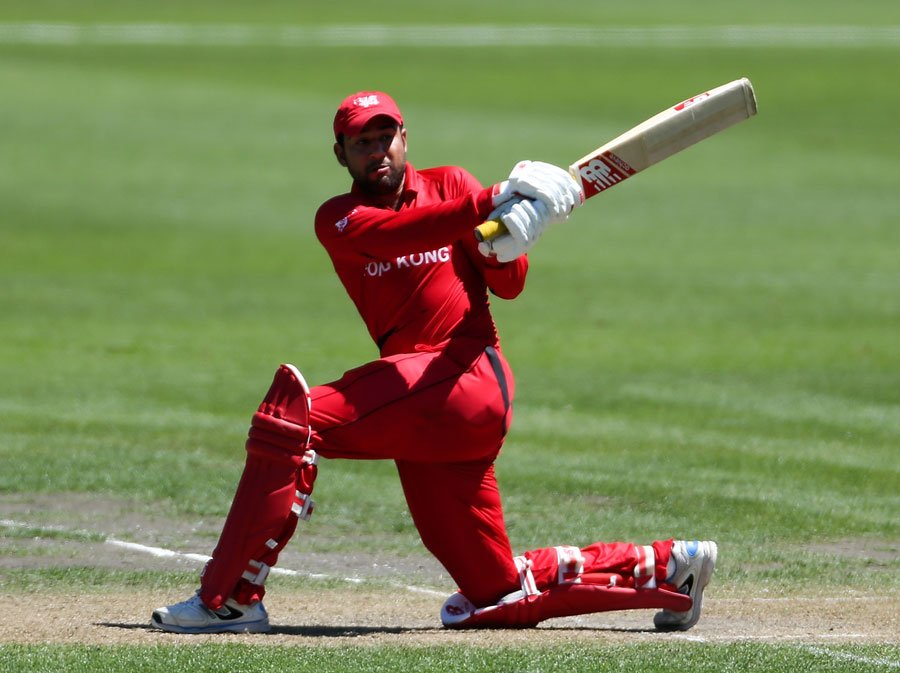
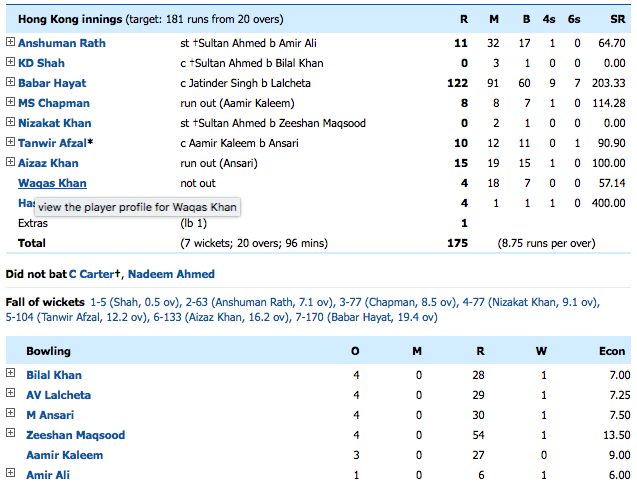
Hong Kong have been beaten in a thriller in their opening Asia Cup qualifier against Oman in Dhaka. Chasing 181 runs to win, Babar Hayat smashed the fourth fastest Twenty20 International century of all time off just 50 balls but Hong Kong still fell five runs short.
Hayat ended up on 122 off 60 balls, his innings included 9 fours and 7 sixes. “I was happy with the way I played but we should have won the game so I should be a lot happier, to end up on the losing side is never a good thing,” Hayat said “When you are chasing a big total you have to be aggressive so I just tried to do this and everything kept coming out of the middle. It’s the best innings I’ve played and my first hundred in T20 international cricket so I am happy with this.”
Hong Kong at one stage required 45 runs off the last three overs but rocketed back into contention when Hayat hit four sixes in an over that went for 27. “I’ve never done that before,” Hayat said “I did target that bowler and at that stage we had no choice but to go for it, I thought from there we deserved to win.”
However some accurate death bowling from Oman prevented Hong Kong from achieving the remaining 18 runs off 12 balls. Coach Simon Cook paid high praise for Hayat’s innings and lamented the fact it did not result in a win.
“Outstanding innings, he’s become a lot more consistent over the last few months and again proven why he’s the best batsman in Hong Kong,” Cook said “He controlled the innings perfectly and it showed that we let them get 20 runs too many because even with a fantastic innings by Babar, he still ended up on the losing side.”
While Hayat’s century was the highlight of the match, a controversial incident caused a stir when Hong Kong’s Mark Chapman fell victim to a mankad and Cook wasn’t impressed. “Yes it’s in the laws but I think it goes against the spirit of the game when you’re not at least giving a warning,” Cook said “Ultimately it’s a cowardly way out really, if you’re battling against one another, man against man, out in the middle and you choose to go down that route to get a wicket and win the game, it’s not really in the spirit of cricket.”
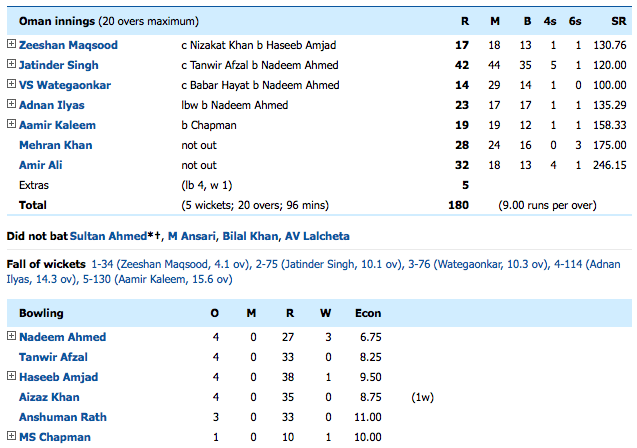
Oman won the toss and chose to bat, the innings got off to a solid start as Jatinder Singh (42 off 35 balls) added 34 with opening partner Zeeshan and 41 with No. 3 Vaibhav Wategaonkar to move them to 75 for 1 at the 10-over mark. Left-arm spinner Nadeem Ahmed dismissed both Jatinder and Wategaonkar in the 11th over, but every member of Oman’s middle order chipped in to ensure there was no loss of momentum. Adnan Ilyas (23) and Aamir Kaleem (19) were dismissed in quick succession after putting on 38 for the fourth wicket, before Mehran Khan (28* off 16) and Amir Ali (32* off 13) gave the innings an explosive finish, adding an unbroken 50 runs for the sixth wicket, off just 24 balls.
Hong Kong’s next match is against UAE on Sunday – a must win game to keep their qualification hopes alive.
Source: HK Cricket Association, Image: © ICC
Valley v Gai Wu Highlights Regular Season Final Weekend

A women’s Premiership triple-header at King’s Park will feature an end-of-season clash between league champions Valley Black and their longstanding rivals, second-placed Gai Wu Falcons (18.00). Valley, currently on the longest unbeaten streak in Hong Kong rugby, will put their run of 25 matches without loss on the line on Saturday. A win over the Falcons will complete two full league seasons without a defeat and position Valley to defend their Grand Championship title from last year.
The competitiveness of the two sides is such that Valley’s last reverse came at the hands of Gai Wu in the 2013-14 Grand Championship, a match decided by a single try. In a hard-fought contest between the two sides earlier this season, Valley muscled their way to a 15-3 victory – its smallest margin of victory this year – with a defining second-half performance. On Saturday, they will look to again keep the action focused in the centre of the field.
Valley coach Chris Garvey commented “Gai Wu are extremely quick on the wing and have probably the best front row in the Premiership but we should have an edge in midfield. Our forwards continue to do an admirable job, while our back line has become extremely competitive, having previously struggled to get the ball over the line enough to make bonus points. Now we have girls on the bench who can come on and perform. There are no passengers in this side.”
Valley and Hong Kong veteran Colleen Tjosvold echoed Garvey: “We’ll be looking to exploit our contact area skills and stop their wide attack. We play a good territory game and can inch our way up the field if necessary. It will be a good game, but more about attrition than blinding long runs. They go for discipline and running down the flanks. We look to our contact strength to keep up unrelenting pressure.”
“The success we’ve had gives you confidence but also a lot of pressure,” adds Tjosvold. “You’re expected to keep it up. The pressure is always on – every team wants to beat us. You can’t win every game. I’m always confident, but you never know what’s going to happen.”

Gai Wu coach Lai Yiu Pang is keen to topple the league winners, with an eye on staking an early claim on the Grand Championship, as the two sides are the leading contenders to advance to the season’s finale match. He expects his side to maintain possession and build phases in attack, capitalising on their superior fitness. “Conditioning is our strength, and we need to make it count,” he says.
He can draw on almost a full squad against Valley, as a number of players have returned from injury ahead of the play-offs, but the team will miss Tang Wai Kwan, a “key asset” according to Lai, who is grounded after receiving a red card last time out.
Vice-captain Melody Li chimes with her coach:“Valley are physically stronger, so we need to put up a solid defence which has been our training focus. We have to apply pressure to contain them and we have been working harder on our defence patterns.”
With both teams boasting numerous Hong Kong internationals there is much respect shared between the sides. “Gai Wu are a great club, with a lot of talented individuals,” says Garvey. “They’ve had a bit of a rough season with injuries, but some of their girls have been together for 8, 9, 10 years. They are a tight unit.” Lai admires the strength of Valley’s scrum, “which allows them more time and space to build their attack, and their captain Bella Milo, a former captain of Samoa, is a big weapon.”
There is little doubt that the two teams represent the cream of Hong Kong’s Women’s Rugby. Gai Wu boast around ten Hong Kong internationals, while Valley could field an entire side of national representatives, with 16 Hong Kong internationals across both fifteens and sevens, along with the totemic Milo and fullback Olivia Coady, who has represented New Zealand.
While the favourites for the Grand Championship final are Valley and Falcons, both coaches cautioned that they are not counting third-ranked USRC Tigers out of the hunt. The Tigers are coming into form, including a recent win over Gai Wu – just its second loss on the season – a key result that deprived the Falcons of the opportunity to capture the league title and the automatic bye to the Grand Championship semi final that accompanies it.
By virtue of their successful league defence Valley will advance directly to the Grand Championship semi-finals, while the six remaining teams will contest knockout matches for the remaining three slots. The semi-finals and final are “a whole new game,” says Tjosvold. “Even with everything we’ve done, it’s a new scrap. We’re excited.”
As the on-pitch action moves toward its climax, both coaches reflected on the growth and success of the women’s game this season. In particular, both welcomed the introduction of the Super Series, which saw the best players from across the Premiership redistributed to create three teams for a round robin series. Garvey, who is also the Assistant National Women’s XVs coach, says “The Super Series has been wonderful. As a result of availability problems for some of the lower sides, the Premiership has almost turned into two levels. The lower levels have some excellent players but they lack the chance to play enough competitive games. So the Super Series has been excellent and should be repeated.”
Lai, who is also HKRU National Performance Coach (Development), agrees that the Super Series is boosting development and notes that the Premiership is getting stronger, “HKFC and Tai Po Dragons were close at the beginning of the season before injuries cost them and National League One also has more clubs now, indicating that the women’s rugby population is growing. More resources for coaching and training will definitely help close the gaps between clubs.”
Garvey agrees saying, “Kowloon and Tai Po are very young clubs, and if they can get two or three seasons under their belt, they will develop. It’s not a short-term project but with the individuals they’ve got, and maybe some recruitment from overseas, we can have a really competitive Premiership.”
Find the full list of women’s fixtures for the 20 February, 2016 here
Source: HKRU