Happy Birthday bc

Happy Birthday to us!

Thirty-one, yes 31, years ago today, bc magazine debuted on the streets of Hong Kong.

Much has changed over the last 30+ years, especially since Covid… Lan Kwai Fong and Wanchai are now (sadly) unrecognisable from the vibrant social melting pots of years past.

What does the future hold? It seems unlikely the “work hard, party harder” culture will return. And that feels sad, maybe something new will replace it but ‘connecting’ via social media is vastly different than meeting in person… And yes the world has moved online, but personal connections are still where it matters.

A lot of people – staff, friends, advertisers and readers have been involved over the years, thank you for your continued support and strength.

Carpe Diem!

30th Anniversary, bc magazine

Happy Birthday to us!

Thirty, yes 30, years ago today, bc magazine debuted on the streets of Hong Kong.

Much has changed over the last 30 years, especially in the last couple Lan Kwai Fong and Wanchai are now unrecognisable from the vibrant social melting pots of the past.

And while you can’t fight change. It does feel a bit sad that many people today seem to care more about a ‘like’ from an invisible unknown digital stranger than engaging with the real people around them.

The melting pot of people around us is after all what makes/made Hong Kong ‘Asia’s World City.’ A place of magic where hard work and a bit of luck (or meeting the right person in a bar) anyone could achieve almost anything.

After all, I could never have imagined when asking two complete strangers in McDonalds if they wanted a job starting a magazine that it’d still be around 30 years later.

A lot of people – staff, friends, advertisers and readers have been involved over the years, thank you for your continued support and strength.

Carpe Diem!

bc is Twenty-Nine!

Happy Birthday to us!

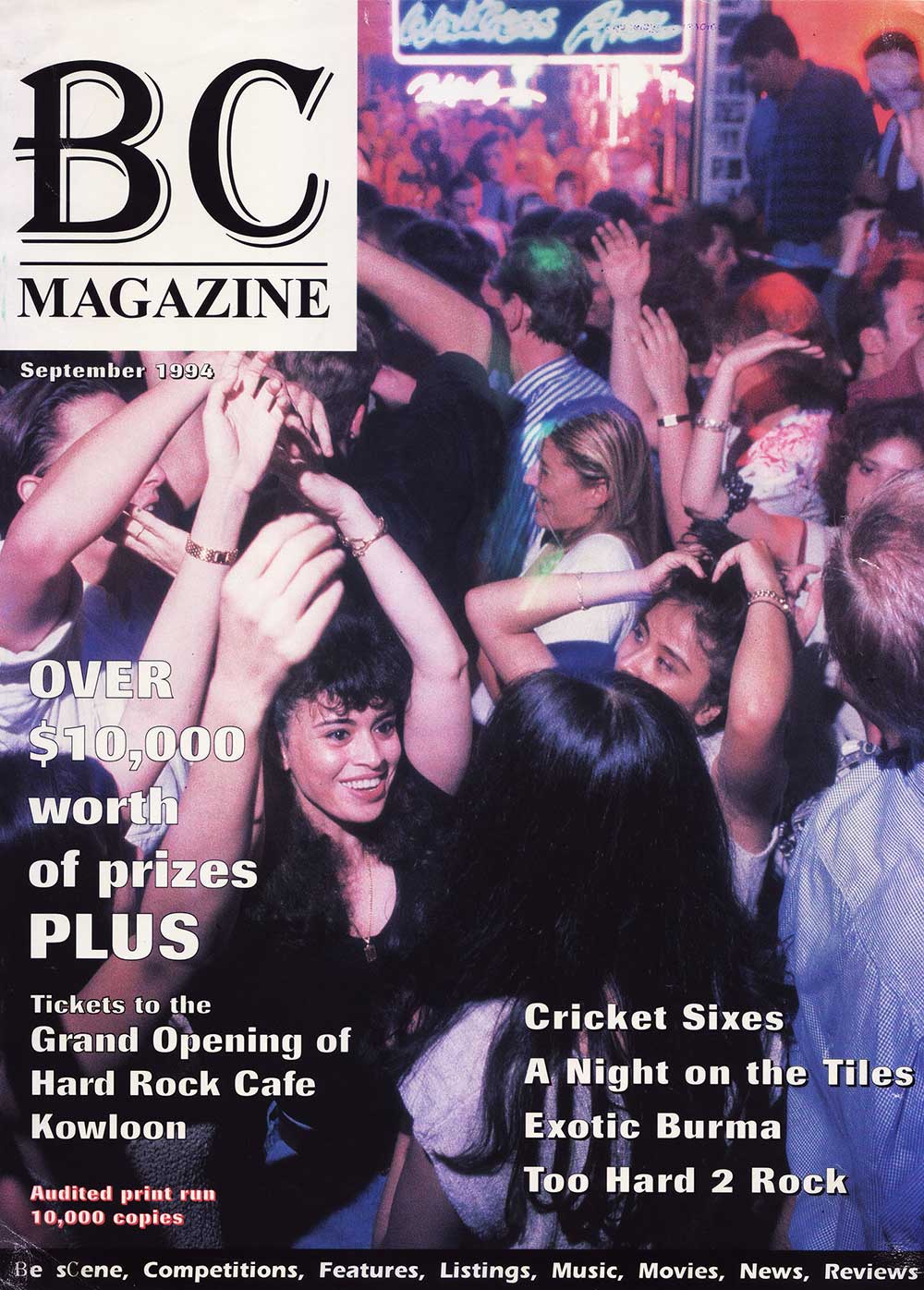
Twenty-nine years ago on the 1st September 1994, bc magazine debuted on the streets of Hong Kong.

A lot of people – staff, friends, advertisers and readers have been involved over the years, thank you for your continued support and strength especially now. Stay safe.

Carpe Diem!

28 Anniversary, bc magazine

Happy Birthday to us!

Twenty-eight years ago today, bc magazine debuted on the streets of Hong Kong.

A lot of people – staff, friends, advertisers and readers have been involved over the years, thank you for your continued support and strength especially now.

Carpe Diem!

HKPPA News Photo of the Year: The Pillar of Shame

The Hong Kong Press Photographers Association (HKPPA) has announced the winner of its annual “Focus on the Frontline” photo competition.

The 2021 winner is HK01‘s Liu Ngan Hung for his photo “The Pillar of Shame” depicting workers removing the Pillar of Shame from HKU. The statue remembers those murdered when the People’s Liberation Army opened fire on democracy protesters in Tian’anmen Square on 4 June 1989.

The “Focus On The Frontline” photo contest began in 1993 and has become one of the most prestigious awards for local photojournalists. Through the competition, the HKPPA looks for photographs that are important to Hong Kong’s history and which combine the elements of art and journalism.

Commenting on the winner “The jury thinks ‘The Pillar of Shame’ reflects the Hong Kong people’s sustained concern over June 4th, which is also a yearning and worries for the country’s democratisation. As workers removed the pillar in the twilight, it symbolises the freedoms of thought and expression once cherished in Hong Kong being dispossessed. The lighting condition and framing of the photograph gives it a baroque aesthetic, bringing tension to the work. The posture of workers lowering their heads to avoid being photographed and the darkness that envelopes the action are metaphorical, constructing a meaning that is more than the sum of all the visual elements in the image.”

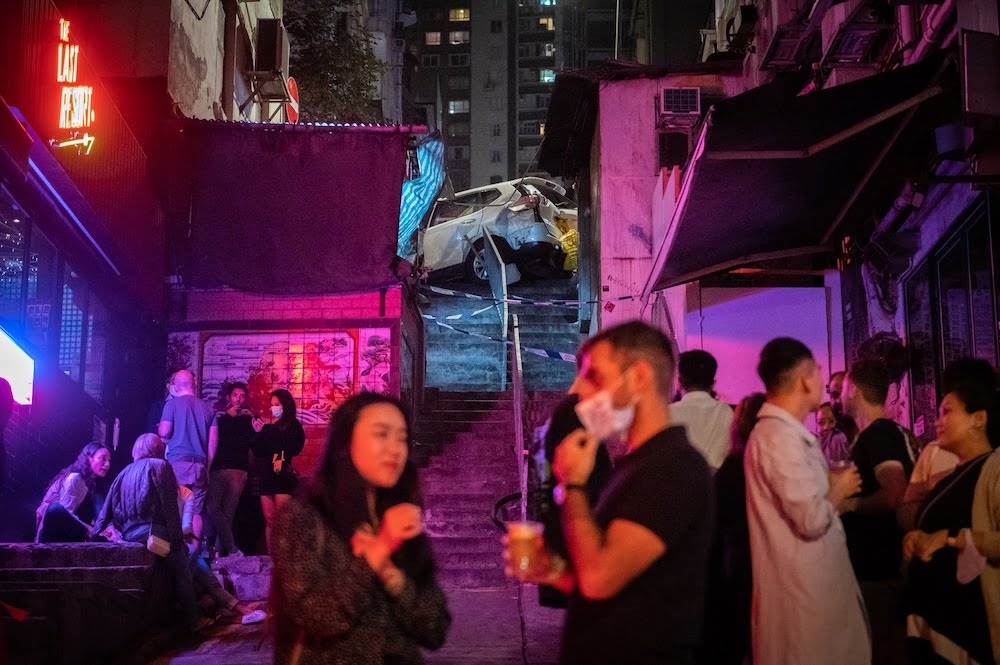
Ming Pao’s Lam Oi Yee image of people drinking on a street, metres away from a fatal car accident came second in the Spot News category.

Lam Oi Yee

Press Freedom Plunges….

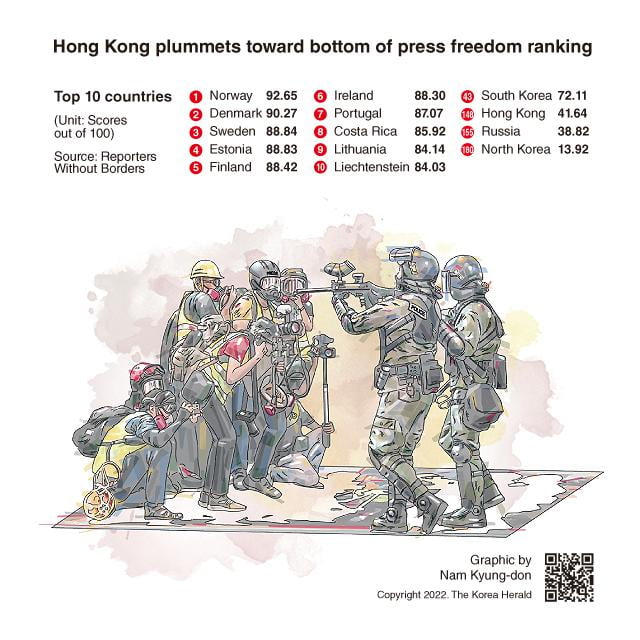
Hong Kong’s ‘press freedom’ has plunged 68 places to 148th (out of 180) since the implementation of the National Security Law as government critics are jailed and publications silenced.

The 20th World Press Freedom Index published by Reporters Without Borders (RSF) reveals a large increase in polarisation amplified by information chaos – that is, media polarisation fuelling and feeding divisions within and between countries.

The spread of ‘opinion media’ and disinformation are amplified by the way social media functions and are creating extreme polarisation of views with an unrepresented and unlistened to middle ground.

“At the international level, democracies are being weakened by the asymmetry between open societies and despotic regimes that control their media and online platforms while waging propaganda wars against democracies.”

Reporters Without Borders defines press freedom as “the effective possibility for journalists, as individuals and as groups, to select, produce and disseminate news and information in the public interest, independently from political, economic, legal and social interference, and without threats to their physical and mental safety.”

In order to reflect press freedom’s complexity, five indicators are used to compile the Index: the political context, legal framework, economic context, sociocultural context, and security.

image: The Korea Herald

FCC Opposes New Hong Kong Police Accreditation Process for Journalists

The FCC issued the following statement in regards to the new restrictions imposed by the police on journalists in Hong Kong. If the HK Police have nothing to hide, then they should not fear media scrutiny of their actions.

Sadly, in numerous recent court cases, video evidence from journalists has proved that the HK Police have submitted factually inaccurate statements under oath to the court in attempts to convict innocent HongKongers.

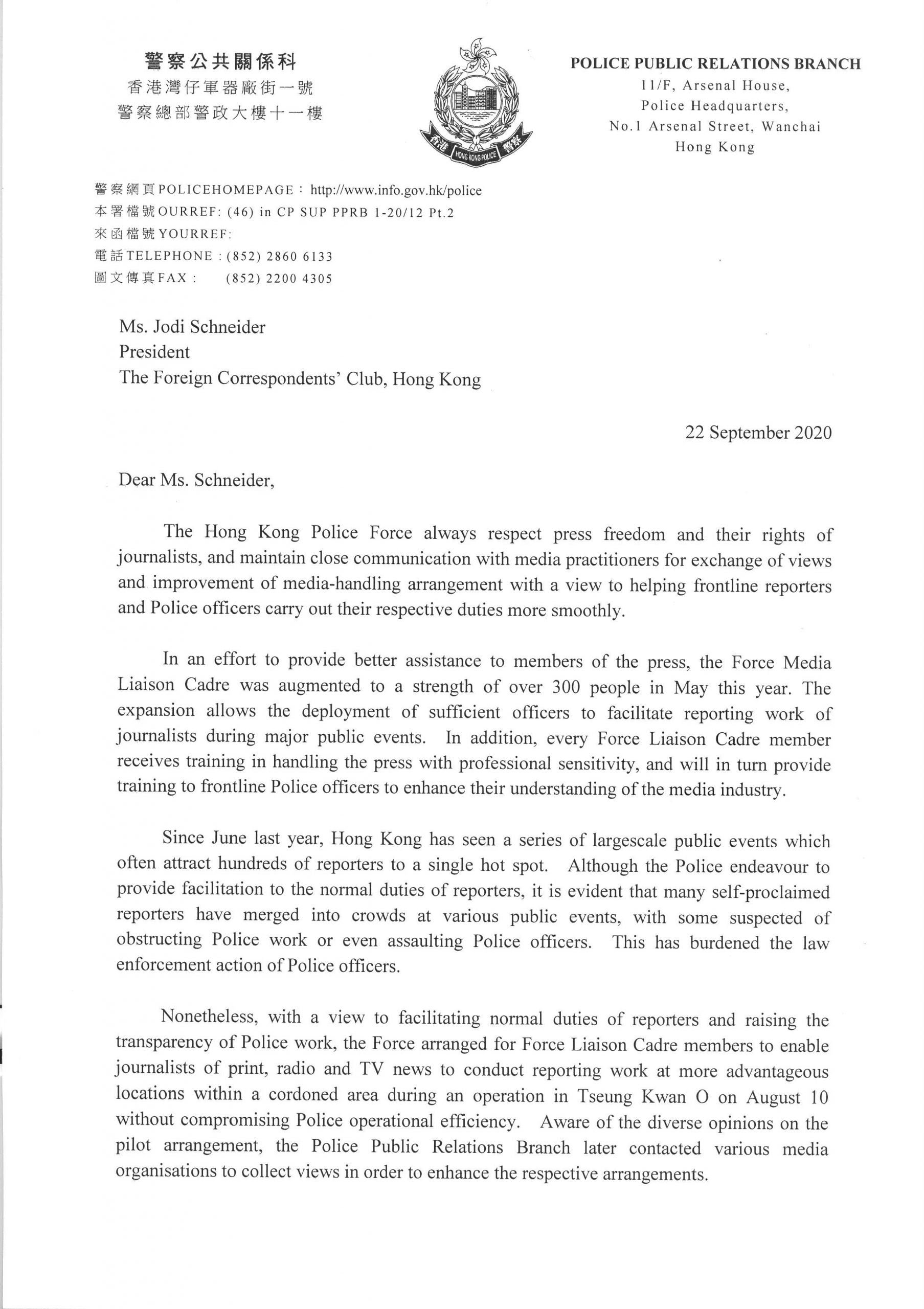
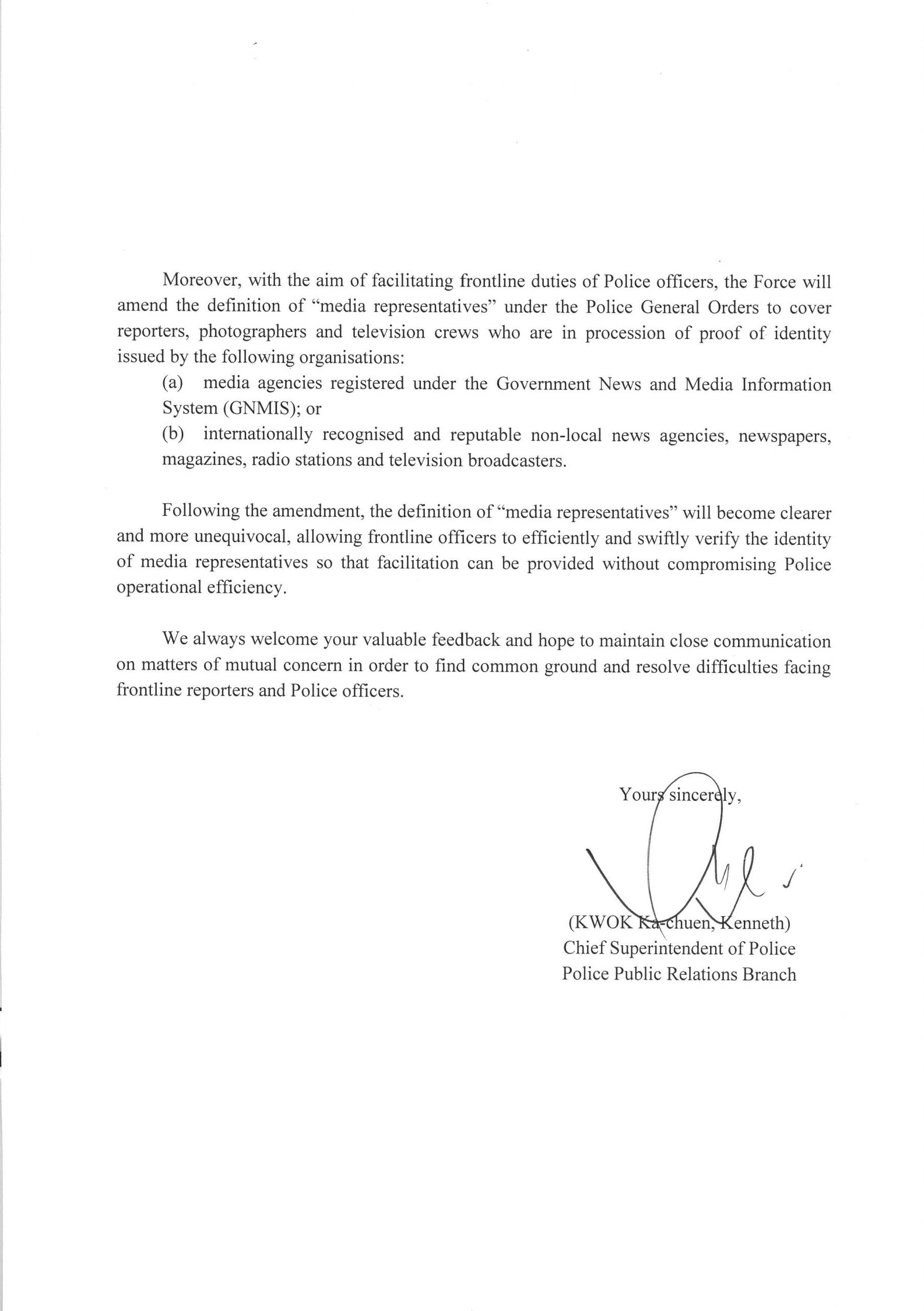
Here is the FCC statement in full, including a letter from the HK Police to the FCC.

The Foreign Correspondents’ Club, Hong Kong, is firmly opposed to a restrictive new accreditation policy for journalists in the city as detailed in a 22 Sept. letter from the Hong Kong Police. This move is another step in the erosion of Hong Kong’s once cherished press freedom as it would give the police — rather than reporters and editors — the power to determine who covers the police.

The changes are not referred to as an accreditation system, but rather a redefinition of who is a journalist in the Police General Orders with the aim of “allowing frontline officers to efficiently and swiftly verify the identity of media representatives.” The letter says the police force will “amend the definition of ‘media representatives’ under the Police General Orders.” Yet the practical impact is the same as accreditation or licensing.

The new rule says police will only recognise as media those who have registered with the Government News and Media Information Service, or members of “internationally recognised and reputable” foreign media outlets. The goal, according to police spokesmen, is to weed out so-called “fake reporters,” who they claim — without offering evidence — have obstructed police operations and even assaulted police officers on duty.

The FCC stands firmly against the system detailed in the Hong Kong Police Force’s letter for the following reasons:

* It undercuts the local journalist organisations whose membership cards have been routinely recognised and respected, the Hong Kong Journalists’ Association and the Hong Kong Press Photographers Association. These organisations conduct rigorous vetting of candidates before issuing membership cards, and this move by the police would take the power to determine who is a legitimate journalist out of the hands of journalists’ groups and place it in the hands of a government entity. That in itself is a serious erosion of press freedom and independence.

* The new scheme would give police officers the power to decide what foreign media outlets are “internationally recognised and reputable.” How would that be determined? With the proliferation of new media outlets around the world, how can the police on the ground determine which ones are “internationally recognised” and deserving to be treated as legitimate? What about media that do not publish or broadcast in English, or that are not widely known outside of their home countries or immediate regions — are they not to be considered real journalists?

* The policy would be a serious blow for freelancers and student reporters — two groups of journalists who have provided some of the most compelling reporting from last year’s protests and police actions. Many journalists now operate as freelancers, some working regularly for specific organisations, and many others offering their stories and videos to multiple outlets “on spec”. News outlets have come to rely on freelancers due to the changing economics of the industry. But most of them cannot obtain registration because of their freelance status.

Student journalists, likewise, have been integral to the reporting on — and public understanding of — last year’s protest movement. Student reporters have faced the same dangers as veteran journalists, and some have been injured.

But this is about more than access to events and invitations to the inside of the police cordon. Journalists who are not recognised under this new policy could face the real possibility of arrest for unlawful assembly or rioting.

Before this new policy, Hong Kong had already dropped to an ignominious 80th place on the Reporters Without Borders annual press freedom index of 180 countries, down from 48th place in 2009. And that was before the 10 August police raid on the headquarters of Apple Daily and the arrest of its founder, Jimmy Lai.

The Hong Kong police in their letter say they “always respect press freedom and their rights of journalists.” If that is the case, they should welcome free and unfettered access to their operations and should encourage open reporting instead of trying to restrict the number of journalists covering its operations. A force that is proud of its discipline and confident its officers follow established protocols and guidelines should have nothing to fear from the spotlight journalists shine on it.

Source: https://www.fcchk.org/fcc-opposes-hong-kong-police-accreditation-process-for-journalists/


Where to Access Coronavirus News Without a Paywall

When it comes to coronavirus news / COVID-19, there is a mass of misinformation and charlatans looking to profit from the suffering of others.

Many of the media sources you might trust are behind paywalls – journalism after all costs money – with limited free articles.

However because of the seriousness and global nature of the pandemic many news outlets have made their COVID-19 news free to access. Here is list of major outlets with free updates and articles:

The New York Times is offering its COVID-19 coverage for free.

The Washington Post has a free email newsletter for coronavirus-related news. All articles linked in the newsletter are free.

The Los Angeles Times coronavirus liveblog is available for free.

The Wall Street Journal has created a free section for coronavirus articles.

The Atlantic is offering all coronavirus-related articles for free.

The Star is labeling free articles related to the coronavirus with a red “free digital access” label.

The Guardian has no paywall.

BBC has no paywall

Associated Press

STAT, which covers health and medicine, is offering its coronavirus coverage for free.