Following one of the longest and most painful doldrums crossings in memory, the Volvo Ocean Race fleet is now in the northeast trade winds and speeding towards the finish line in Hong Kong, some 2,700 nautical miles to the northwest.
The fleet finds itself in three distinct groupings, with Dongfeng Race Team leading team AkzoNobel and Vestas 11th Hour Racing in the northernmost triumvirate. And it’s in the north where the stronger winds should be as the northeasterly trades winds get established.
“I think we are in a strong position,” said Dongfeng Race Team skipper Charles Caudrelier. “We have just left the doldrums and we should be the first ones to catch the trade winds… we hope. We are very close on the ranking with Scallywag but we prefer our position for the future.”
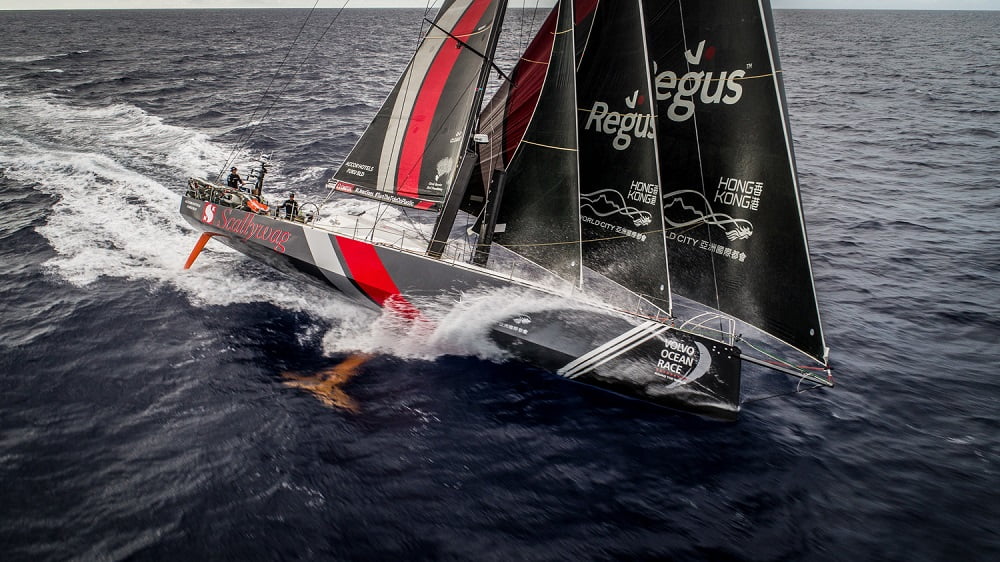
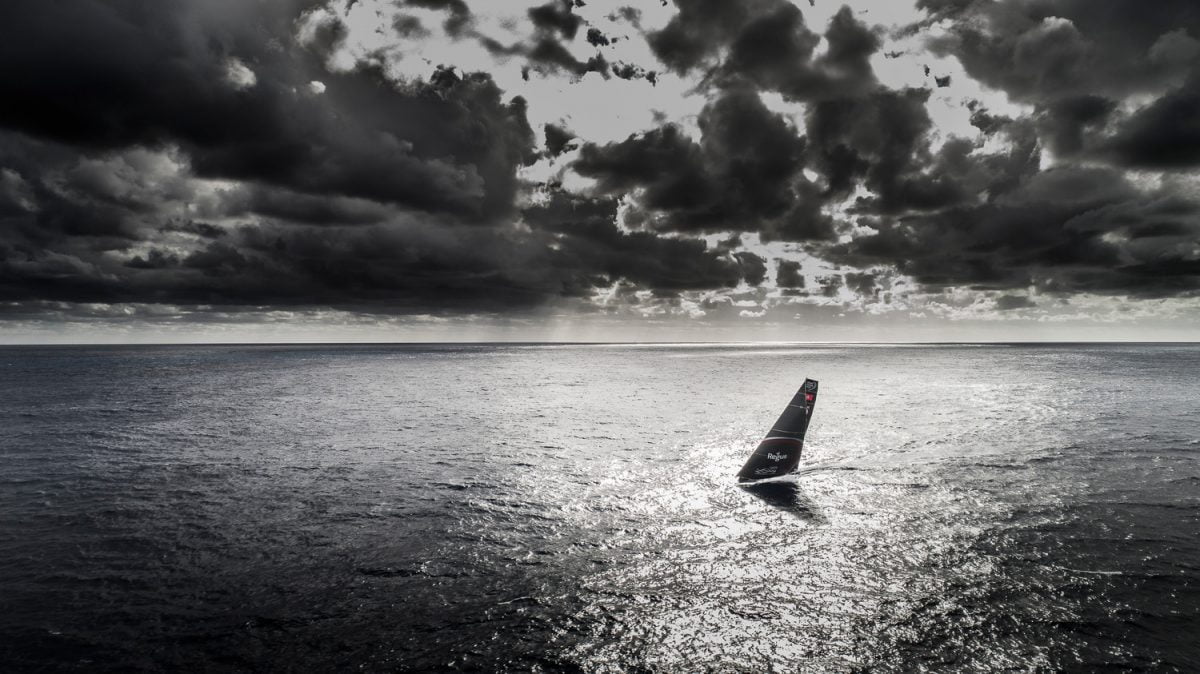
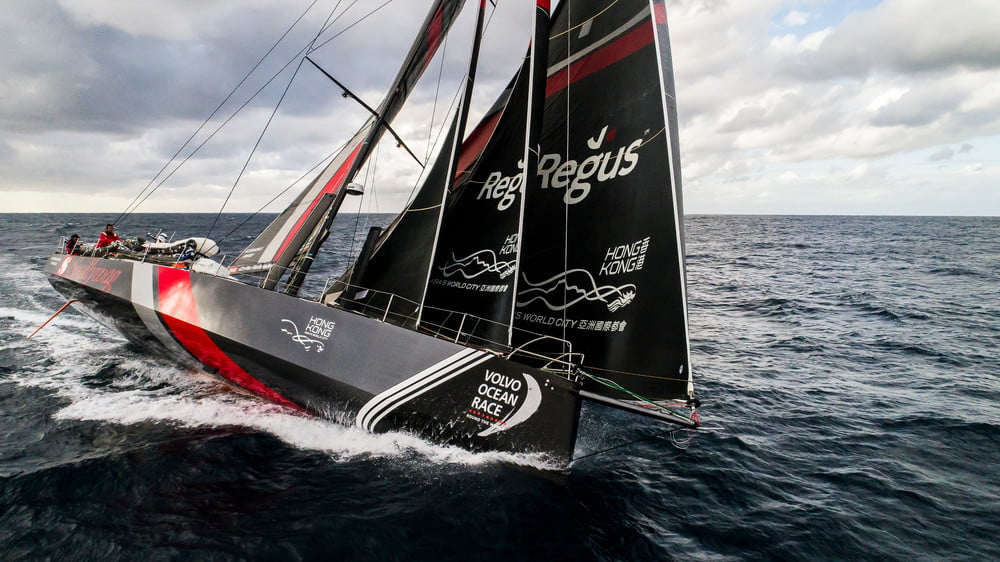
While that northern option may turn out to be the correct one, at the moment, it’s David Witt’s Sun Hung Kai/Scallywag who are stealing a march on the opposition.
Contrary to many weather routing predictions, Witt and his crew have managed to craftily cut the corner, turning west before the rest of the fleet and gaining valuable miles towards the finish.
“The weather has helped us for sure,” Witt said. “It’s a balance between making decisions based on what the weather files tell you and what you can see in front of you… Anything can happen, it’s a pretty volatile situation still, but I’m pretty sure this group of people can deal with whatever happens.”
The Scallywags make up the middle grouping on their own, with MAPFRE leading Turn the Tide on Plastic and Team Brunel in the final triad, some 150 nautical miles directly east (and further from the finish line) compared to Scallywag.
For the trailing group, it’s been 24 hours of immense frustration. One final cloud in the doldrums grabbed these three and wouldn’t let go, while the other four boats were speeding away.
“We thought we’d be fighting at the front and now we’re fighting at the back which is not where we wanted to be,” said Dee Caffari, the skipper of Turn the Tide on Plastic. “Really disappointed. But we have nearly 3000 miles left to make it up.”
Additional reporting and photos: Konrad Frost, Volvo Ocean Race, Brian Carlin
Tse Long-hin scored the crucial penalty as Hong Kong won the 40th Hong Kong-Guangdong Cup 4-2 on penalties. After winning the first leg 2-0 at the HK Stadium on the 4 January, Hong Kong lost the second leg away as Guangdong reversed the score at home as they triumphed 2-0 in Guangzhou.
With the match all square after normal time goalkeeper Douglas Yuen Ho-chun – who made several fine saves during the game – was the star in the penalty shoot-out saving twice as Hong Kong won 4-2 and regained the Guangdong-Hong Kong Cup for the first time in five years.
“The boys performed really well under the circumstances,” said interim Hong Kong coach Kenneth Kwok Ka-lok. “We are a young side and some of the players were suffering from injuries and even illness so that made it more difficult. But we had fire in our bellies and we handled the pressure, even in the penalty shootout where we held our own. We rose to the occasion. It wasn’t an easy thing to do.”
Unlike the traditional Southern Ocean route of Leg 3, the fourth stage of the Volvo Ocean Race from Melbourne to Hong Kong is a new addition for the 2017-18 edition – but some of the challenges it poses will be recognisable from the early north-south legs.
The Volvo Ocean Race leg four will start in Melbourne on the 2 January and the fleet are expected to arrive in Victoria Harbour around the 20 January with local boat Scallyway looking to lead them home.
Where Leg 3 was all about hooking onto the infamous depressions of the Westerly Storm Track that circle the bottom of the world west to east unrestricted by land mass, Leg 4 is all about navigating through climate zones.
Setting out across the Coral Sea, the sevens boat fleet must tackle the Subtropical High Pressure Zone, a stable, semi-static area of high pressure in the Pacific lying between 30 and 38 degrees south. Because of its proximity to the northern edge of the Westerly Storm Track there is a real chance of being propelled out of Melbourne by big winds. Equally, the anticyclone could prove dominant.
The normally-consistent trade winds will come into play as the fleet climbs further north, before the dreaded Doldrums come into play once more. Throw in numerous Pacific Islands dotted around the course and you’ve got a serious challenge in the shape of Leg 4.
Leg 3, Cape Town to Melbourne, day 3, on board Sun Hung Kai/Scallywag. Photo by Konrad Frost/Volvo Ocean Race. 12 December, 2017.
Additional reporting and images: Konrad Frost, Volvo Ocean Race
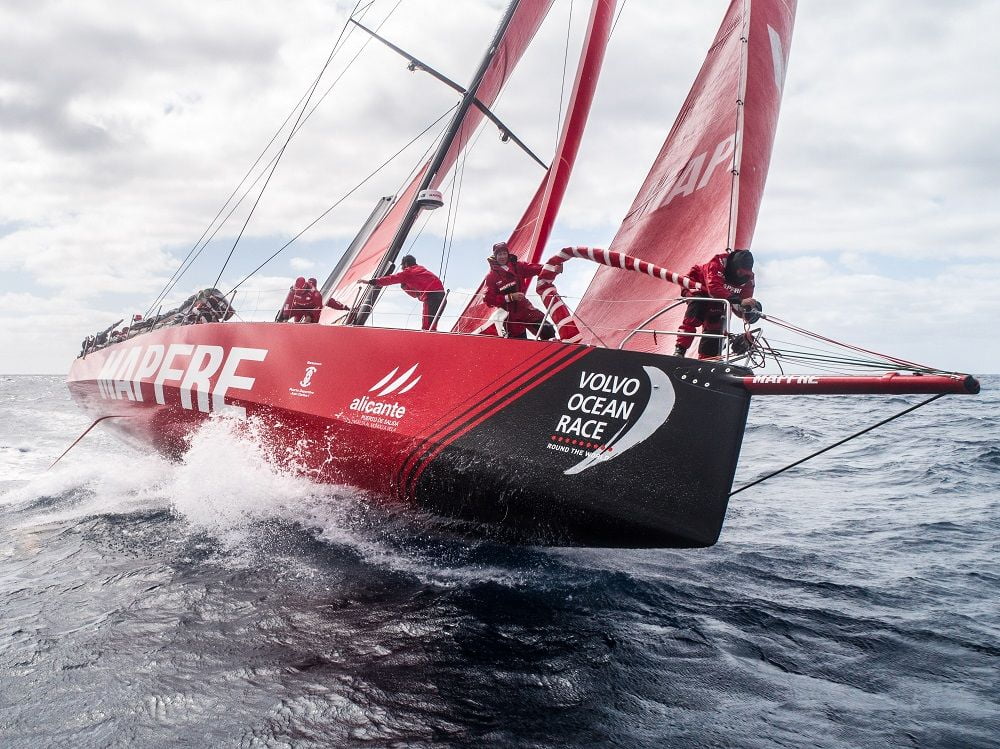
The Spanish Volvo Ocean Race team MAPFRE wins Leg 3 from Cape Town to Melbourne, a 6,500 nautical mile dive into the fierce challenges posed by the Southern Ocean.
For the second consecutive leg, MAPFRE needed to come from behind to earn the victory. And for the second time in a row, it was Dongfeng Race Team they passed mid-stage, to snatch the win.
“We had to fight very hard for this victory,” skipper Xabi Fernández said moments after crossing the finish line. “There’s so much of the race to go. But for now it’s looking good and we’re very happy of course.”
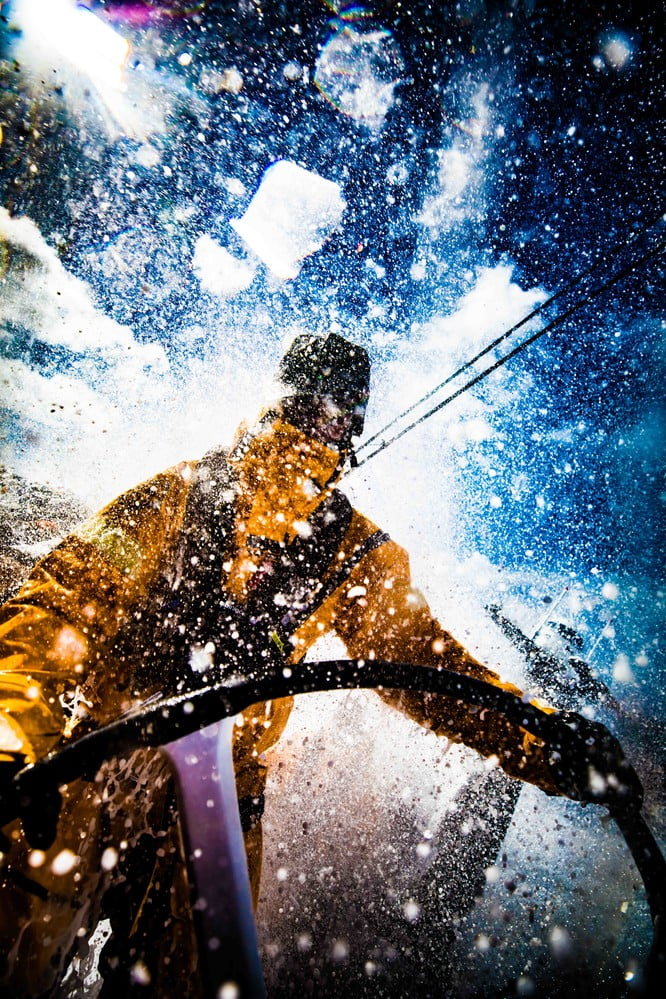
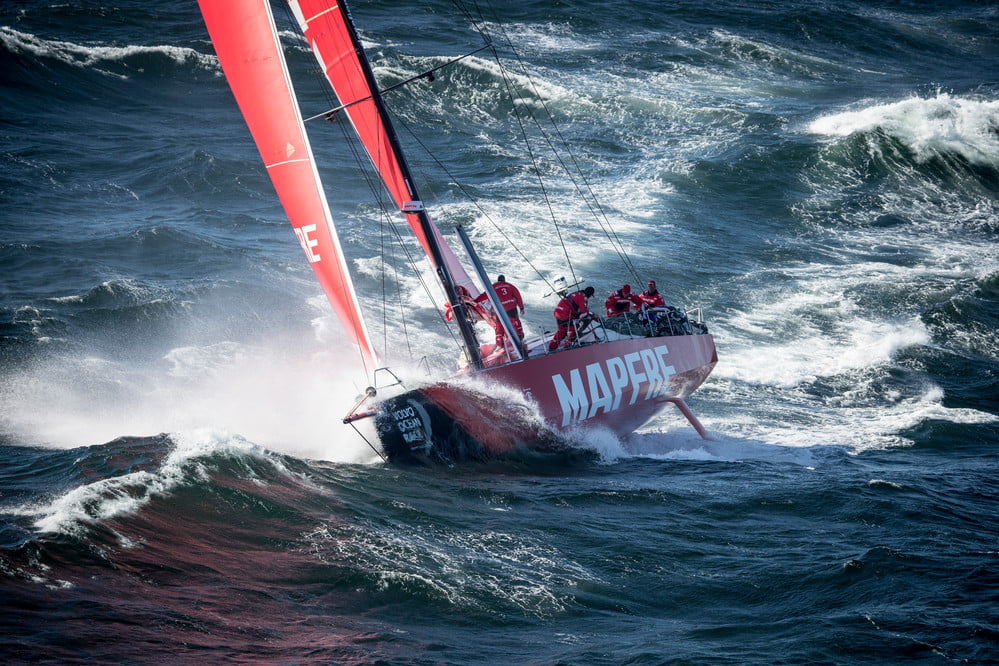
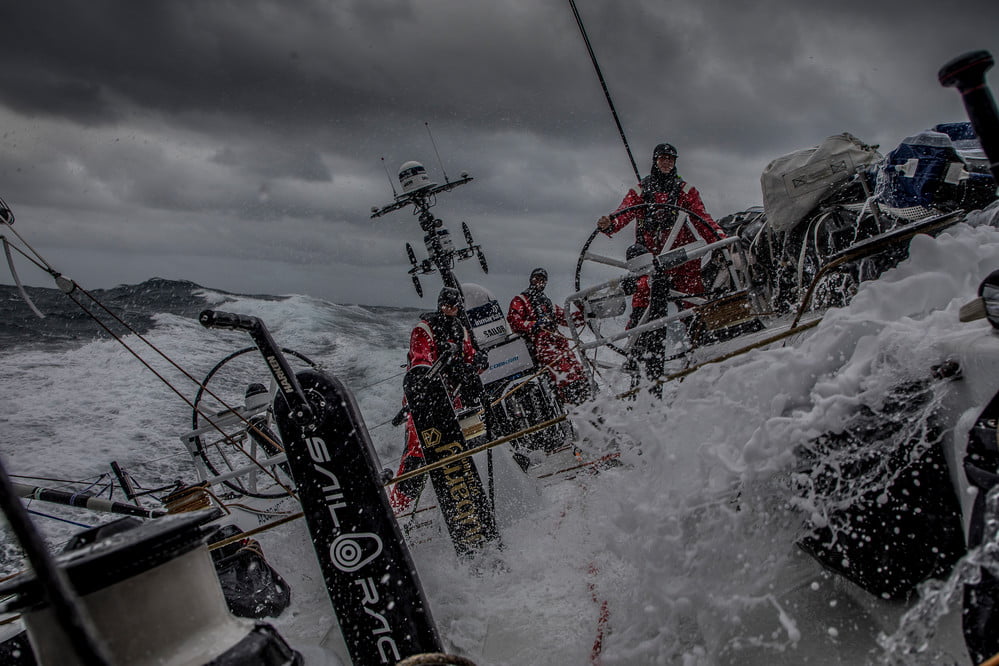
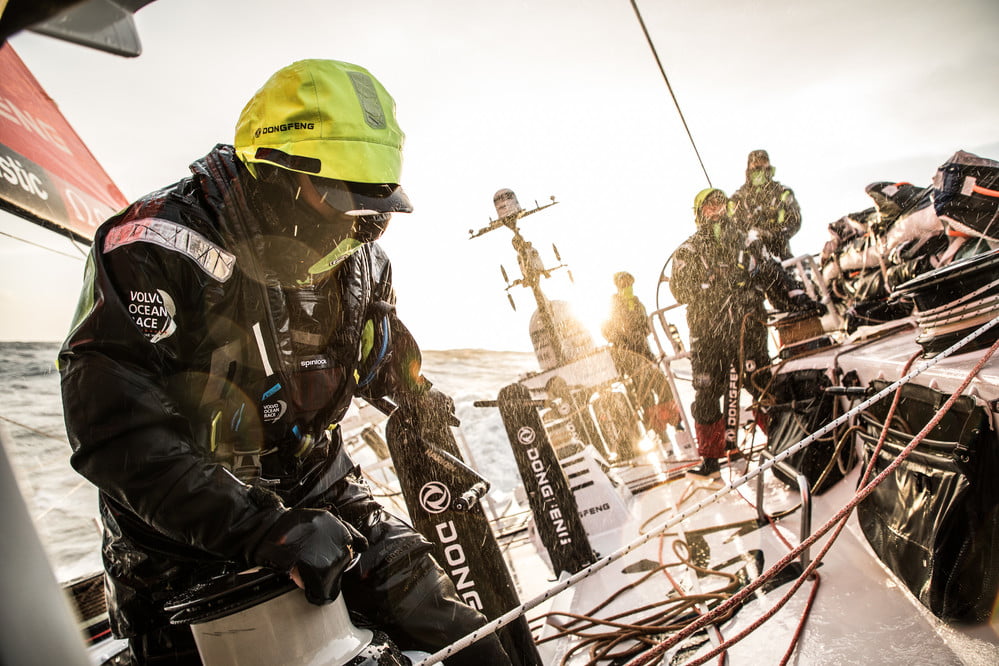
The Southern Ocean pushed the teams to the limit. Extreme cold, storm force winds for days on end and towering seas posed massive seamanship challenges, let alone allowing for racing and tactics.
“The strongest point for this team is the group of people we have,” Fernandez acknowledged. “They are so good and give us so much and have been working so hard on this leg. It was so tough, but it’s all gone perfect. Now we have a few days for recovery and we can get ready for the next one.
Leg 3, Cape Town to Melbourne, Start. Photo by Ainhoa Sanchez/Volvo Ocean Race. 10 December, 2017.
Dongfeng Race Team, nursing home a boat with a damaged keel system was able to fend off a late charge by Vestas 11th Hour Racing and Team Brunel to secure second place finish. It’s the second consecutive second place finish for skipper Charles Caudrelier’s team and this one will be bittersweet. The team led for much of this hard Southern Ocean leg and were disappointed to see MAPFRE make a pass to take the win
“This was the toughest leg I’ve ever done,” Caudrelier said. “We had this big fight with MAPFRE for most of the race and then a big problem on board just before the finish. A crazy section of gybing around the ice limits, it was a very, very difficult leg. We’re a bit disappointed after leading 80 per-cent of the time to give first place up to MAPFRE, but there are more legs to come and we will do better.”
Vestas 11th Hour Racing grabbed the final spot on the podium. Just after crossing the finishing line, Mark Towill, team director and co-skipper acknowledged the scale of the achievement “It was a tough leg. We’re happy to be on the podium again. It’s great to be in on Christmas and I know we’re all looking forward to getting ashore. It was a difficult leg, hard on the bodies, but everyone has held up well.”
Leg 3, Cape Town to Melbourne, day 5, Morning watch on board Sun Hung Kai/Scallywag. Photo by Konrad Frost/Volvo Ocean Race. 14 December, 2017.
The Vestas 11th Hour Racing crew finished behind Dongfeng Race Team but ahead of Team Brunel. At one point, with about 36 hours to go, the race tracker showed nothing to choose between Vestas and Dongfeng in terms of distance to finish, but in reality, the tactical situation favoured the Chinese/French boat.
“It was looking pretty close for a little while, but they were always ahead,” Towill said. “They were always comfortable. Brunel sailed well too so credit to them. It was challenging conditions and we’re all happy to be here and in one piece.”
In fourth place was Team Brunel, skipper Bouwe Bekking knows it keeps his team in touch with leaders but wants to be challenging the leaders. hoa
“It’s been a really hard leg. We always expected it would be tough and it lived up to that,” Bekking said. “Plenty of breeze and some awesome sailing as well.
Fifth place in Leg 3 went to Sun Hung Kai/Scallywag who managed to hold off Turn the Tide on Plastic, for the second consecutive leg. Skipper David Witt steered Scallywag across the Melbourne finish line on a sunny boxing day, just in time for lunch. Turn the Tide on Plastic was less than three hours behind, after over two weeks and 6,500 nautical miles of close, hard-fought racing.
“Aussies arriving home after a tough leg. 6th place – shame we couldn’t catch those Scally’s. We tried and it was close. Hopefully next time,” tweeted Turn the Tide on Plastic skipper Dee Caffari as her boat approached the finish line.
Leg 3 of the Volvo Ocean Race represented a return to the roots of the race – a dip down to the Roaring Forties of the Southern Ocean, where storm systems circle Antarctica, unimpeded by land. The result is day after day of cold, strong winds and fearsome seas.
“The Southern Ocean always turns it on,” said Scallywag’s Luke Parkinson as the boat pulled up to the dock. “There are big waves and a lot of wind. This time we probably spent more time further south with day after day of big wind. It certainly can wear you down. When we turned left and headed up to Australia it was pretty special – a very good feeling. We’ve got to rest up now and be ready to leave in a few days.”
It’s an abbreviated stopover in Melbourne, with restrictions on how much work the crews are allowed to do on the boats, ahead of the start of Leg 4, to Hong Kong, on January 2, 2018.
Leg 3, Cape Town to Melbourne, day 06, on board Dongfeng. Rough sailing condition close to the ice gate. Black at the pit. Photo by Martin Keruzore/Volvo Ocean Race. 15 December, 2017.
Volvo Ocean Race Leg 3 – Provisional Results
MAPFRE – 14 days, 04h:07m:21s
Dongfeng Race Team – 14 days, 08h:10m:16s
Vestas 11th Hour Racing – 14 days, 09h:52m:11s
Team Brunel – 14 days, 11h:36m:27s
Sun Hung Kai/Scallywag -15 days, 13h:06m:31s
Turn the Tide on Plastic -15 days, 15h:52m:50s
team AkzoNobel – still racing
Volvo Ocean Race Leaderboard
MAPFRE – 29 points
Dongfeng Race Team – 23 points
Vestas 11th Hour Racing – 23 points
Team Brunel – 14 points
Sun Hung Kai/Scallywag – 11 points
AkzoNobel – 7 points
Turn the Tide on Plastic – 6 points
Additional reporting, images: Volvo Ocean Race, Martin Keruzore, Jeremie Lecaudey, Konrad Frost, Ainhoa Sanchez
Strong winds are forecast for the start of Leg 3 of the Volvo Ocean Race on Sunday afternoon in Cape Town as the famous ‘Cape Doctor’ – a strong southeasterly wind – pays a visit over the weekend.
On Saturday morning the doctor made a house call bringing a steady 40 knots of wind, and at least one gust of over 60 knots was recorded. This is expected to moderate somewhat for Sunday’s race start, but winds are forecast to remain in the 25 to 35 knot range, with some gusts significantly stronger.
“It’s going to be full-on for the start,” says Vestas 11th Hour Racing navigator Simon Fisher. “Very strong southeasterlies and then when we get offshore it will be a decent sea-state we’re banging into as well. It will soften a bit but then we’re quickly into the westerlies and it’s the proper Southern Ocean. It’s going to be an intense leg in general.”
“It could be very windy for the first week and very high speed,” agreed Charles Caudrelier, skipper of Dongfeng Race Team. “I think it’s going to be a fantastic leg.”
Leg 3, from Cape Town to Melbourne, Australia is a nominal 6,500 nautical miles. The routing takes the teams down into the ‘Roaring Forties’, the area south of 40-degrees latitude where storm systems circle Antarctica, unimpeded by any land mass. Towering waves, steady gale and storm force winds, and ice-cold temperatures are a daily feature here.
“We should remember it’s late spring, just the beginning of summer and the winter has just passed in the Southern Hemisphere so the water is still bloody cold,” said race veteran Bouwe Bekking, the skipper of Team Brunel.
“I think the most frightening thing is that the depressions are still so strong… the amount of pressure that is in the air is just humongous. And of course, the water temperatures – hopefully with the ice limits we don’t encounter any ice – but if the water is just a few degrees above freezing and you get a southerly breeze, you might be having icicles off the mast some times. We’ve experienced it in the past… When we did this leg in the old days, this was the leg when the most damage appeared. The boats today are stronger than before, but still things can break.”
Deciding when to push for speed and when to throttle back to protect crew and equipment is a delicate balance. The stakes are even higher as this is the first double-point leg. The winner of Leg 3 will collect 15 points (7 x 2 = 14 plus a 1 point win bonus).
“I think we have a lot of experience on our boat and we have to trust that experience in the Southern Ocean,” explained Charlie Enright, skipper of Vestas 11th Hour Racing talking about finding the balance of how hard to push. “It not just about the points, it’s the fact we don’t haul-out in Melbourne, it’s the heavy conditions in the Southern Ocean, because you don’t want to break anything…To finish first, you must first finish.”
For Xabi Fernández, the skipper of MAPFRE, the race leader, the stopover in Cape Town provided a much needed opportunity to recharge.
“After the first long leg (Lisbon to Cape Town), it’s always important to be in the front,” he said. “We’re happy as a team. We had a good stopover. The boat is in great shape and the team is as well, so we’re ready to go.”
The start of Leg 3 is scheduled for 2pm in Cape Town, 12:00 UTC, and will be broadcast live on www.volvooceanrace.com.
Additional reporting and images: Pedro Martinez, Volvo Ocean Race
Vestas 11th Hour Racing and Dongfeng Race Team traded blows throughout the first half of the Cape Town In-Port Race course on Friday afternoon, before the Chinese-French team grabbed the lead midway through the race and stretched away for their first win in the series.
The victory vaults skipper Charles Caudrelier’s team to second place on the leaderboard for the In-Port Race Series, just behind MAPFRE who retained the overall lead with a fightback second place finish on Friday.
“The team did a fantastic job, very nice boat handling and good speed, so well done to the full team,” Caudrelier said after the race. “Our start was not fantastic, but after that we made a good call to tack a bit earlier and put pressure on Vestas and then we found some good speed. That was a key factor.”
Conditions were spectacular on the waters off Cape Town, with wind near 20 knots, under bright, sunny skies. Boat handling was at a premium in the fresh conditions and on the first two laps of the course, there were several very close crosses as the boats approached the turning gates.
Near the end of the second run, Vestas 11th Hour Racing were sailing on an awkward wind angle to the mark and had difficulty furling their big A3 downwind sail in preparation for the rounding.
It didn’t hurt them immediately but when they next tried to deploy the sail at the final top mark, it wouldn’t fully unfurl, and the team was very slow for most of the final run.
“We started well,” said navigator Simon Fisher. “At the second top mark Dongfeng did a great job, pushing us to the less favoured side, which pushed us back into the fleet, which put pressure on the downwind drop, which meant we didn’t have a great furl, and that hurt us on the last run. It’s just a great example of how things can snowball.”
The mistake cost the team two places, as both MAPFRE and team AkzoNobel raced past on the run to the finish.
The second place finish represented a tremendous comeback for MAPFRE who were forced into a penalty turn just before the start, leaving them them the last to get across the line.
But the Spanish team kept pushing its way up the fleet, finally forcing team AkzoNobel away with an aggressive luff near the final top mark, setting the table for the pass of Vestas 11th Hour Racing on the final run.
Further back, Brunel and Scallywag engaged in a luffing match early on the first run. The Umpires penalised Scallywag for an infraction and following the penalty turn, David Witt’s team were trailing the fleet.
At the finish, a hard-charging Brunel nearly stole a place from Turn the Tide on Plastic. But Dee Caffari’s team, who had a very strong start to the race, held on for fifth place.
Cape Town In-Port Race Results 1. Dongfeng Race Team
2. MAPFRE
3. team AkzoNobel
4. Vestas 11th Hour Racing
5. Turn the Tide on Plastic
6. Team Brunel
7. Sun Hung Kai / Scallywag
Volvo Ocean Race In-Port Race Series Leaderboard 1. MAPFRE – 19 points
2. Dongfeng Race Team – 18 points
3. Team Brunel – 13 points
4. Vestas 11th Hour Racing – 12 points
5. Team AkzoNobel – 11 points
6. Scallywag – 6 points
7. Turn the Tide on Plastic – 5 points
Additional reporting and images: Volvo Ocean Race, Pedro Martinez, Ainhoa Sanchez







 “We should remember it’s late spring, just the beginning of summer and the winter has just passed in the Southern Hemisphere so the water is still bloody cold,” said race veteran Bouwe Bekking, the skipper of Team Brunel.
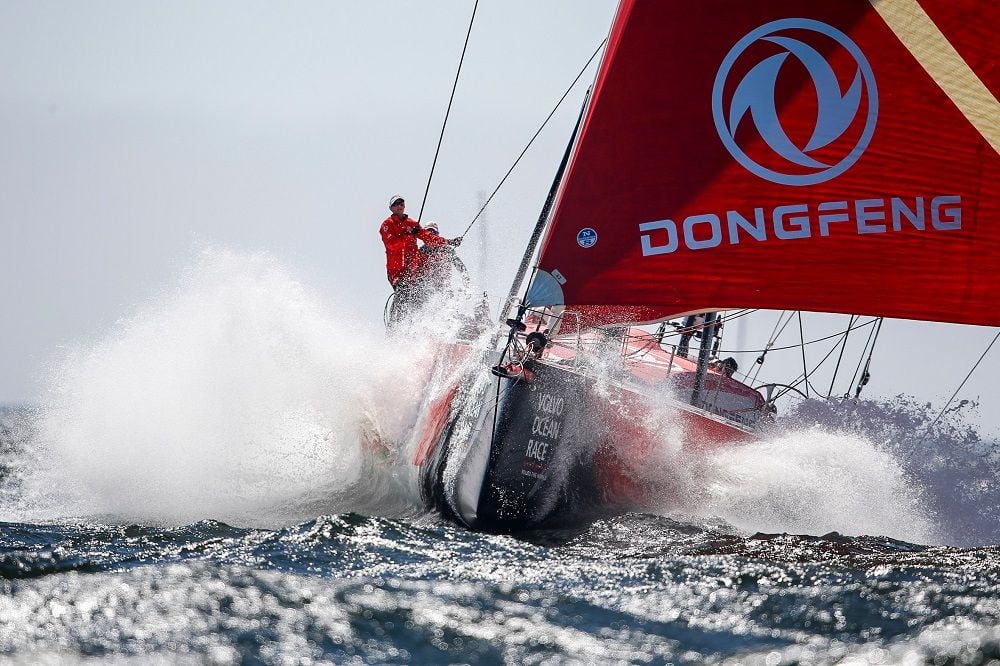
 Conditions were spectacular on the waters off Cape Town, with wind near 20 knots, under bright, sunny skies. Boat handling was at a premium in the fresh conditions and on the first two laps of the course, there were several very close crosses as the boats approached the turning gates.
 It didn’t hurt them immediately but when they next tried to deploy the sail at the final top mark, it wouldn’t fully unfurl, and the team was very slow for most of the final run.
 But the Spanish team kept pushing its way up the fleet, finally forcing team AkzoNobel away with an aggressive luff near the final top mark, setting the table for the pass of Vestas 11th Hour Racing on the final run.