HK Indigenous is one of several new political groups that has evolved from the experiences learned during the initial months of the Umbrella Movement. They “want to break away from the pseudo democratic roadmap and put direct pressure on the government with the right means of protest. We have to alert the government that the indigenous value of Hong Kong cannot be washed away or sold.”
This is the HK Indigenous Charter in English if you didn’t know what they are about:
————
Hong Kong Indigenous: Upholding Indigenous Virtue Against Suppression
18 years have passed since the handover of Hong Kong. “One Country, Two System” is just a scam under the Communist Party rule. Day after day we local Hong Kong people lose our rights and indigenous values to the Chinese Communist Party, while the pan-democratic legislators indulge in their own ‘China Dream.’
Hong Kong people are fed up with this. We rallied against the National Education Reform and the North East New Territories Development. We took part in the Umbrella Revolution. We are doing more and more to get this message across to the government – we are not going to back away or accept our fate lying down. The pseudo democrats time after time created fake protests which achieved nothing but keeping the peace for the authorities. Hong Kong people are being betrayed and kept away from true democracy, as well as being hindered in developing our own indigenous virtue.
We are a group of nameless Hong Kong people who are on the frontline of protests. Since the old resistance methods have failed against the authorities, we have no choice but to stand out and break the stalemate.
Hong Kong Indigenous was founded after we learned from the lessons from the Umbrella Revolution. We want to break away from the pseudo democratic roadmap and put direct pressure on the government with the right means of protest. We have to alert the government that the indigenous value of Hong Kong cannot be washed away or sold. Thus we are upholding indigenous virtues, as we the people own this city.
We are Hong Kong people. We have the spirit to overcome whatever challenges are thrown at us. We have overcome 1967, 1989, 1997, SARS and avian flu. What is there to fear?
Hong Kong Indigenous leads the way in the new era of protest, where we would not be fooled by pan-democrats or ignored by the government.
If you are proud of the values that Hong Kong People have created during our rich history, then please join us or support us in this fight.
As a westerner living in Hong Kong one of the first things you notice about the Hong Kong Cantonese is that they spend a lot of time shouting at each other. Often, what you think is a conflict is actually just two friends engaging in friendly banter about horses or Korean soap operas. That said, you don’t have to have lived here too long before you will encounter a real confrontation. Whatever the reason for the conflict, these situations quickly escalate into loud slanging matches, punctuated with elaborate verbal abuse and theatrical posturing. These conflicts almost never end in violence. Almost every westerner who witnesses these events for the first time thinks, “There’s no way I would let anyone shout at me like that, I would punch them in the face.”
And on the whole it’s true, westerners are much quicker to fight than Cantonese. Maybe it’s something to do with the Cantonese language being very colloquial and street-wise, who knows? But Cantonese really do enjoy verbally abusing each other where other nationalities would already be rolling in the dirt and fighting.
The Occupy protests amplified this penchant for verbal abuse into a mass movement. Battles over Lung Wo Road regularly saw more than 2000 people chanting abuse to the police but staying incredibly peaceful physically. I personally took a major role in convincing a few people not to load house bricks onto the road, so as to prevent the crowd from bloodbathing the police, who were at this point so cocky that they were running around beating people with no shields or helmets. Good sense won over, in that the Cantonese are really good at verbally abusing each other and don’t need actual violence to articulate and vent their views. Unfortunately this good sense hasn’t seeped down into the police who believe they have the right to Route One to violence because they are being shouted at by the protesters. In this, the police are stepping outside of the Cantonese social norm, in that tens of thousands of times a day, Cantonese hurl verbal rocks at each other, but 99% have the self restraint to not lash out into actual physical violence.
These days in heated confrontations with protesters the HKPF always bemoan, “We’re not doing anything international police wouldn’t do in a similar situation,” but the critical point they miss, is the Cantonese aren’t acting like international rioters. They’re acting like Cantonese. They know the rules of the game, which the police have forgotten, or choose to ignore. Instead They somehow feel they are apart from local culture and are justified in using violence because they’re police and should automatically deserve respect without earning it. This attitude is destroying Cantonese culture by introducing quick, physical violence as a way of resolving conflict. The Blue Ribbons have taken to this new way of conflict resolution like ducks to water. This represents a significant slide in the cultural values of the Hong Kong society and the police created it on October 3rd when they turned a blind eye to the triads causing chaos in Mongkok.
So, the reality is the Occupy Movement has been high on verbal violence and infinitesimally low on actual violence because the Cantonese culture regularly substitutes verbal violence for real violence to resolve conflict and express frustration.
With this in mind, we can see that the current redirection of the democracy movement from protests on the streets outside Legco to Direct Action in the districts has also manifested this engrained habit. Instead, the targets of verbal abuse has changed from the Government and the Police to smugglers and parallel traders.
I stood outside the 3BX Bus line in Tuen Mun for many hours on Sunday and the level of verbal violence that was being hurled was fairly substantial. Certainly, it is not something I would do, but I’m not Cantonese. Those hurling the abuse are not stupid and they are also not racists. I grew up in 1970/80s Birmingham, England, I know what racism is, and what was on display in Tuen Mun last Sunday was certainly not racism.
Instead it is a form of verbal violence against actions that people see as objectionable. If we’d have been in Europe, the protesters would have burnt the bus stop, the bus and probably routed the police out of town. But like I said, this is not the Cantonese style, Cantonese love shouting shit at each other and especially at things they don’t like.
Certainly, from a superficial level, watching the verbal barrage is not pretty and could be misconstrued as hateful racism, but if you are there you can quickly see that it is very specifically directed at a certain type of person carrying out a certain type of action. It is not based on anything the person can’t rectify very quickly. If a Mainlander was in the crowd, they would not be targeted carte blanche for their race or heritage. This is not to say, if they tried to defend the actions they wouldn’t receive a volley of abuse, but they could take part or silently observe without any fear of attack from the rabid crowd. This shows it’s much more sophisticated than racism. Try sticking a silent, black person in a group of European Neo Nazi racists and see if you get the same result.
This is the critical difference between the anti-Mainland sentiment in Hong Kong and say classic white, black racism in Europe or America. They are coming from completely different foundations. One is a temporary form of protest, or a new form of expression at the dissatisfaction towards our malign government. The other is coming from hatred based on ignorance, is long lasting and often incurable.
Given this, at this point, I have no fear that the democracy movement has been hijacked by racism, certainly a tiny minority may misunderstand what is going on. Definitely our malign government will try and exploit it for its own advantage, but the protestors are smart and savvy. They will use this current tactic while it is useful and discard it once it becomes a burden.
It may not be pretty, but revolutions never are. Some might argue that flirting with racism is playing with fire, but the protesters would argue back,
We’re in the midst of a ‘game’ generation. Everyone is gaming whether on their phone, using a computer or game station or even vicariously by watching videos of others gaming. And it’s fun! We enjoy pitting our skills against the computer or friends across the digital world. But it’s intrinsically a singular experience we game alone in our own world… which goes really against the idea of games. Games are social experiences, people get together to share, have fun, build bonds, reduce stress – all things apart from fun, that are missing in the digital experience.
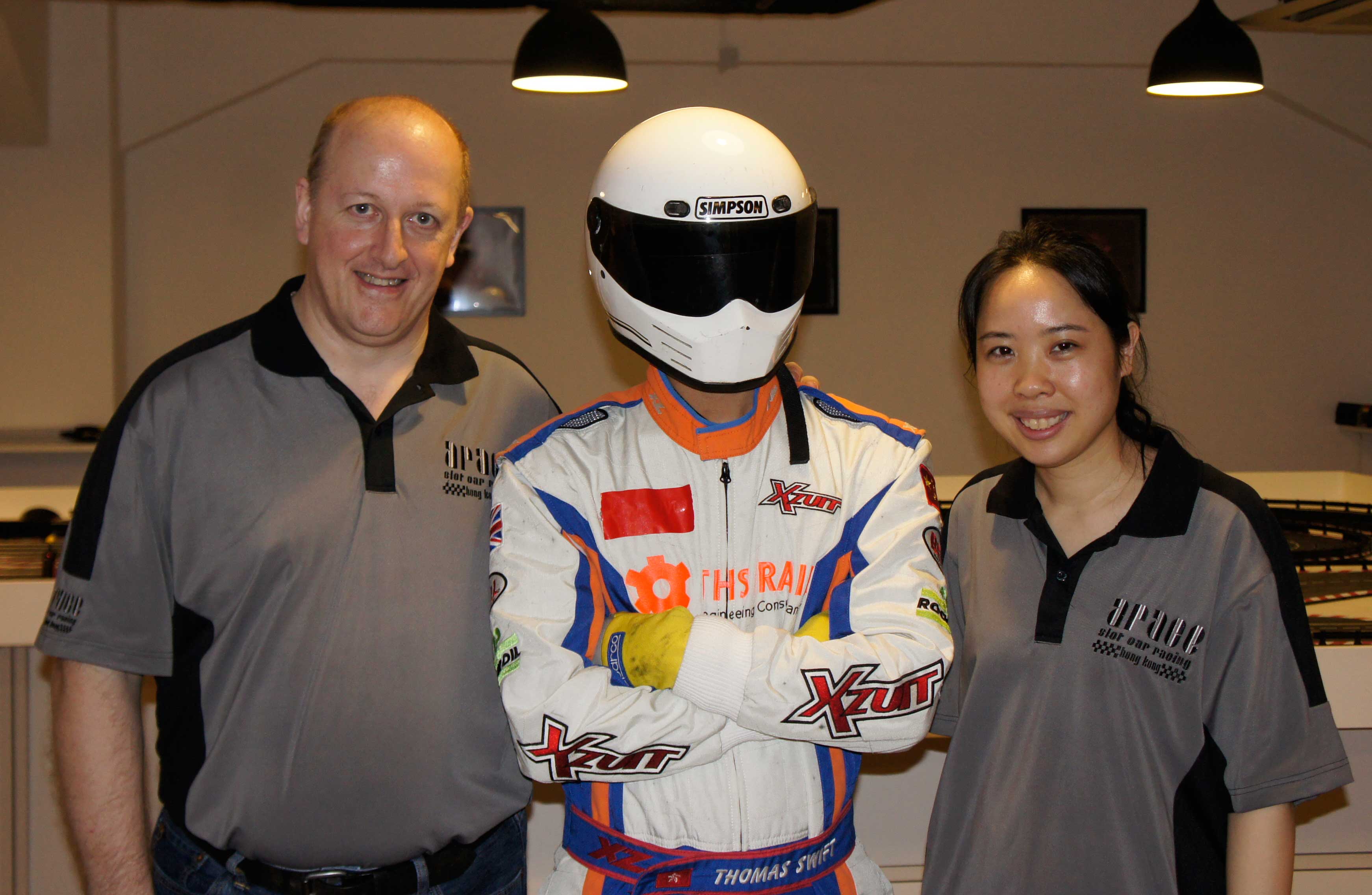
Andy Raishbrook, Sue Man and HK ‘The Original’ Stig at ARace’s opening Pit Stop
Looking to change that are Andy Raishbrook and Sue Man the founders of ARace who are wanting to bring the social back into gaming and give people a fun night out with real world experiences and memories. The ARace 50m long track recently opened in Quarry Bay and after a few hours of fun, crashes, spills and racing bc asked Andy and Sue what it’s all about.
Why slot car racing? The new era of digital slot car racing is a popular hobby and sport enjoyed in many parts of Europe, the US, Australia and New Zealand. However, slot car racing has never become popular in Hong Kong, not because the people of Hong Kong are not interested in it, but because it hasn’t been as readily available to them.
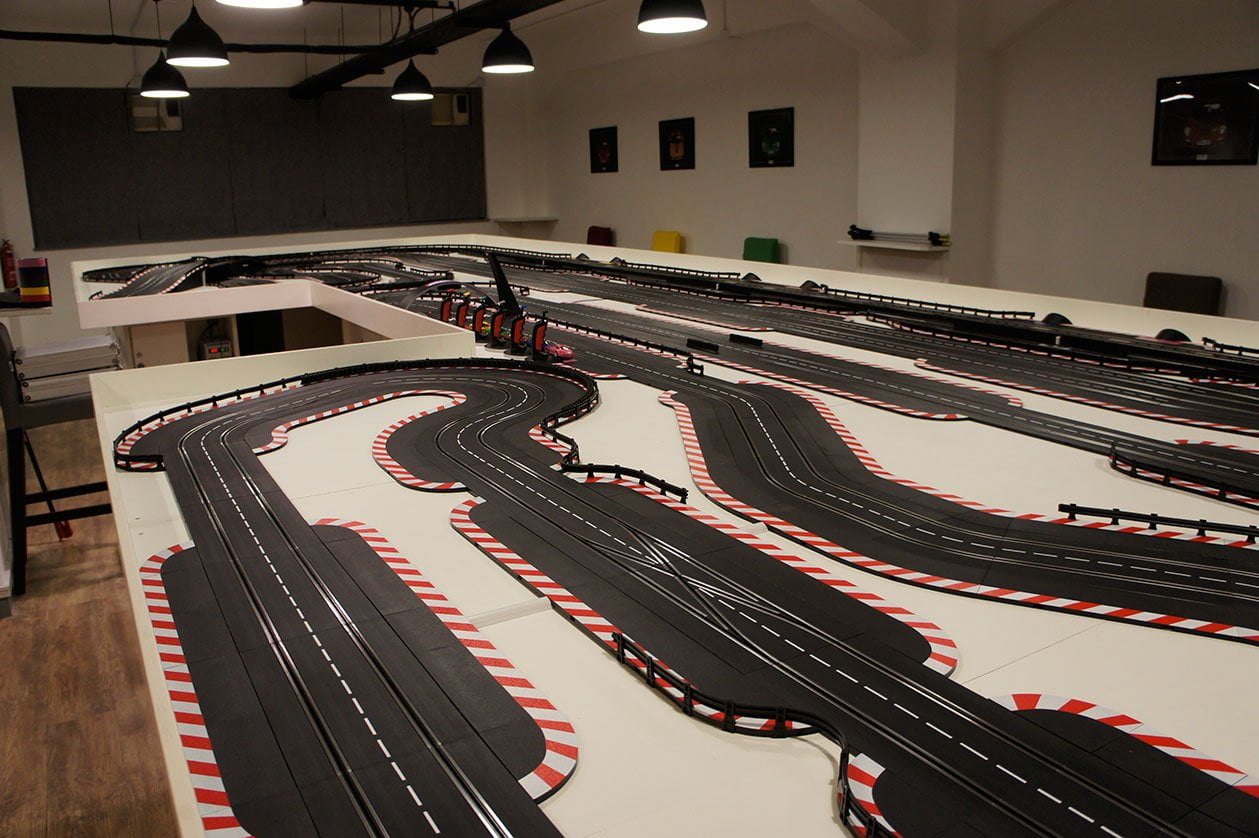
ARace is seeking to build awareness of digital slot car racing, and has set up a large 50-metre commercial track to enable Hong Kongers to participate in an activity that is enjoyed by citizens of many other nations around the world. Slot car racing is not just for children or teens. With the advancement of technology, slot car racing is now just as enjoyable and challenging for adults.
ARace is setup to provide slot car racing as a fun and socially interactive sport, ideal for a social gathering, party, corporate event, or teambuilding activity. Those who want to enjoy racing cars have previously been limited to driving simulators, where enjoyment is limited to the individual racer. ARace provides an active and more social racing experience, where racers can drive while standing side by side and moving freely around a large track Teammates can assist in the racing challenges as ‘pit crew’, and spectators can also enjoy watching and cheering the racers from beside the track. Slot car racing can be a useful tool for teamwork activities, and for encouraging good sportsmanship. There will be fun and exciting themed race events at ARace, including James Bond and Formula 1 race nights.
With several different slot car systems available why did you chose Carrera? There were many reasons why we chose to build our slot car circuit using the Carrera system. The main reason was that we believe the Carrera system to be the most robust and reliable. Our research found that the Austrian manufacturing company, Stadlbauer, had invested significantly in recent years to introduce new digital and wireless technology that provides more exciting challenges, and experiences closer to those faced in real-life motor-racing.
The detailing of the Carrera cars, of which there is a large and varied catalogue, the precise engineering, and the high standards of quality production by Stadlbauer, are further reasons why we chose to select their system for our venue.
The Stadlbauer team has been most helpful and receptive to our ideas and suggestions and strives to continually improve and better the experiences for slot car racers. Indeed, we were recently able to welcome the company founder Dr Dieter Stadlbauer, the Managing Director Mr Andreas Stadlbauer, and their team, to our venue when they recently visited Hong Kong.
We hope to be able to continue working with Stadlbauer into the future, to ensure that the new exciting digital technology now emerging in slot car racing, and being implemented in the Carrera system, is brought to Hong Kong so that Hongkongers can be amongst the first to enjoy it.
How has technology impacted slot car racing? For those of us who were able to experience slot-car racing when we were younger, we know how fun and exciting it can be to spend hours playing without getting bored. In the past, slot car racing was limited to just two racers, circling on simple parallel tracks, with limited challenges.
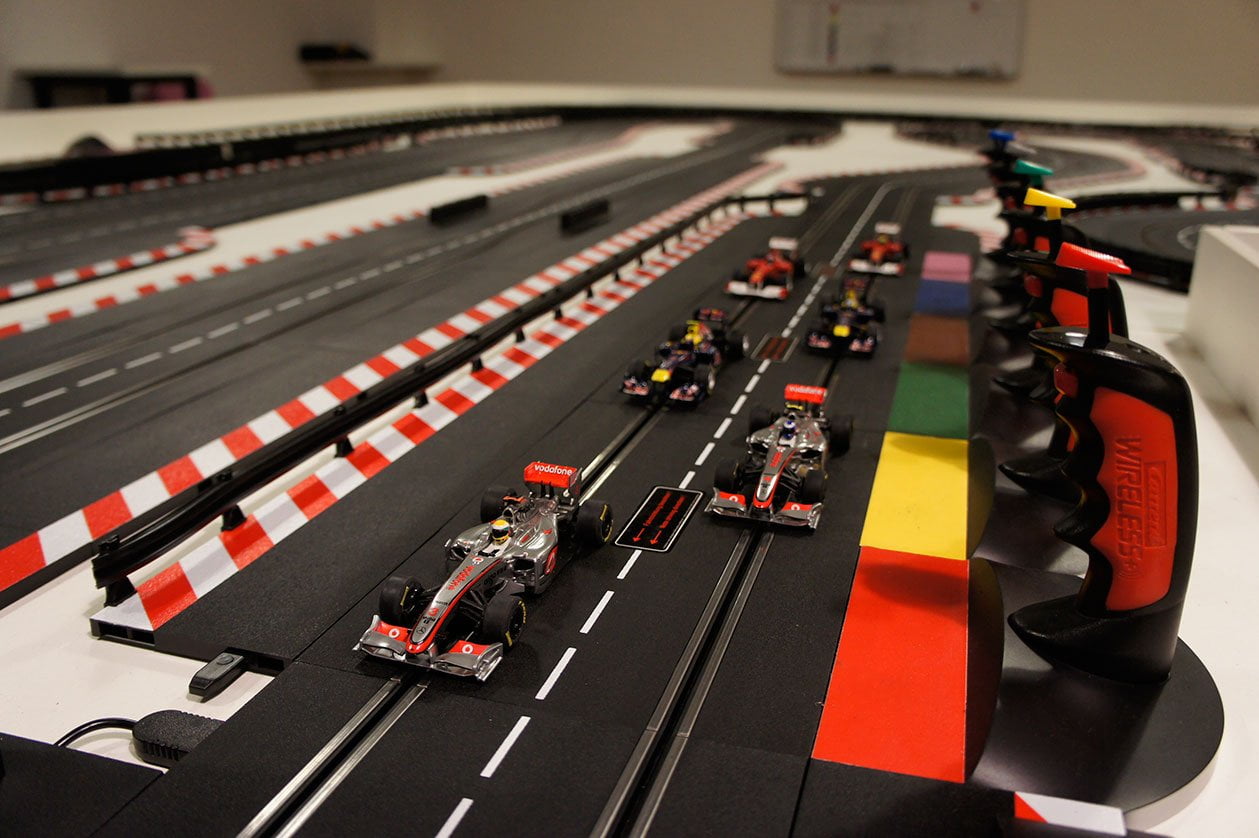
In recent years, advanced digital and wireless technology has been introduced that brings slot-car racing to a new exciting level. At ARace, we can race up to six drivers simultaneously on custom built circuits that can include multiple lanes, lane changing, and overtaking possibilities. The wireless handsets allow “drivers” to move 360 degrees around the circuit, with no impediment. One of the most exciting innovations is that we can now simulate each car having a “fuel load” at the beginning of each race, necessitating a pit-stop strategy for periodically “refueling”. This is just one example of the extra challenges available to more experienced slot car racers. There are numerous challenges that can be set for different skill levels.
The digital technology further enhances the racing experience as we are now able to accurately record lap times, race positions, speed, and laps completed. At ARace, our Carrera system is connected to a PC, and to large monitors positioned around our comfortable venue. The statistics of each race can be displayed, including graphical information of race performance, for all to see and discuss. Post-race analysis is often lively and interesting.
Can customers bring and race their own cars? Yes. Our standard racing sessions will include the hire of 6 cars, normally Porsche 911 models at 1:32 scale. However, we encourage our customers to consider purchasing their own cars from the extensive range available from Carrera, including Formula 1 models. A new range of Carrera cars becomes available every year, including nice collectors’ items for car enthusiasts. The ARace system is suitable for Carrera slot cars at either 1:32 or 1:24 scale which must have a Carrera digital chip. Digital chips by other makers will not function on our track. If customers bring their own cars they will be tested to ensure compatibility, and to avoid damaging our system.
We are currently liaising with educational organisations to incorporate slot car racing into the classroom. Slot car racing has already been successfully implemented in the US, and has been incorporated into the syllabus in numerous subjects, such as science and technology, mathematics and arts and crafts. Such projects are very student-centered, practical, and motivating for both students and teachers. Students can design, build, and then race their own slot-cars, and by using advanced computer software students can design and decorate their own slot cars in the most imaginative of ways.
ARace is set up as a communal/social experience, what options are there for individuals to race? Whilst ARace is readily available for groups and families to enjoy slot car racing, we also have membership plans available for individuals to come and race too. Once sufficient individual members have signed up, exciting race events will be scheduled, and leagues will be established to compete for the fastest race times.
The individual memberships will be categorised into 3 different age groups, namely; a: kids (8 to 12); b: teens (13 to 17); and c: adults (18+). Further information about individual memberships will be available in due course.
Interested individuals can currently join our online “Meetup” group at http://www.meetup.com/Slot-Car-Racing-Hong- Kong-Social-Meetup-Group or they may email us at [email protected].
You can find more information on membership or sign up for to the ARace monthly newsletter to receive the latest information, promotions, updates on the availability of Carrera products and upcoming special Arace events at www.arace.hk.
Would you confuse beer and an energy drink? Red Bull seems to think it’s customers are that stupid or maybe they’ll be confused that Red Bull has entered the beer market, if they came in contact with Virginia’s Old Ox Brewery?
Attorneys for the extreme drink certainly think so, and have filed a complaint in the United States Patent and Trademark Office. In it, attorneys – always looking to increase their billable hours – for the energy drink assert some consumers might confuse the brands because “An ‘ox’ and a ‘bull’ both fall within the same class of ‘bovine’ animals and are virtually indistinguishable to most consumers. In addition, an ox is a castrated bull.”
In reply the Old Ox Brewery released a public letter asking the company that makes Red Bull energy drinks to drop its complaint.
Hey Red Bull –
You seem pretty cool. You sponsor snowboarders, adventure racers, rock climbers and motocross bikers. You launch people into space so that they can skydive back down to earth. That’s all really darn cool. For all I know, you’re reading this while strapping yourself into a Formula One racecar that is about to be lit on fire and jumped over a large chasm of some sort. How cool would that be? Feel free to give it a try.
Here’s the thing, though. You are being extremely uncool to us at Old Ox Brewery. We are a small startup brewery in Ashburn, Virginia. We’re family-run, we love beer, and we love our community. For reasons that we cannot understand, you have attempted to strong arm us into changing our identity for the last 10 months because you believe folks might mistake Old Ox beer for Red Bull energy drinks. We respectfully disagree. The only similarity between our two products is that they are both liquids. You make non-alcoholic (but very extreme) energy drinks. We make delicious (but laid-back) beer. Our consumers are looking for two distinctly different experiences from our respective products.
Basically you are holding us hostage with a list of demands that, if agreed to, would severely limit our ability to use our brand. Demands like, never use the colour red, silver or blue; never use red with any bovine term or image; and never produce soft drinks. Do you own the colour red? What about fuchsia, scarlet, crimson, or mauve? Are you planting your flag in the colour wheel and claiming those shades for Red Bull? Do you claim exclusive rights to all things bovine? Do you plan to herd all heifers, cows, yaks, buffalo, bison, and steer into your intellectual property corral, too?
When we refused to succumb to your demands, you responded by filing a formal opposition to not just our trademark but to the very name Old Ox Brewery. Way to step on our American dream. You say you are protecting your intellectual property rights, but your claim, in our opinion, is Red Bulls**t.
We can only interpret your actions as one thing—bullying. You are a big Red Bully. Just like that mean kid from grade school pushing everyone down on the playground and giving us post-gym class wedgies. You are giving us one hell of a corporate wedgie. We don’t appreciate it and we sure as hell don’t deserve it.
Is this really what you’re about? Are you a bully? Your extensive marketing campaigns (your glitzy advertising, your sponsored sports events, your death defying stunt shows, etc.) certainly don’t project that image. Take a hard look at your “case.” Can you honestly look at our brand and say, “this is a threat to my image?” We don’t think you can. Given that, we repeat our offer: We agree NEVER to produce energy drinks. In exchange, we are asking for one simple thing: Leave us alone. Drop this trademark dispute. The only people benefiting are the lawyers.
Sincerely and Uninfringingly Yours,
Chris Burns President – Old Ox Brewery
As Shelly commented it’s easy to get confused “I’m just a silly girl. Sometimes I really need an energy drink and I get confused why I’m in a brewery. Wait, why are they carding me for an energy drink? This is weird. Oh wait…. I’m getting drunk from this energy drink from my tulip glass. And sometimes I’m in 7-11 thinking I can get a great craft beer, but this can is only making me hyper… Why is life so hard? I need a beer.”
Why, when we have a malign government that failed to be moved by 79 days of Occupy have many highly motivated young people turned to combating smugglers?
Isn’t all this New Territories shenanigans just a side show to the main event which is political reform? Wouldn’t their efforts be best served outside Legco facing down the government they hate so much?
The answer to this question is a resounding NO!
Why?
Because all rules of the game have changed. In the eyes of the young people who make up these Direct Action Groups the Pan Democrats have been dallying with the government for 30 years and achieved all but nothing. For them, it’s an entirely new game and they are taking politics right back to the roots. Local politics for local people solving local issues. They are the masters of their own destiny now. Not distant politicians with political agendas that have been forged over decades. They know no-one is coming to save them. They know the force that they are fighting has enormous influence and resources, but they also know that real power lies within in the hearts and minds of the people.
Over the past few months these groups have been working to capture the hearts and minds of the residents of Sheung Shui and Tuen Mun. The currency they are dealing with is called empowerment. A community empowered to take charge of its destiny is a powerful force for change.
Admittedly, there are many in these areas that are still slow to catch up with their message and struggle to separate these groups out from Occupy, but the tide is turning. The people in these long suffering districts are slowly realising that they have the power to take their districts back. Certainly, they may not agree fully with the Direct Action Groups hardcore tactics, but they fully support their message.
These groups have taken it upon themselves to be the hammer that breaks down the door of local issues. They openly accept that the police are authorised, from the very top, to use whatever force is necessary to meet them, for they understand clearly that the harder the police hit them, the louder their message is amplified.
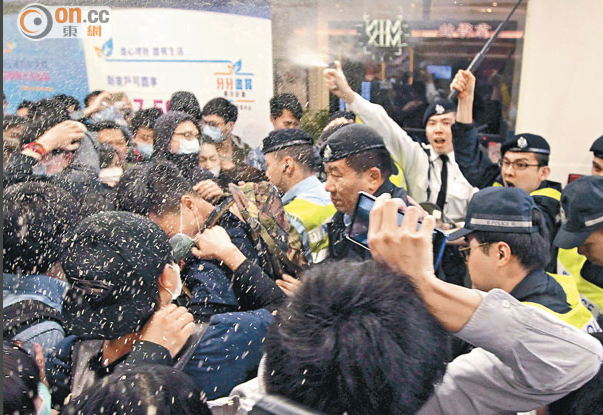
In the current climate, provoking the police is not difficult at all. Just being there is enough for the police to come out fighting and the trap is sprung. The media predictably jump all over it and their goal is achieved. For the Direct Action Groups the Tuen Mun operation was a complete success. Every news media organisation in Hong Kong now has the plight of these affected communities front and centre. This is all thanks to a small group of politically astute, hardcore protesters, non of whom are much older than 27. Using a delicate blend of cooperation and confrontation they have bought a festering, hidden sore of Hong Kong life into the spotlight and laid it bare for everyone to see and solve. The locals thank them for it.
But let’s be clear here, these maybe raw, high stakes protests, but they are in no way coarse or uncontrolled. It’s a highly calculated balancing act between knowing when to push and knowing when to yield. This they learnt in the cauldron of the Mongkok Occupy. On Sunday, they played the police like an old fiddle.
Just being there was enough to make the police go into hyper aggression mode once again. This doesn’t mean to say that they relish conflict, nor does it mean to say that every time a person is pepper sprayed or arrested the group members aren’t beside themselves with anger and anguish.
Instead, it’s an acute awareness that the police have long since set themselves up as a political arm of the government, therefore they are a legitimate political force to be manipulated at will. An amplifier as it were, which the groups turn on or off depending upon the timings for their message. No doubt the police will now be bringing all the sophisticated powers they have to monitor these new groups and curb them at every turn.
Just take a while to digest that. Civic groups set up specifically to encourage and support local issues and problems are now the focus of the police, as if they were terrorists or triads. Can there be any doubt that Hong Kong is being lead down the wrong path by malignant people?
This kind of Direct Action like we have witnessed in Tuen Mun and Tai Po, may not be your cup of tea. They are certainly not the main road to universal suffrage, but they are an essential part of it. While some say that Occupy lost public support, they have begun to win it back where it counts, in the districts.
You may never fully understand them but don’t shun them. Take the time to understand. Open your eyes to what’s going on around you, take you head out of the sand and take an interest in the place you call home. Whatever your view, remember their goal is the same – an open corruption free Hong Kong where everyone can enjoy societies benefits not just the privileged few.
The wide range of protest is a hopeful sign that a genuine shift in society is taking place.
Addendum: Tuen Mun resident Fran Wong posted this comment on facebook: Fran WongThanks for your in-depth report. As a Tuen Mun resident, I fully support this action and thank the Direction Action groups for organizing this. Unfortunately, there are alot of local residents who still have some misconception or doubts about these local groups, and some even consider them as triads and radical losers in the society. The most disappointing is that alot of local mainstream media rarely report the conflicts between these local groups and the blue-ribbon groups, or any injustices took place in the local districts in the previous weeks. But from all the videos which went viral, it’s crystal clear that the government/ the police are targeting these local groups.
I have lived in Tuen Mun since I was born. Lots of the residents here could tolerate the long traveling time to the city centre, the frequent traffic jams on Tuen Mun Highways, and the juvenile problems in the early 90s. Yet, the ‘multi-entry permit’ has brought a great deal of disturbance to this residential area. What has the government done all these years? Nothing. Now, the situation has only become bad to worse. So, you’re right! Looking at all the problems in HK, when no one is coming to save us, we have to empower ourselves. Indeed, I was amazed to see the flexible tactics these local groups adopted on Sunday. But it was also sad and worrying to see the young kids being arrested and beaten up by the police. I hope the young kids will try to keep themselves safe.
I truly appreciate what the local groups did on Sunday. They helped to unite the Tuen Mun residents to voice out and stand up. So, like what you said, we gotta explain, explain and explain to clear those so-obsessed- with-being-peaceful-rational-and-non-violent people’s misconception about these local Direction Action groups.
Thanks for reporting the truth to HK people. Your articles report a great deal of information which the local mainstream media rarely covers.
(note: the author takes no responsibility for the numerous, terrible, law enforcement puns in this article)
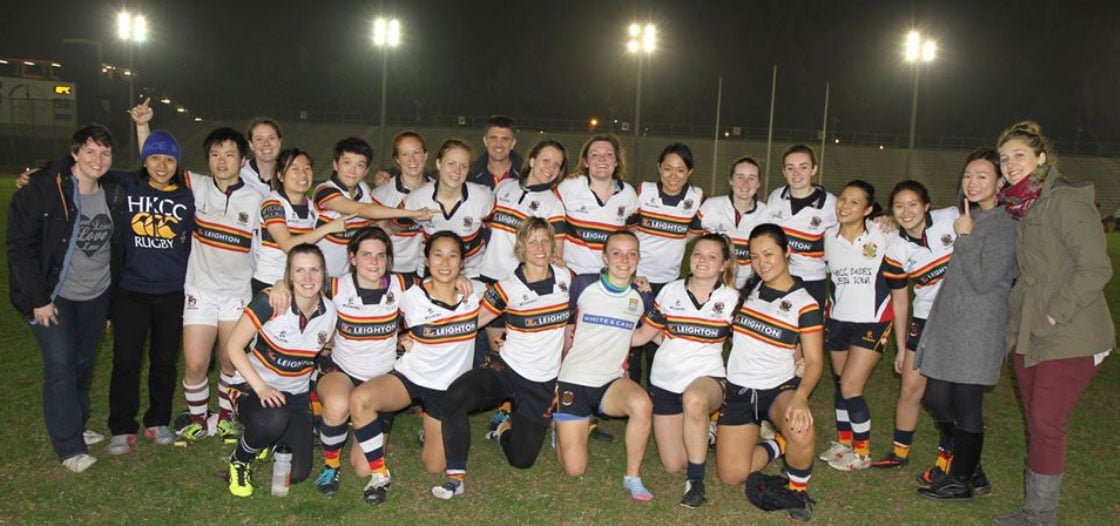
The Women’s National League 1 regular season drew to a close on Saturday, with HKCC Babes hosting Police Sirens at Aberdeen. Delays in earlier games meant kick-off was postponed until 18:45; with the sides opting to “play until the lights went out”.
The Police, in yellow, received the ball to start the first half, but good poaching from Winnie Cheung and Emily Tuck arrested their attack almost immediately, at which point HKCC turned on the heat. The second row partnership of Lauren Petersen and Cornelia Noren (making an exciting 15s debut) powered a dominant HKCC scrum, which perhaps let off Sirens lightly by not pressing its advantage in the drive. Babes set up camp in the Police 22, but it was only in the 20th minute that points went on the board, returning centre Julia Mason displaying excellent skills in the midfield and making space via a loop ball; then resisting three defenders to score on the far left of the field. The conversion was narrowly missed. HKCC should perhaps have had the courage of their convictions more often, working hard to create the space but then under-utilising this by relying too much on crashing the ball through the forwards. In full-flow, however, the Babes looked threatening and full of promise; Tinley Wong and Lucy Thomson, carrying matching shoulder injuries, scampered through the Police defence time and again but excellent speed and awarenesss from the Siren’s scrum half saved their bacon, securing turnover ball in some sloppy rucks.
The second half was an equally scrappy affair. The Babes’ occupation of the Police half threatened to last the entire game, as the HKCC scrum brought the Babes to within the 5 yard line yet again. Several phases later the referee raised his arm to indicate a try. The decision was overturned on appeal, both Babes and officials having being deceived by extraneous white paint on the pitch and thus short of the true try line. With possession secured, Carolyn Champion peeled off the back of a subsequent ruck but couldn’t find the final yards as the ball was held up yet again. Sirens broke out of their 22 on the left wing and, at full flight with support behind, looked nailed-on to score. But full back Brenda Chan bailed HKCC out of trouble with spectacular reading of the play and a well-timed tackle that forced a line out. HKCC soon stomped back down the field, hackles raised by some subtle infringements in the ruck – well, as subtle as stamping and hair pulling can be. Scrum half Lynda Nazer’s prints were all over the ball as she distributed it throughout a stop-start series of phases that saw no real breakthrough.
The first significant defensive error from the Babes (forming a line more umbrella shaped than flat) allowed Police to break through again, with winger Steph Zhang halting the attack but earning a card for doing so with a high tackle. And as the minutes ticked down, a second error, in not retreating ten yards from a penalty, earned Sirens their chance in the Babes 22. An over-zealous quick-tap was firmly rebuffed by the referee, and then play halted for several minutes to deal with an injured Sirens’ player. In the cold, the Police massed around the ball. The Babes closed ranks on their try line, poised and ready. After nearly 60 minutes, the game hinged on what was deemed the final minute. The Babes held their line after four phases. Sirens looked to pass across the width of the field, to exploit the space of the extra player. Excellent blitz defending held out to the very end though, and Sirens couldn’t hold on to the ball; Harriet Jamieson kicking out to secure a win that, with a little more poise and experience in attack, could have been so much more convincing.
Next week is championship quarter finals; at the top of the bill Nataxis HKFC Ice will take on 8th seeded Police Sirens and second seeds Bloomberg HK Scottish Kukri tackle Society General Valley Red Ladies. HKCC Babes face off against Comvita City, in what should prove an exciting contest.
Unfortunately, your correspondent won’t be here to see it, or any future matches, owing to an imminent departure from Hong Kong. As ever with stories about this beautiful city, the tale is one of endless arrivals and departures, of soaring summers and hot-pot winters. The centerpiece of my own version will certainly be the fantastic, utterly brilliant year with HKCC, both on and off the pitch; when the most drunken 7s declaration ever made (why yes, Anna Holmes, maybe I would be interested in playing rugby again) became one of the best decisions I ever made. My thanks to bc magazine for hosting these only-slightly-biased match reports; and most of all to the people who’ve appeared in them. Babes, you’re all awesome – Keep playing ‘til the lights go out. HK….CC!
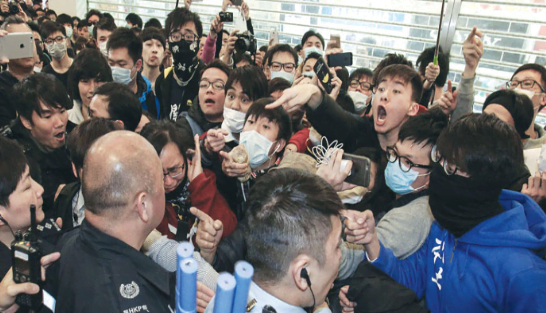
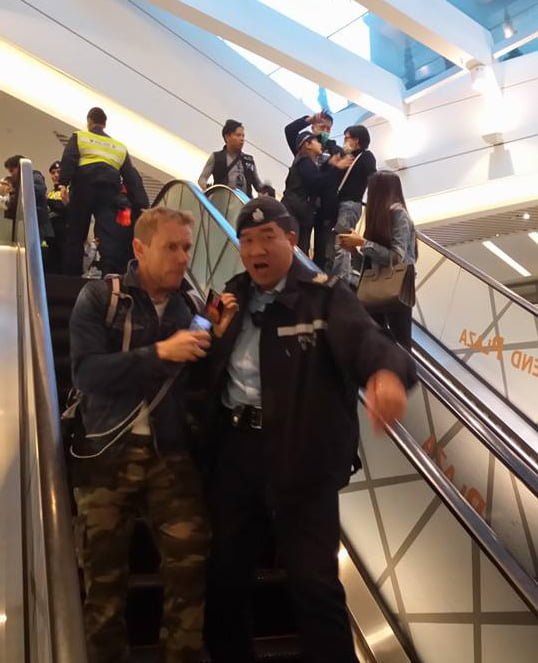
bc’s Richard Scotford was in Tuen Mun covering the anti-smuggler protests as the pepper-spray started flying in the shopping mall when he was verbally harassed and assaulted by a young policeman who tried to shove him down an escalator.
Here’s his initial thoughts on what happened
“I don’t think they knew who I was, here’s what happened. You may have seen some video of the police raising a red flag and going crazy with the pepper spray in a shopping mall. Well in those videos, I am just to the right, out of shot standing at top of the escalator. Clearly I can’t go forward as there is pepper spray going off everywhere. The escalator I’m on has been sealed off at the bottom by police after I came up it. So as the police pushed forward I was left behind the police line.
A young policeman then beelined for me and started to push me down the escalator. I protested and showed my press card but he was shoving me quite hard to go down. When I revealed I was press he then feigned that he didn’t speak English. About 300 people all around lining the shopping centre could see him trying to bundle me down the stairs and began to boo. His senior officer came along and then took over.
This is what you see here now in the still photo. I’m trying to explain to him that I wasn’t even moving, was behind police line and that I was press. He said that I was crossing police cordon, which is a lie, as on the other side of the police line was a battle.”
https://www.youtube.com/watch?v=R2nPGXBMptA
This is no different to the regular verbal and physical harassment that other members of the press and public have received when standing there peacefully covering the protests or walking around Hong Kong. Why is it that the police now feel the need to antagonistically and confrontationally get right-up in someone’s face and scream at them… If you want someone to move ask them politely. As can be seen in the video Richard is just standing there when the young policemen goes off on him. There’s no one around him, no pushing or shoving, no urgent need for him to move as the position he’s covering the fracas from is not interring with any police action…
Over a month ago I had the good fortune to sit at a table surrounded by some highly motivated, young activists. We discussed many issues concerning protest in Hong Kong and one of the issues they kept coming back to were the operations that were starting up in Sheung Shui to confront the parallel traders, or smugglers. They were very keen to hear my views on it. The fact was that I didn’t really know much about what was going on in Sheung Shui and I answered, to my discredit now, that I thought it was a distraction from the main idea of political reform. I wrongly believed, at the time, that their focus would have been better served in Admiralty or 9wu. My only redemption was that I asked the pointed question;
Do the local people support you in your efforts against the smugglers? Their answer was a categorical, Yes. Then, it can’t be a bad thing, I replied.
A month is a long time in politics and the actions that have since taken place in the districts have shown that the Direct Action Groups that these young, activists belong to are very politically astute. While the more traditional methods of protest have temporarily stalled, they have created an entirely new frontline that is a realistic way to build horizontal support and increase vertical pressure.
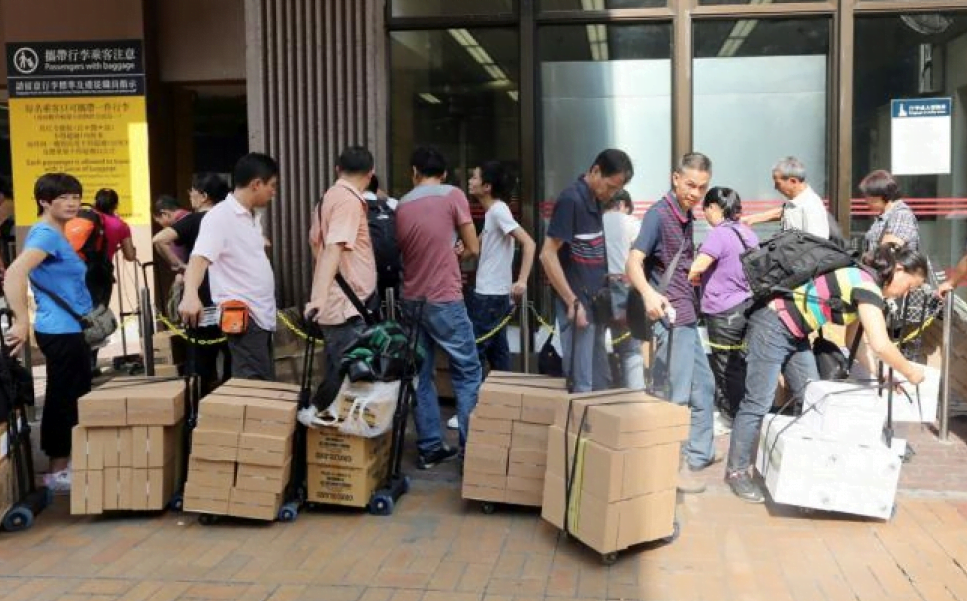
This is not big politics, it is raw street politics. The northern towns of The New Territories are awash with smuggler dens that transport everything from baby milk, to iPhones to live lobsters across the border daily. They serve no public function for the local residents The locals aren’t getting rich from this thriving trade. Resentment is at breaking point in these districts. In responding to the alleged attempted fire-attack on one of the smuggler shops the other day, Apple Daily reported that one local said, “He wished they would burn all the shops.”
The Direct Action Groups reasoning is simple and raw, we are local people and we will prove that we can solve local issues.
Taking on the smugglers is not easy political capital. That’s why the government refuses to do it. Too many vested interests. On top of this, these smuggling rings are almost certainly linked in to other forms of organised crime or dark forces across the border. Despite this, at great personal risk to themselves many Direct Action Groups have been conducting anti-smuggler actions week in week out, largely going under the radar of traditional media. They have had great success given that the only resource they really have are their own bodies and time.
The linchpin to the preventing the thriving industry is the MTR. The smugglers are operating on very tight margins so the business model ideally involves carrying as much as possible in trolleys on the MTR. The MTR does have strict regulations on baggage size and weight, which it tries to enforce, but the smugglers overwhelm the staff on duty with both numbers and threats of violence. The MTR staff want the problem solved, The local police want the problem solved and have also assisted in helping the groups make the smugglers queue up to have bags weighed and measured. This has had an effect, but unfortunately the side-effect has been to push the smugglers to other areas and other means of transport, like the buses. The smugglers are a tenacious bunch. The appetite for their products across the border is voracious.
The small gains achieved have definitely endeared the locals with the activists, but the problem is huge and needs to be tackled in every district simultaneously.
This Sunday, Feb 8th the Direct Action Groups will launch their biggest operation yet in a combined action in Tuen Mun. Early reports are that the triads will be waiting to meet them. As a little side reference, during the skirmishes at the Mongkok Occupy, it was widely reported that the so-called triads who joined forces with the Blue Ribbons were not local but from Tuen Mun. Things could certainly get heated. The bravery of these Direct Action Groups is mind boggling. I will go to this operation, but I have no qualms in saying, I’m scared.
Sunday will be interesting, especially as there is one other principle actor that I haven’t really mentioned much yet, the police. Firstly, let’s get this clear, I’m not anti-police, but I’m certainly vehemently against bad-policing. If the police want me to stop writing about them then police fairly. It’s simple. It’s not rocket science!
If you’ve seen any of the post-Occupy police videos you will notice that there’s a key theme running through all of them; Law and Order. Any policeman interfacing with the public or media now needs to make sure we all know that this is the central business the police are in, keeping law and order.
Given this, this Sunday’s operation will be a huge test for the police, which has been specifically created by the Direct Action Groups. Everyone will be watching to see if the police can put their personal political prejudices to one side for the sake of law and order: Triad gangs, smugglers, civic groups all in the mix together. How are the police going to catorgorize the threats to law and order?
Batons out and pepper spray are standard procedure these days when facing off large groups of civic groups. Last Sunday’s Tai Po operation showed that the police feel it is operationally expedient to just pat away Blue Ribbons acting violently, yet engage in baton charges or resort to dangerous choke holds on Yellows until they faint. The police may understand this in their heads, but the general public does not. We look at that video of the policeman dragging the boy out by his neck, and think what is the rationale for this level of violence? What did that person do to receive such thuggery from the police? This is the bad policing that more and more people are growing to deplore.
The issue is easily fixed. The solution is not silencing the persistent criticism that arises on social media. The solution lies in fair and equal policing: something the police have lost sight of under the direction of Andy Tsang. Instead, the police are operationally biased from the moment they leave their briefing rooms and step foot on the street. Civic groups engaging in illegal assembly is now the most pressing threat the police perceive and they want to use force to address it. Hoisting banners informing people that they ‘may’ be in an illegal gathering and ‘may’ be subject to violence may make sense in Andy Tsang’s world of CCP cronies, but for people who still have their moral compasses in tact the police’s Route One to violence method is abhorrent and inhumane. Let’s not forget here, no one has been convicted of illegal assembly yet. No one has even been charged officially with illegal assembly yet. So why do the police think they are justified in beating people on suspicion of illegal assembly?
The HKPF is going to have to be a lot smarter and sharper this weekend if it’s going to avoid another free fall in its approval rating. Excuses that, it’s not us it’s them, are wearing very thin now from a force that is paid well to be professional and impartial. If people are gathering illegally, arrest them, charge them and send them to court, don’t beat them, that just makes you look like thugs and black hearts.
To conclude, The Direct the Action Groups are smart. They have created this explosive cocktail for a reason. Only vested interest groups feel threatened by it.
The smugglers are breaking laws and regulations day in, day out unchecked. This operation will highlight the detrimental effects it has on Hong Kong society.
On top of this, the police will be forced to demonstrate their commitment to law and order above their open political biases and personal vendettas.
We have all experienced that many police officers have more in common with rowdy Blue Ribbons and aggressive triads than they have with ‘snot-nosed students’ demanding democracy, but they need to rise above this and concentrate on their jobs, which they keep reminding us is law and order.
Law and order in New Territories’ towns is breaking down because they’re over run with smugglers, not because kids are gathering illegally to complain about them.