Police Refusing To Identify Themselves

https://bcmagazine.smugmug.com/Bcene-photos/2015/Tim-Mei-Avenue-27-September/52245869_Qr7mM6#!i=4386266720&k=GF3ND9r

Police refusing to identify themselves and wear their warrant cards clearly displayed have become common place over the last twelve months. If mr policeman you are doing nothing wrong, why do you worry about being identified as a policeman and held accountable for your actions?

https://bcmagazine.smugmug.com/Bcene-photos/2015/Tim-Mei-Avenue-27-September/52245869_Qr7mM6#!i=4386252961&k=3F3St5r


Tim Mei Avenue – 27 September, 2015

https://bcmagazine.smugmug.com/Bcene-photos/2015/Tim-Mei-Avenue-27-September/52245869_Qr7mM6#!i=4386344190&k=8bMtcWm

https://bcmagazine.smugmug.com/Bcene-photos/2015/Tim-Mei-Avenue-27-September/52245869_Qr7mM6#!i=4386303005&k=jcJ7QqP

Tim Mei Avenue – 27 September, 2015
click on any photo to access the full gallery

https://bcmagazine.smugmug.com/Bcene-photos/2015/Tim-Mei-Avenue-27-September/52245869_Qr7mM6#!i=4386247236&k=6V8xKXp

https://bcmagazine.smugmug.com/Bcene-photos/2015/Tim-Mei-Avenue-27-September/52245869_Qr7mM6#!i=4386335970&k=X8dmTM2

https://bcmagazine.smugmug.com/Bcene-photos/2015/Tim-Mei-Avenue-27-September/52245869_Qr7mM6#!i=4386283628&k=rXhVg7X

https://bcmagazine.smugmug.com/Bcene-photos/2015/Tim-Mei-Avenue-27-September/52245869_Qr7mM6#!i=4386353923&k=rdp9RK4

Umbrella Movement First Anniversary Events

https://bcmagazine.smugmug.com/Bcene-photos/2014/Student-Democracy-Protest/44617740_X2wFp2#!i=3570296547&k=gFdD4Jt

https://bcmagazine.smugmug.com/Bcene-photos/2014/Student-Democracy-Protest/44617740_X2wFp2#!i=3570257961&k=4qGhMzt

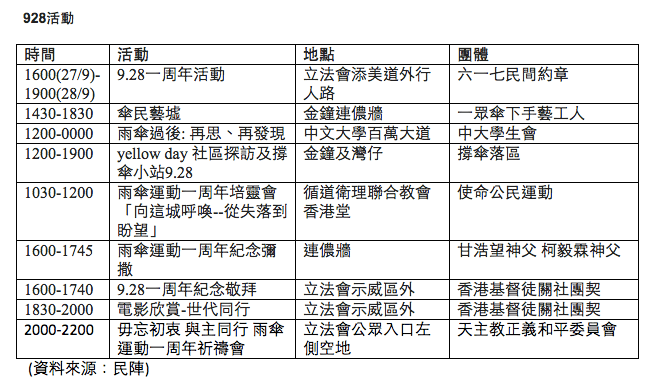
Umbrella Movement First Anniversary Activities

September 26 (Saturday)

HKFS & Scholarism talks
Time: 1 – 9 pm (7 – 9 pm Chan Kin-man and Nathan Law)
Location: Tamar Park & LegCo
More info: https://www.facebook.com/hkfs1958/photos/a.433111302871.207569.269056797871/10153272698257872/?type=3

9WU March & Rally
Time: 6:30 – 10:30 pm
Location: Mong Kok Sai Yeung Choi Street South to Admiralty Civic Square
Contact: Ah Wai 9520 6046

http://i.imgur.com/RVnoCB8.jpg

September 27 (Sunday)

HKFS & Scholarism Talks
Time:
1 – 5:30pm (4-5:30 pm Agnes Chow)
Location: Tamar Park & LegCo
More info: https://www.facebook.com/hkfs1958/photos/a.433111302871.207569.269056797871/10153272698257872/?type=3

Christian Group Camp Out
Time:
Evening till September 28 noon
Location: LegCo
More info: https://www.thestandnews.com/politics/%E4%BD%94%E9%A0%98%E9%81%8B%E5%8B%95%E4%B8%80%E5%91%A8%E5%B9%B4%E5%B0%87%E8%87%B3-%E5%9C%98%E9%AB%94%E9%80%A3%E6%97%A5%E8%88%89%E8%BE%A6%E7%B4%80%E5%BF%B5%E6%B4%BB%E5%8B%95/

September 28 (Monday)

People Power returns to Admiralty
Time: 12pm
Location: Lennon Wall
More info:
https://www.facebook.com/peoplespower/posts/959745417420946

Civil Human Rights Front Rally
Time:
3 – 8pm (5:58 pm silent stand for tear gas memorial)
Location: Lennon Wall
More info: http://hk.apple.nextmedia.com/news/art/20150923/19305999

Mass by Father Franco Mella
Time: 4 – 5:45pm
Location: Lennon Wall
More info: http://www.police.gov.hk/info/doc/nono/CRN15046509E.pdf

Prayer & Film Screening
Time:
4-8pm
Location: LegCo
More info: https://www.facebook.com/events/721477591312188/

Prayer session by Cardinal Zen, Catholic Justice & Peace Commission
Time:
8-10pm
Location: LegCo
More info: https://www.facebook.com/events/1488805408113134/

Bible Reading at Wanchai Methodist Church for Occupy Anniversary
Time:
10:30am – 12pm
Location: Wanchai Methodist Church
More info: https://www.facebook.com/events/428896173983596/

CUHK Student Union Talks
Time:
12-10 pm (12 – 1 pm Chan Kin-man)
Location: CUHK main library
More info: https://www.facebook.com/CUHK.SU/photos/a.416078851787863.103438.416069858455429/987348491327560/?type=3

Blue Ribbon March & Rally (Defend HK Campaign = Fu Chun-chung 保衛香港聯盟=傳振中)
Time:
1:30 – 5:30 pm
Location: Causeway Bay Hang Lung Centre to Wan Chai Canal Road bridge
More info: http://www.police.gov.hk/info/doc/nono/WCHRN15047906E.pdf

Blue Ribbon March & Rally (Occupy Central Not Represent Me, Man Shek 佔中不代表我,忠義民團石房有)
Time:
2-6pm
Location: Chater Garden to Police HQ to Tamar Park
More info: https://www.facebook.com/TANGTAKTAK/posts/1493584797602452:0

eXIBddtSeptember 29 (Tuesday)

CUHK Student Union Talks
Time:
12 pm – 12 am (12 – 2pm Long Hair)
Location: CUHK main library
More info:  https://www.facebook.com/CUHK.SU/photos/a.416078851787863.103438.416069858455429/987348491327560/?type=3

September 30 (Wednesday)

CUHK Student Union Talks
Time: 12 – 4pm
Location: CUHK main library
More info: https://www.facebook.com/CUHK.SU/photos/a.416078851787863.103438.416069858455429/987348491327560/?type=3

Hong Kong Bar Association on Zhang Xiaoming’s Speech

Further reaction to Zhang Xiaoming’s speech on Saturday when he stated that Hong Kong’s Chief Executive enjoys a special legal position that puts him above the legislature and judiciary. The Hong Kong Bar Association said in an eight-page statement in both Chinese and English that the role of Hong Kong’s chief executive was clearly defined in the city’s mini-constitution and could not be said to be above the law.

Here is the Press Statement of HKBA – English – 14 September, 2015 in full.

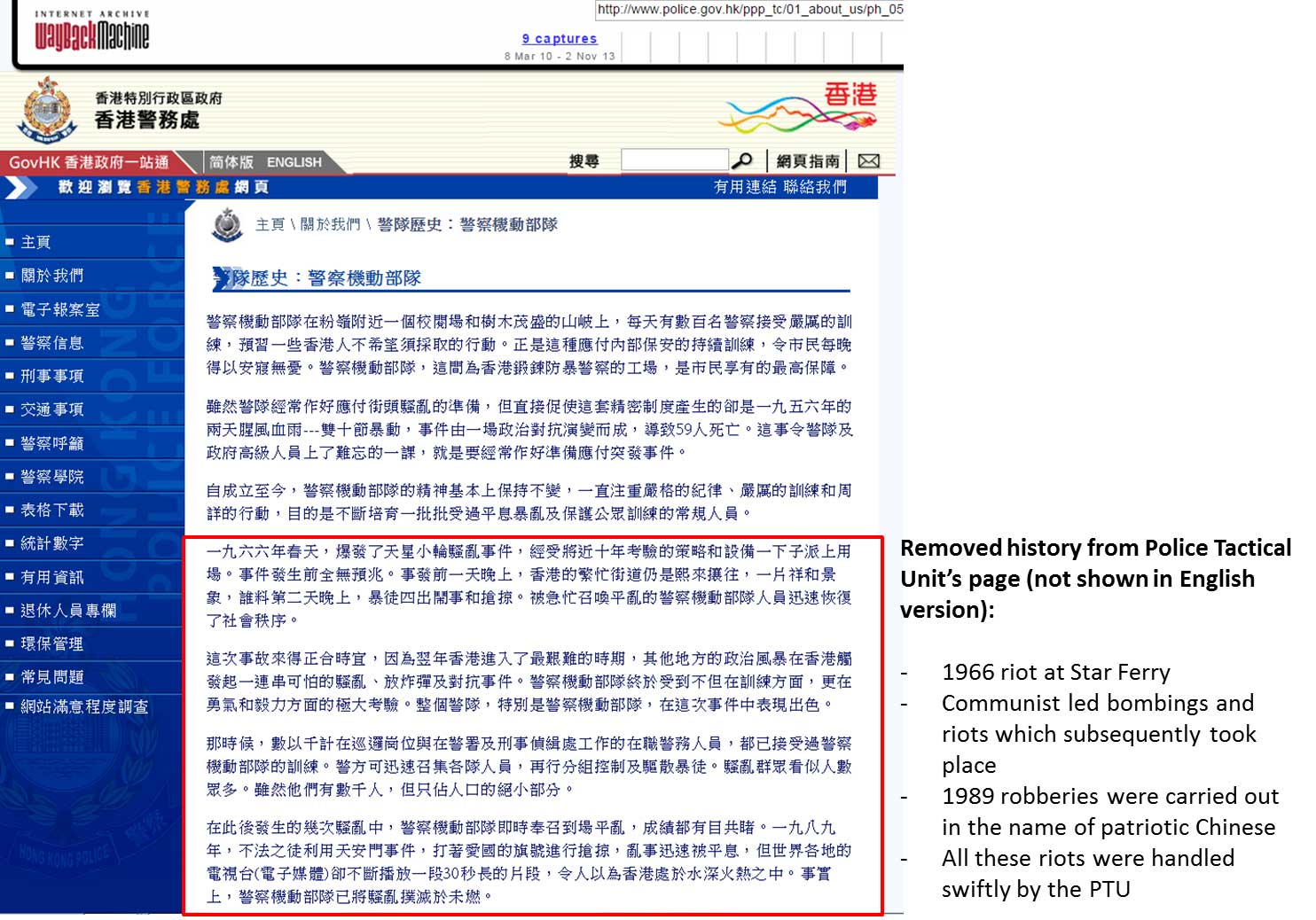
Police Re-Write History to Remove Communists

HK Police website in 2010

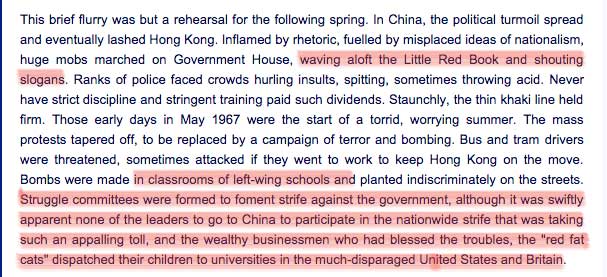
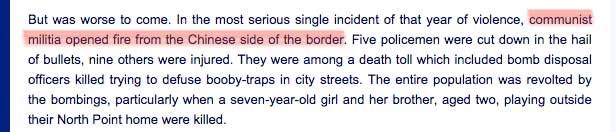
The Hong Kong Police Force website has been re-writing history in an apparent attempt “clean up” the ‎Communist Party and pro-China individuals reputations. Words like “communist” have been removed in several places as have details of communists making bombs at school & setting up “struggle committees” during the 1967 communist instigated riots.

Another comment on a trend back then that resembles Hong Kong today has been removed “wealthy businessmen who had blessed the troubles, the “red fat cats” dispatched their children to universities in the much-disparaged United States and Britain”

As have all mentions of “Little Red Book”

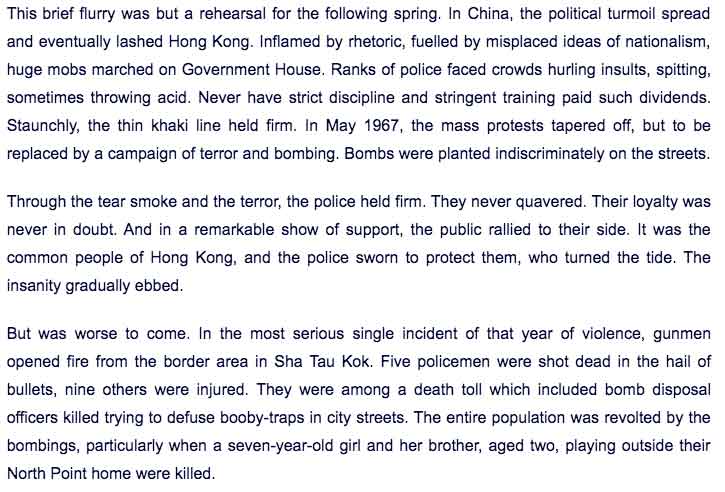
Here is the original text from the Internet archive and ‘new’ version of history – deleted parts in bold

HK Police website in 2010

Police website text in 2010 – source
This brief flurry was but a rehearsal for the following spring. In China, the political turmoil spread and eventually lashed Hong Kong. Inflamed by rhetoric, fuelled by misplaced ideas of nationalism, huge mobs marched on Government House, waving aloft the Little Red Book and shouting slogans. Ranks of police faced crowds hurling insults, spitting, sometimes throwing acid. Never have strict discipline and stringent training paid such dividends. Staunchly, the thin khaki line held firm. Those early days in May 1967 were the start of a torrid, worrying summer. The mass protests tapered off, to be replaced by a campaign of terror and bombing. Bus and tram drivers were threatened, sometimes attacked if they went to work to keep Hong Kong on the move. Bombs were made in classrooms of left-wing schools and planted indiscriminately on the streets. Struggle committees were formed to foment strife against the government, although it was swiftly apparent none of the leaders to go to China to participate in the nationwide strife that was taking such an appalling toll, and the wealthy businessmen who had blessed the troubles, the “red fat cats” dispatched their children to universities in the much-disparaged United States and Britain.

Through the tear smoke and the terror, the police held firm. They never quavered.

Their loyalty was never in doubt. And in a remarkable show of support, the public rallied to their side. It was the common people of Hong Kong, and the police sworn to protect them, who turned the tide. The insanity gradually ebbed.

But was worse to come. In the most serious single incident of that year of violence, communist militia opened fire from the Chinese side of the border. Five policemen were cut down in the hail of bullets, nine others were injured. They were among a death toll which included bomb disposal officers killed trying to defuse booby-traps in city streets. The entire population was revolted by the bombings, particularly when a seven-year-old girl and her brother, aged two, playing outside their North Point home were killed.

Revived Police Website text
This brief flurry was but a rehearsal for the following spring. In China, the political turmoil spread and eventually lashed Hong Kong. Inflamed by rhetoric, fuelled by misplaced ideas of nationalism, huge mobs marched on Government House. Ranks of police faced crowds hurling insults, spitting, sometimes throwing acid. Never have strict discipline and stringent training paid such dividends. Staunchly, the thin khaki line held firm. In May 1967, the mass protests tapered off, but to be replaced by a campaign of terror and bombing. Bombs were planted indiscriminately on the streets.

new-police-website-text1-web

Through the tear smoke and the terror, the police held firm. They never quavered. Their loyalty was never in doubt. And in a remarkable show of support, the public rallied to their side. It was the common people of Hong Kong, and the police sworn to protect them, who turned the tide. The insanity gradually ebbed.

But was worse to come. In the most serious single incident of that year of violence, gunmen opened fire from the border area in Sha Tau Kok. Five policemen were shot dead in the hail of bullets, nine others were injured. They were among a death toll which included bomb disposal officers killed trying to defuse booby-traps in city streets. The entire population was revolted by the bombings, particularly when a seven-year-old girl and her brother, aged two, playing outside their North Point home were killed.

UPDATE
As the public increasingly criticises the police for re-writing history on its website, Police Commissioner Steven Lo Wai-chung is reported to have responded that the “streamlined version” is to match modern reading habits as the original version was “too long to fit in the page and people may lose interest in reading it.”

'new'-version-police-website3-web

Sources: 本土新聞Local Press, PassionTimes 熱血時報, 蘋果日報, Hong Kong Police Force, Real Hong Kong News, Internet Archive Wayback Machine

Zhang Xiaoming’s Comments Devoid of Legal Basis

Not that the ‘Rule of Law’ means anything in China where a ‘contract’ is often worth less than the paper it’s written on, but according to the Progressive Lawyers Group, Zhang Xiaoming’s recent statement has no legal basis under the Basic Law.

The Director of the Central Government’s Liaison Office, Zhang Xiaoming, said on the 12 September that the Chief Executive’s (CE) position transcends that of the executive, legislative and judicial branches of government, and that separation of powers between these three branches of government can only be applied at the level of a sovereign.

The Progressive Lawyers Group considers such views to be devoid of legal basis for the following reasons.

(1) The CE’s position stems from the Basic Law, with no “special legal status”

The Basic Law has constitutional status in Hong Kong SAR, and is the source which sets out the CE’s powers. The SAR’s affairs, including the CE’s roles and limits on his powers, are provided for under the Basic Law, and cannot be altered simply by some apparatchik claiming that the CE is the means by which the Central Government rules Hong Kong:

– Article 2 of the Basic Law clearly states that Hong Kong enjoys executive, legislative, and independent judicial (including the power of final adjudication) powers.

– Article 11 of the Basic Law requires that Hong Kong’s systems in respect of executive, legislature and judiciary shall be based on the Basic Law itself.

– Article 59 of the Basic Law stipulates that the SAR Government is the executive branch of government in Hong Kong, and that the CE is the head of the SAR Government. Thus, the CE is clearly and merely part of the executive branch, and does not in any way enjoy a status which transcends the executive branch.

– Article 64 of the Basic Law also states that the SAR Government must abide by the law. Thus, as the head of the SAR Government, the CR must abide by and cannot transcend the law, including the Basic Law.

As can be seen, under the Basic Law, there does not exist any so-called special legal position when it comes to the CE’s role in Hong Kong’s political system. Thus, Zhang Xiaoming’s statements are devoid of legal basis.

(2) Separation of powers between the three branches of government is not only applicable at the sovereign level, the CE is subject to legislative and judicial checks

The separation of powers between the executive, legislative and judicial branches, where they operate independently but also subject to checks on each other’s powers, is something that is currently applicable to the national, state and even local governments of many democratic jurisdictions. Zhang Xiaoming’s assertion that this concept is applicable only at the level of the sovereign clearly shows his ignorance in this regard.

As to Hong Kong, looking at the provisions of the Basic Law as a whole, the existence of such separation of powers is relatively clear, and was affirmed by the Court of Final Appeal (see Leung Kwok Hung v The President of the Legislative Council of the Hong Kong Special Administrative Region (2014), paragraph 27). The Basic Law clearly delineates Hong Kong’s executive, legislative and judicial branches of government, and in a various parts set out provisions which create checks on each other’s powers. For example:

– Article 64 of the Basic Law states that the SAR Government must abide by the law and be accountable to the Legislative Council.

– Articles 49, 50, 51 and 76 states that the CE’s checks on the Legislative Council, such as the special circumstances when he can dissolve the Legislative Council.

– As regards the judiciary, Article 80 of the Basic Law states that the various courts of Hong Kong constitute the Hong Kong’s judiciary, which exercises the Hong Kong SAR’s judicial power, and the independence of the judiciary is protected by Article 85: “The courts of the Hong Kong Special Administrative Region shall exercise judicial power independently, free from any interference”.

(3) Zhang Xiaoming should seek to familiarise himself with the Basic Law

Zhang Xiaoming graduated with law degrees from Southwest University of Political Science and Law and Renmin University of China, both of which are apparently colleges of renown within Mainland China. However, his remarks on Saturday demonstrated his twisting and ignorance of the law, which is a disservice to his alma mater’s reputation. Rather than yet again sowing trouble and discord in Hong Kong, Zhang Xiaoming the apparatchik should seek first to familiarise himself with the Basic Law before saying anything further on these topics. In short, Zhang’s comments are so patently absurd that those seeking to defend him should be careful of being seen as sailing too close to the wind, lest they end up also appearing as buffoons themselves.

Progressive Lawyers Group
14 September 2015
https://www.facebook.com/proglawgroup

Originally published in The Stand News

The Progressive Lawyers Group  are a group of Hong Kong lawyers dedicated to promoting core values of rule of law, judicial independence, democracy, human rights, freedom, and justice.

Police Look to Buy Hearts + Minds With ‘Free’ Gift

https://bcmagazine.smugmug.com/Bcene-photos/2015/Police-Hearts/51867446_HhshFM#!i=4339839177&k=rZSj3VM

With their reputation, integrity and ‘public trust’ at levels too low to accurately measure, the Hong Kong police instead of investigating crimes are blocking the street and looking to buy ‘hearts and minds’ with ‘free’ gifts!

Outside Wanchai MTR exit A4, at around 5:30pm on the 8 September, 2015, there’s a police van illegally parked blocking one westbound lane of Hennessy Road. Why’s the van there? To act as a poster billboard! That area of road is clear of bus stops and is used for car and taxi drop-offs to the MTR. The van’s location also forced members of the public to stand dangerously out in the middle of Hennessy Road to hail a taxi.

Unlike most illegally parked police vans, this one actually had turned off it’s engine – much to the obvious displeasure of the driver.

https://bcmagazine.smugmug.com/Bcene-photos/2015/Police-Hearts/51867446_HhshFM#!i=4339839099&k=BvZ2Grf

NPC Decision on HK Chief Executive Election by Universal Suffrage

August 31st marks the one year anniversary of the publication of the Decision of the Standing Committee of the National People’s Congress on Issues Relating to the Selection of the Chief Executive of the Hong Kong Special Administrative Region by Universal Suffrage.

For those who have not read it, here is the full text

Decision of the Standing Committee of the National People’s Congress on Issues Relating to the Selection of the Chief Executive of the Hong Kong Special Administrative Region by Universal Suffrage and on the Method for Forming the Legislative Council of the Hong Kong Special Administrative Region in the Year 2016

(Adopted at the Tenth Session of the Standing Committee of the Twelfth National People’s Congress on 31 August 2014)

The Standing Committee of the Twelfth National People’s Congress considered at its Tenth Session the Report on whether there is a need to amend the methods for selecting the Chief Executive of the Hong Kong Special Administrative Region in 2017 and for forming the Legislative Council of the Hong Kong Special Administrative Region in 2016 submitted by Leung Chun-ying, the Chief Executive of the Hong Kong Special Administrative Region, on 15 July 2014. In the course of deliberation, the relevant views and suggestions of the Hong Kong community were given full consideration.

The Session points out that according to the Decision of the Standing Committee of the National People’s Congress on Issues Relating to the Methods for Selecting the Chief Executive of the Hong Kong Special Administrative Region and for Forming the Legislative Council of the Hong Kong Special Administrative Region in the Year 2012 and on Issues Relating to Universal Suffrage adopted by the Standing Committee of the Tenth National People’s Congress at its Thirty-first Session on 29 December 2007, the election of the fifth Chief Executive of the Hong Kong Special Administrative Region in the year 2017 may be implemented by the method of universal suffrage; at an appropriate time prior to the selection of the Chief Executive of the Hong Kong Special Administrative Region by universal suffrage, the Chief Executive shall make a report to the Standing Committee of the National People’s Congress as regards the issue of amending the method for selecting the Chief Executive in accordance with the relevant provisions of the Hong Kong Basic Law and the Interpretation by the Standing Committee of the National People’s Congress of Article 7 of Annex I and Article III of Annex II to the Basic Law of the Hong Kong Special Administrative Region of the People’s Republic of China, and a determination thereon shall be made by the Standing Committee of the National People’s Congress. From 4 December 2013 to 3 May 2014, the Government of the Hong Kong Special Administrative Region conducted an extensive and in-depth public consultation on the methods for selecting the Chief Executive in 2017 and for forming the Legislative Council in 2016. In the course of consultation, the Hong Kong community generally expressed the hope to see the selection of the Chief Executive by universal suffrage in 2017, and broad consensus was reached on important principles such as: the method for selecting the Chief Executive by universal suffrage shall comply with the Hong Kong Basic Law and the relevant Decisions of the Standing Committee of the National People’s Congress and the Chief Executive shall be a person who loves the country and loves Hong Kong. With respect to the methods for selecting the Chief Executive by universal suffrage in 2017 and for forming the Legislative Council in 2016, the Hong Kong community put forward various views and suggestions. It was on this basis that the Chief Executive of the Hong Kong Special Administrative Region made a report to the Standing Committee of the National People’s Congress on issues relating to amending the methods for selecting the Chief Executive in 2017 and for forming the Legislative Council in 2016. The Session is of the view that the report complies with the requirements of the Hong Kong Basic Law, the Interpretation by the Standing Committee of the National People’s Congress of Article 7 of Annex I and Article III of Annex II to the Hong Kong Basic Law and the relevant Decisions of the Standing Committee of the National People’s Congress, and reflects comprehensively and objectively the views collected during the public consultation; and is thus a positive, responsible and pragmatic report.

The Session is of the view that implementing universal suffrage for the selection of the Chief Executive represents a historic progress in Hong Kong’s democratic development and a significant change in the political structure of the Hong Kong Special Administrative Region. Since the long-term prosperity and stability of Hong Kong and the sovereignty, security and development interests of the country are at stake, there is a need to proceed in a prudent and steady manner. The selection of the Chief Executive of the Hong Kong Special Administrative Region by universal suffrage has its origin in Paragraph 2 of Article 45 of the Hong Kong Basic Law: “The method for selecting the Chief Executive shall be specified in the light of the actual situation in the Hong Kong Special Administrative Region and in accordance with the principle of gradual and orderly progress. The ultimate aim is the selection of the Chief Executive by universal suffrage upon nomination by a broadly representative nominating committee in accordance with democratic procedures.” The formulation of the method for selecting the Chief Executive by universal suffrage must strictly comply with the relevant provisions of the Hong Kong Basic Law, accord with the principle of “one country, two systems”, and befit the legal status of the Hong Kong Special Administrative Region. It must meet the interests of different sectors of the society, achieve balanced participation, be conducive to the development of the capitalist economy, and make gradual and orderly progress in developing a democratic system that suits the actual situation in Hong Kong. Given the divergent views within the Hong Kong community on how to implement the Hong Kong Basic Law provisions on universal suffrage for selecting the Chief Executive, and in light of the constitutional responsibility of the Standing Committee of the National People’s Congress for the proper implementation of the Hong Kong Basic Law and for deciding on the method for the selection of the Chief Executive, the Standing Committee of the National People’s Congress finds it necessary to make provisions on certain core issues concerning the method for selecting the Chief Executive by universal suffrage, so as to facilitate the building of consensus within the Hong Kong community and the attainment of universal suffrage for the selection of the Chief Executive smoothly and in accordance with law.

The Session is of the view that since the Chief Executive of the Hong Kong Special Administrative Region shall be accountable to both the Hong Kong Special Administrative Region and the Central People’s Government in accordance with the provisions of the Hong Kong Basic Law, the principle that the Chief Executive has to be a person who loves the country and loves Hong Kong must be upheld. This is a basic requirement of the policy of “one country, two systems”. It is determined by the legal status as well as important functions and duties of the Chief Executive, and is called for by the actual need to maintain long-term prosperity and stability of Hong Kong and uphold the sovereignty, security and development interests of the country. The method for selecting the Chief Executive by universal suffrage must provide corresponding institutional safeguards for this purpose.

The Session is of the view that the amendments made to the method for forming the fifth term Legislative Council in 2012 represented major strides towards the direction of enhancing democracy. The existing formation method and voting procedures for the Legislative Council as prescribed in Annex II to the Hong Kong Basic Law will not be amended, and will continue to apply in respect of the sixth term Legislative Council in 2016. This is consistent with the principle of gradual and orderly progress in developing a democratic system that suits Hong Kong’s actual situation and conforms to the majority view in the Hong Kong community. It also helps the various sectors of the Hong Kong community to focus their efforts on addressing the issues concerning universal suffrage for selecting the Chief Executive first, thus creating the conditions for attaining the aim of electing all the members of the Legislative Council by universal suffrage after the implementation of universal suffrage for the selection of the Chief Executive.

Accordingly, pursuant to the relevant provisions of the Basic Law of the Hong Kong Special Administrative Region of the People’s Republic of China, the Interpretation by the Standing Committee of the National People’s Congress of Article 7 of Annex I and Article III of Annex II to the Basic Law of the Hong Kong Special Administrative Region of the People’s Republic of China and the Decision of the Standing Committee of the National People’s Congress on Issues Relating to the Methods for Selecting the Chief Executive of the Hong Kong Special Administrative Region and for Forming the Legislative Council of the Hong Kong Special Administrative Region in the Year 2012 and on Issues Relating to Universal Suffrage, the Standing Committee of the National People’s Congress makes the following decision:

I. Starting from 2017, the selection of the Chief Executive of the Hong Kong Special Administrative Region may be implemented by the method of universal suffrage.

II. When the selection of the Chief Executive of the Hong Kong Special Administrative Region is implemented by the method of universal suffrage:

(1) A broadly representative nominating committee shall be formed. The provisions for the number of members, composition and formation method of the nominating committee shall be made in accordance with the number of members, composition and formation method of the Election Committee for the Fourth Chief Executive.

(2) The nominating committee shall nominate two to three candidates for the office of Chief Executive in accordance with democratic procedures. Each candidate must have the endorsement of more than half of all the members of the nominating committee.

(3) All eligible electors of the Hong Kong Special Administrative Region have the right to vote in the election of the Chief Executive and elect one of the candidates for the office of Chief Executive in accordance with law.

(4) The Chief Executive-elect, after being selected through universal suffrage, will have to be appointed by the Central People’s Government.

III. The specific method of universal suffrage for selecting the Chief Executive shall be prescribed in accordance with legal procedures through amending Annex I to the Basic Law of the Hong Kong Special Administrative Region of the People’s Republic of China: The Method for the Selection of the Chief Executive of the Hong Kong Special Administrative Region. The bill on the amendments and the proposed amendments to such bill shall be introduced by the Hong Kong Special Administrative Region Government to the Legislative Council of the Hong Kong Special Administrative Region in accordance with the Hong Kong Basic Law and the provisions of this Decision. Such amendments shall obtain the endorsement of a two-thirds majority of all the members of the Legislative Council and the consent of the Chief Executive before being submitted to the Standing Committee of the National People’s Congress for approval.

IV. If the specific method of universal suffrage for selecting the Chief Executive is not adopted in accordance with legal procedures, the method used for selecting the Chief Executive for the preceding term shall continue to apply.

V. The existing formation method and voting procedures for the Legislative Council as prescribed in Annex II to the Hong Kong Basic Law will not be amended. The formation method and procedures for voting on bills and motions of the fifth term Legislative Council will continue to apply to the sixth term Legislative Council of the Hong Kong Special Administrative Region in 2016. After the election of the Chief Executive by universal suffrage, the election of all the members of the Legislative Council of the Hong Kong Special Administrative Region may be implemented by the method of universal suffrage. At an appropriate time prior to the election of the Legislative Council by universal suffrage, the Chief Executive elected by universal suffrage shall submit a report to the Standing Committee of the National People’s Congress in accordance with the relevant provisions of the Hong Kong Basic Law and the Interpretation by the Standing Committee of the National People’s Congress of Article 7 of Annex I and Article III of Annex II to the Basic Law of the Hong Kong Special Administrative Region of the People’s Republic of China as regards the issue of amending the method for forming the Legislative Council. A determination thereon shall be made by the Standing Committee of the National People’s Congress.

The Session stresses that it is the consistent position of the central authorities to implement resolutely and firmly the principles of “one country, two systems”, “Hong Kong people administering Hong Kong” and a high degree of autonomy, strictly adhere to the Hong Kong Basic Law and steadily take forward the selection of the Chief Executive by universal suffrage in 2017. It is hoped that the Hong Kong Special Administrative Region Government and all sectors of the Hong Kong community will act in accordance with the provisions of the Hong Kong Basic Law and this Decision and jointly work towards the attainment of the aim of selecting the Chief Executive by universal suffrage.