As a westerner living in Hong Kong one of the first things you notice about the Hong Kong Cantonese is that they spend a lot of time shouting at each other. Often, what you think is a conflict is actually just two friends engaging in friendly banter about horses or Korean soap operas. That said, you don’t have to have lived here too long before you will encounter a real confrontation. Whatever the reason for the conflict, these situations quickly escalate into loud slanging matches, punctuated with elaborate verbal abuse and theatrical posturing. These conflicts almost never end in violence. Almost every westerner who witnesses these events for the first time thinks, “There’s no way I would let anyone shout at me like that, I would punch them in the face.”
And on the whole it’s true, westerners are much quicker to fight than Cantonese. Maybe it’s something to do with the Cantonese language being very colloquial and street-wise, who knows? But Cantonese really do enjoy verbally abusing each other where other nationalities would already be rolling in the dirt and fighting.
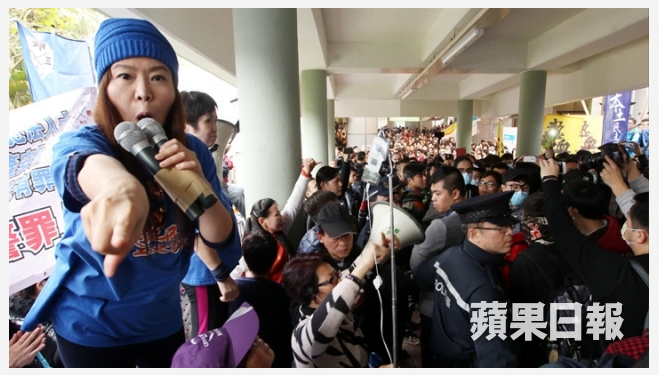
The Occupy protests amplified this penchant for verbal abuse into a mass movement. Battles over Lung Wo Road regularly saw more than 2000 people chanting abuse to the police but staying incredibly peaceful physically. I personally took a major role in convincing a few people not to load house bricks onto the road, so as to prevent the crowd from bloodbathing the police, who were at this point so cocky that they were running around beating people with no shields or helmets. Good sense won over, in that the Cantonese are really good at verbally abusing each other and don’t need actual violence to articulate and vent their views. Unfortunately this good sense hasn’t seeped down into the police who believe they have the right to Route One to violence because they are being shouted at by the protesters. In this, the police are stepping outside of the Cantonese social norm, in that tens of thousands of times a day, Cantonese hurl verbal rocks at each other, but 99% have the self restraint to not lash out into actual physical violence.
These days in heated confrontations with protesters the HKPF always bemoan, “We’re not doing anything international police wouldn’t do in a similar situation,” but the critical point they miss, is the Cantonese aren’t acting like international rioters. They’re acting like Cantonese. They know the rules of the game, which the police have forgotten, or choose to ignore. Instead They somehow feel they are apart from local culture and are justified in using violence because they’re police and should automatically deserve respect without earning it. This attitude is destroying Cantonese culture by introducing quick, physical violence as a way of resolving conflict. The Blue Ribbons have taken to this new way of conflict resolution like ducks to water. This represents a significant slide in the cultural values of the Hong Kong society and the police created it on October 3rd when they turned a blind eye to the triads causing chaos in Mongkok.
So, the reality is the Occupy Movement has been high on verbal violence and infinitesimally low on actual violence because the Cantonese culture regularly substitutes verbal violence for real violence to resolve conflict and express frustration.
With this in mind, we can see that the current redirection of the democracy movement from protests on the streets outside Legco to Direct Action in the districts has also manifested this engrained habit. Instead, the targets of verbal abuse has changed from the Government and the Police to smugglers and parallel traders.
I stood outside the 3BX Bus line in Tuen Mun for many hours on Sunday and the level of verbal violence that was being hurled was fairly substantial. Certainly, it is not something I would do, but I’m not Cantonese. Those hurling the abuse are not stupid and they are also not racists. I grew up in 1970/80s Birmingham, England, I know what racism is, and what was on display in Tuen Mun last Sunday was certainly not racism.
Instead it is a form of verbal violence against actions that people see as objectionable. If we’d have been in Europe, the protesters would have burnt the bus stop, the bus and probably routed the police out of town. But like I said, this is not the Cantonese style, Cantonese love shouting shit at each other and especially at things they don’t like.
Certainly, from a superficial level, watching the verbal barrage is not pretty and could be misconstrued as hateful racism, but if you are there you can quickly see that it is very specifically directed at a certain type of person carrying out a certain type of action. It is not based on anything the person can’t rectify very quickly. If a Mainlander was in the crowd, they would not be targeted carte blanche for their race or heritage. This is not to say, if they tried to defend the actions they wouldn’t receive a volley of abuse, but they could take part or silently observe without any fear of attack from the rabid crowd. This shows it’s much more sophisticated than racism. Try sticking a silent, black person in a group of European Neo Nazi racists and see if you get the same result.
This is the critical difference between the anti-Mainland sentiment in Hong Kong and say classic white, black racism in Europe or America. They are coming from completely different foundations. One is a temporary form of protest, or a new form of expression at the dissatisfaction towards our malign government. The other is coming from hatred based on ignorance, is long lasting and often incurable.
Given this, at this point, I have no fear that the democracy movement has been hijacked by racism, certainly a tiny minority may misunderstand what is going on. Definitely our malign government will try and exploit it for its own advantage, but the protestors are smart and savvy. They will use this current tactic while it is useful and discard it once it becomes a burden.
It may not be pretty, but revolutions never are. Some might argue that flirting with racism is playing with fire, but the protesters would argue back,
Why, when we have a malign government that failed to be moved by 79 days of Occupy have many highly motivated young people turned to combating smugglers?
Isn’t all this New Territories shenanigans just a side show to the main event which is political reform? Wouldn’t their efforts be best served outside Legco facing down the government they hate so much?
The answer to this question is a resounding NO!
Why?
Because all rules of the game have changed. In the eyes of the young people who make up these Direct Action Groups the Pan Democrats have been dallying with the government for 30 years and achieved all but nothing. For them, it’s an entirely new game and they are taking politics right back to the roots. Local politics for local people solving local issues. They are the masters of their own destiny now. Not distant politicians with political agendas that have been forged over decades. They know no-one is coming to save them. They know the force that they are fighting has enormous influence and resources, but they also know that real power lies within in the hearts and minds of the people.
Over the past few months these groups have been working to capture the hearts and minds of the residents of Sheung Shui and Tuen Mun. The currency they are dealing with is called empowerment. A community empowered to take charge of its destiny is a powerful force for change.
Admittedly, there are many in these areas that are still slow to catch up with their message and struggle to separate these groups out from Occupy, but the tide is turning. The people in these long suffering districts are slowly realising that they have the power to take their districts back. Certainly, they may not agree fully with the Direct Action Groups hardcore tactics, but they fully support their message.
These groups have taken it upon themselves to be the hammer that breaks down the door of local issues. They openly accept that the police are authorised, from the very top, to use whatever force is necessary to meet them, for they understand clearly that the harder the police hit them, the louder their message is amplified.
In the current climate, provoking the police is not difficult at all. Just being there is enough for the police to come out fighting and the trap is sprung. The media predictably jump all over it and their goal is achieved. For the Direct Action Groups the Tuen Mun operation was a complete success. Every news media organisation in Hong Kong now has the plight of these affected communities front and centre. This is all thanks to a small group of politically astute, hardcore protesters, non of whom are much older than 27. Using a delicate blend of cooperation and confrontation they have bought a festering, hidden sore of Hong Kong life into the spotlight and laid it bare for everyone to see and solve. The locals thank them for it.
But let’s be clear here, these maybe raw, high stakes protests, but they are in no way coarse or uncontrolled. It’s a highly calculated balancing act between knowing when to push and knowing when to yield. This they learnt in the cauldron of the Mongkok Occupy. On Sunday, they played the police like an old fiddle.
Just being there was enough to make the police go into hyper aggression mode once again. This doesn’t mean to say that they relish conflict, nor does it mean to say that every time a person is pepper sprayed or arrested the group members aren’t beside themselves with anger and anguish.
Instead, it’s an acute awareness that the police have long since set themselves up as a political arm of the government, therefore they are a legitimate political force to be manipulated at will. An amplifier as it were, which the groups turn on or off depending upon the timings for their message. No doubt the police will now be bringing all the sophisticated powers they have to monitor these new groups and curb them at every turn.
Just take a while to digest that. Civic groups set up specifically to encourage and support local issues and problems are now the focus of the police, as if they were terrorists or triads. Can there be any doubt that Hong Kong is being lead down the wrong path by malignant people?
This kind of Direct Action like we have witnessed in Tuen Mun and Tai Po, may not be your cup of tea. They are certainly not the main road to universal suffrage, but they are an essential part of it. While some say that Occupy lost public support, they have begun to win it back where it counts, in the districts.
You may never fully understand them but don’t shun them. Take the time to understand. Open your eyes to what’s going on around you, take you head out of the sand and take an interest in the place you call home. Whatever your view, remember their goal is the same – an open corruption free Hong Kong where everyone can enjoy societies benefits not just the privileged few.
The wide range of protest is a hopeful sign that a genuine shift in society is taking place.
Addendum: Tuen Mun resident Fran Wong posted this comment on facebook: Fran WongThanks for your in-depth report. As a Tuen Mun resident, I fully support this action and thank the Direction Action groups for organizing this. Unfortunately, there are alot of local residents who still have some misconception or doubts about these local groups, and some even consider them as triads and radical losers in the society. The most disappointing is that alot of local mainstream media rarely report the conflicts between these local groups and the blue-ribbon groups, or any injustices took place in the local districts in the previous weeks. But from all the videos which went viral, it’s crystal clear that the government/ the police are targeting these local groups.
I have lived in Tuen Mun since I was born. Lots of the residents here could tolerate the long traveling time to the city centre, the frequent traffic jams on Tuen Mun Highways, and the juvenile problems in the early 90s. Yet, the ‘multi-entry permit’ has brought a great deal of disturbance to this residential area. What has the government done all these years? Nothing. Now, the situation has only become bad to worse. So, you’re right! Looking at all the problems in HK, when no one is coming to save us, we have to empower ourselves. Indeed, I was amazed to see the flexible tactics these local groups adopted on Sunday. But it was also sad and worrying to see the young kids being arrested and beaten up by the police. I hope the young kids will try to keep themselves safe.
I truly appreciate what the local groups did on Sunday. They helped to unite the Tuen Mun residents to voice out and stand up. So, like what you said, we gotta explain, explain and explain to clear those so-obsessed- with-being-peaceful-rational-and-non-violent people’s misconception about these local Direction Action groups.
Thanks for reporting the truth to HK people. Your articles report a great deal of information which the local mainstream media rarely covers.
The whole day can be split into two halves, the protest and the after protest. On top of this, it can also be split into two other parts, what happened and why it happened.
Regarding the actual protest and what happened, it was largely an orderly and peaceful affair meandering through central Tuen Mun to protest at the smugglers domination of the town. What was interesting was that I never heard, saw, or was told about any local residents objecting to the march. From my observations, I would say that the vast majority of the local residents supported the march and welcomed their daily plight being acknowledged by outsiders.
Once the march ended the tone changed. By this point there was at least 500 people packed into the Tuen Mun’s main square and without any kind of leadership the groups began to split into small splinter groups of between 50-100 people. These groups seemed to be led by local residents, who knew where all the main smuggler shops in the area were.
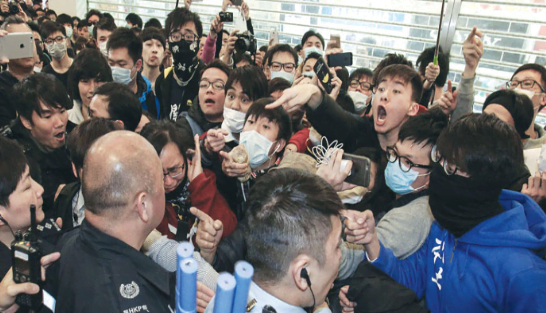
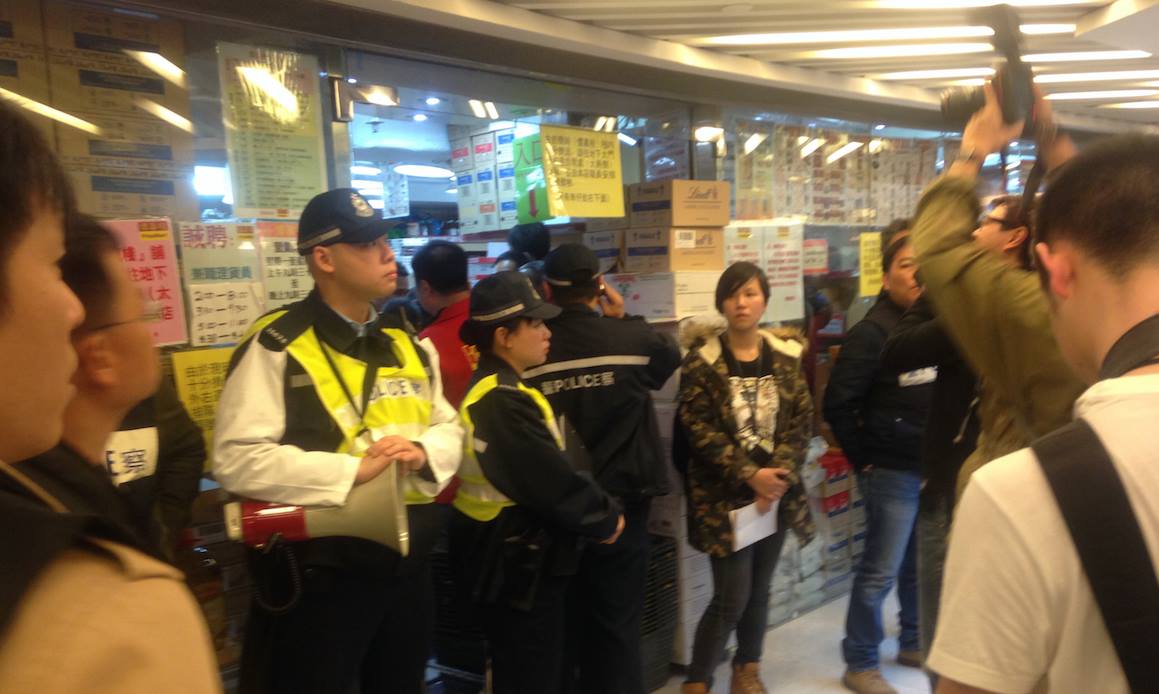
The group I was following arrived at one smuggler shop with about 100 protestors and blocked everyone in. There was chanting and shouting but no violence towards the shop. About ten minutes later the first police arrived. They lined themselves up infront of the shop, despite there being no actual threat of real violence.
After about a ten minute stand-off, the group I was with heard that in another Mall the police had already used pepper spray, so they’d decided to change venues and show support. As the group exited the main Tuen Mun Mall called, Trend Mall, it ran passed a group of about 10 policemen who had been sent as reinforcements. They were left in a quandary as to whether they should follow us, or go to the shop we’d just left.
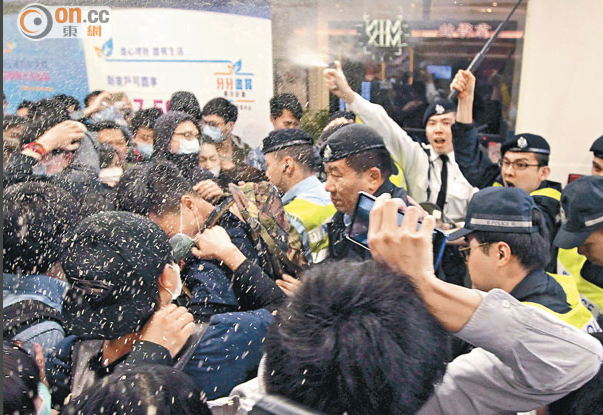
Here is a critical point that you should understand, the group had arrived at the smuggler shop and completely blocked it, but there was no violence. Yet in a completely different location where the police were they’d already used pepper spray. The video of this is on the web. You can see clearly, the most that happened in that Mall was some shoving and defiant standing of ground. No actual violence against police.
Later, after another twenty or so minutes of standing in the main square, another splinter group broke off and headed back to the shop we had first visited. What was originally a small splinter group quickly formed into the entire protest group going back into Trend Mall. Not knowing the layout of Trend Mall and fearful of being trapped inside, I remained outside for about 15minutes, not realising that Trend mall has dozens of exits. I watched at least 300 protesters enter the Mall
Outside we could hear chanting and jeering coming from upstairs, but nothing that would indicate that there was any serious trouble going on. Suddenly a team of about 8 police officers ran through the main doors heading for the second floor, I immediately followed directly behind them up the two escalators. When this small team of officers reached the top of the second floor they were blocked by crowds. They immediately ploughed into the crowd and all hell broke out.
https://vine.co/v/OUhUmOx1KnW
I was directly behind the police officers so could see everything. I wouldn’t describe it as a fight, as only the police were truly fighting, but the police were totally outnumbered and being met with stiff resistance as the protestors refused to budge. There is no doubt in my mind, had the crowd wanted to attack the policemen like in any other city in the world, these policeman would have had no power to stop it and would have been easily over-powered.
It was altogether a ridiculous move on behalf of the police and shows just how much they abuse the protestors passivity. The scrap lasted a good few minutes and the police were definitely in a tight predicament of their own making. At least one policeman and two protestors were down.
Pepper spray was being sprayed indiscriminately like they were spraying cockroaches. It was a complete mess, the police weren’t protecting anything, they just bowled into the crowd fighting. Interestingly, it is now clear from the videos, that it is exactly the same police team that had used pepper spray in the previous Mall that came barging into the crowds at Trend Mall. So, they had effectively come from that incident bringing the same level of intensity with them.
I want to point out again here, we had been in Trend Mall with a 100 protestors just 45minutes prior and there were no police and no violence. Now the police were here and everything was in meltdown.
Within minutes of the pepper spray being fired another 10 or so policemen came up the escalator and reinforced the small corner they were blocked in. Within another 5minutes of that, the police hoisted their red flag and attacked the crowd again, dragging protestors onto the floor to arrest them.
As I watched the spectacle, it seemed that the wisest thing the police should have done is retreated. The crowd was not unruly, it wasn’t smashing or breaking anything, it was just there. Which confirms a point I’ve already made several times that the police whether by order or just shear stubbornness do not want to give up an inch of territory and will therefore use any amount of violence on the crowds for just being there. For them illegal assembly is Route One to violence now. The violence is not justified because they simply aren’t receiving any violence back.
In these situations, I know the police are scared. I also get that large crowds are intimidating, but as police officers, who are paid well by the tax payer, they need to manage themselves professionally and simply attacking crowds because they are there is just plain stupid and unprofessional.
If it were a gang of triads, they wouldn’t use the same level of violence as they would have a full on fight on their hands. These direct action groups of young people never assault the police and it’s akin to watching a lion take down a farmyard cow and the lion complaining because the cow swung its head too hard while the lion was was using both its teeth and claws to maul. The fights are always one-sided with the crowd only shoving and the police swinging batons at anything that moves.
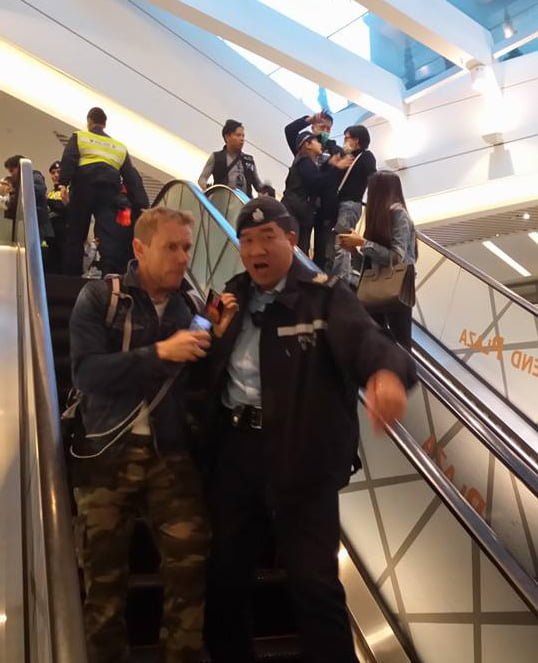
After a few minutes of scuffles, the situation stabilised somewhat, and I was then singled out by a young policeman who bundled me down the escalator for no other reason than he was pumped up from the fight. After this, a number of lower level skirmishes happened all over Tuen Mun, but not nearly to the same intensity. The main fracas in my opinion was caused by the group of policeman barrelling into a large crowd on Level 10. What did they expect?
So, having established what happened, the main issue is WHY did it happen. Just why were the direct action groups there and why are they willing to be attacked time and time again by an angry and frustrated police force? This I will explain in the next post.
The first photo is the smuggler shop the first time we visited after the police arrived. You can see, it’s calm. It’s not chaotic. Once the police arrive in numbers they start throwing their weight around and this is what causes the conflicts.
bc’s Richard Scotford was in Tuen Mun covering the anti-smuggler protests as the pepper-spray started flying in the shopping mall when he was verbally harassed and assaulted by a young policeman who tried to shove him down an escalator.
Here’s his initial thoughts on what happened
“I don’t think they knew who I was, here’s what happened. You may have seen some video of the police raising a red flag and going crazy with the pepper spray in a shopping mall. Well in those videos, I am just to the right, out of shot standing at top of the escalator. Clearly I can’t go forward as there is pepper spray going off everywhere. The escalator I’m on has been sealed off at the bottom by police after I came up it. So as the police pushed forward I was left behind the police line.
A young policeman then beelined for me and started to push me down the escalator. I protested and showed my press card but he was shoving me quite hard to go down. When I revealed I was press he then feigned that he didn’t speak English. About 300 people all around lining the shopping centre could see him trying to bundle me down the stairs and began to boo. His senior officer came along and then took over.
This is what you see here now in the still photo. I’m trying to explain to him that I wasn’t even moving, was behind police line and that I was press. He said that I was crossing police cordon, which is a lie, as on the other side of the police line was a battle.”
https://www.youtube.com/watch?v=R2nPGXBMptA
This is no different to the regular verbal and physical harassment that other members of the press and public have received when standing there peacefully covering the protests or walking around Hong Kong. Why is it that the police now feel the need to antagonistically and confrontationally get right-up in someone’s face and scream at them… If you want someone to move ask them politely. As can be seen in the video Richard is just standing there when the young policemen goes off on him. There’s no one around him, no pushing or shoving, no urgent need for him to move as the position he’s covering the fracas from is not interring with any police action…
Over a month ago I had the good fortune to sit at a table surrounded by some highly motivated, young activists. We discussed many issues concerning protest in Hong Kong and one of the issues they kept coming back to were the operations that were starting up in Sheung Shui to confront the parallel traders, or smugglers. They were very keen to hear my views on it. The fact was that I didn’t really know much about what was going on in Sheung Shui and I answered, to my discredit now, that I thought it was a distraction from the main idea of political reform. I wrongly believed, at the time, that their focus would have been better served in Admiralty or 9wu. My only redemption was that I asked the pointed question;
Do the local people support you in your efforts against the smugglers? Their answer was a categorical, Yes. Then, it can’t be a bad thing, I replied.
A month is a long time in politics and the actions that have since taken place in the districts have shown that the Direct Action Groups that these young, activists belong to are very politically astute. While the more traditional methods of protest have temporarily stalled, they have created an entirely new frontline that is a realistic way to build horizontal support and increase vertical pressure.
This is not big politics, it is raw street politics. The northern towns of The New Territories are awash with smuggler dens that transport everything from baby milk, to iPhones to live lobsters across the border daily. They serve no public function for the local residents The locals aren’t getting rich from this thriving trade. Resentment is at breaking point in these districts. In responding to the alleged attempted fire-attack on one of the smuggler shops the other day, Apple Daily reported that one local said, “He wished they would burn all the shops.”
The Direct Action Groups reasoning is simple and raw, we are local people and we will prove that we can solve local issues.
Taking on the smugglers is not easy political capital. That’s why the government refuses to do it. Too many vested interests. On top of this, these smuggling rings are almost certainly linked in to other forms of organised crime or dark forces across the border. Despite this, at great personal risk to themselves many Direct Action Groups have been conducting anti-smuggler actions week in week out, largely going under the radar of traditional media. They have had great success given that the only resource they really have are their own bodies and time.
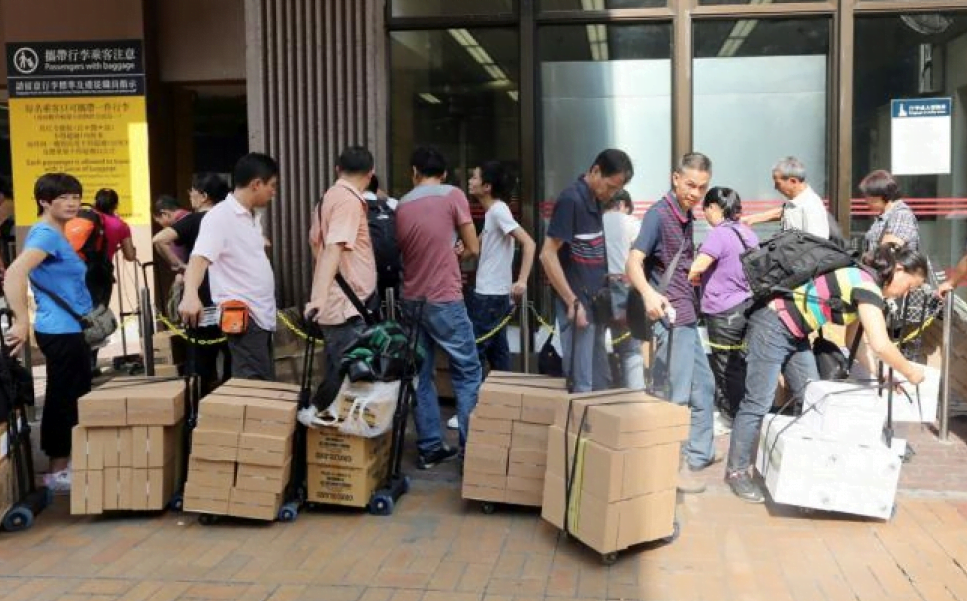
The linchpin to the preventing the thriving industry is the MTR. The smugglers are operating on very tight margins so the business model ideally involves carrying as much as possible in trolleys on the MTR. The MTR does have strict regulations on baggage size and weight, which it tries to enforce, but the smugglers overwhelm the staff on duty with both numbers and threats of violence. The MTR staff want the problem solved, The local police want the problem solved and have also assisted in helping the groups make the smugglers queue up to have bags weighed and measured. This has had an effect, but unfortunately the side-effect has been to push the smugglers to other areas and other means of transport, like the buses. The smugglers are a tenacious bunch. The appetite for their products across the border is voracious.
The small gains achieved have definitely endeared the locals with the activists, but the problem is huge and needs to be tackled in every district simultaneously.
This Sunday, Feb 8th the Direct Action Groups will launch their biggest operation yet in a combined action in Tuen Mun. Early reports are that the triads will be waiting to meet them. As a little side reference, during the skirmishes at the Mongkok Occupy, it was widely reported that the so-called triads who joined forces with the Blue Ribbons were not local but from Tuen Mun. Things could certainly get heated. The bravery of these Direct Action Groups is mind boggling. I will go to this operation, but I have no qualms in saying, I’m scared.
Sunday will be interesting, especially as there is one other principle actor that I haven’t really mentioned much yet, the police. Firstly, let’s get this clear, I’m not anti-police, but I’m certainly vehemently against bad-policing. If the police want me to stop writing about them then police fairly. It’s simple. It’s not rocket science!
If you’ve seen any of the post-Occupy police videos you will notice that there’s a key theme running through all of them; Law and Order. Any policeman interfacing with the public or media now needs to make sure we all know that this is the central business the police are in, keeping law and order.
Given this, this Sunday’s operation will be a huge test for the police, which has been specifically created by the Direct Action Groups. Everyone will be watching to see if the police can put their personal political prejudices to one side for the sake of law and order: Triad gangs, smugglers, civic groups all in the mix together. How are the police going to catorgorize the threats to law and order?
Batons out and pepper spray are standard procedure these days when facing off large groups of civic groups. Last Sunday’s Tai Po operation showed that the police feel it is operationally expedient to just pat away Blue Ribbons acting violently, yet engage in baton charges or resort to dangerous choke holds on Yellows until they faint. The police may understand this in their heads, but the general public does not. We look at that video of the policeman dragging the boy out by his neck, and think what is the rationale for this level of violence? What did that person do to receive such thuggery from the police? This is the bad policing that more and more people are growing to deplore.
The issue is easily fixed. The solution is not silencing the persistent criticism that arises on social media. The solution lies in fair and equal policing: something the police have lost sight of under the direction of Andy Tsang. Instead, the police are operationally biased from the moment they leave their briefing rooms and step foot on the street. Civic groups engaging in illegal assembly is now the most pressing threat the police perceive and they want to use force to address it. Hoisting banners informing people that they ‘may’ be in an illegal gathering and ‘may’ be subject to violence may make sense in Andy Tsang’s world of CCP cronies, but for people who still have their moral compasses in tact the police’s Route One to violence method is abhorrent and inhumane. Let’s not forget here, no one has been convicted of illegal assembly yet. No one has even been charged officially with illegal assembly yet. So why do the police think they are justified in beating people on suspicion of illegal assembly?
The HKPF is going to have to be a lot smarter and sharper this weekend if it’s going to avoid another free fall in its approval rating. Excuses that, it’s not us it’s them, are wearing very thin now from a force that is paid well to be professional and impartial. If people are gathering illegally, arrest them, charge them and send them to court, don’t beat them, that just makes you look like thugs and black hearts.
To conclude, The Direct the Action Groups are smart. They have created this explosive cocktail for a reason. Only vested interest groups feel threatened by it.
The smugglers are breaking laws and regulations day in, day out unchecked. This operation will highlight the detrimental effects it has on Hong Kong society.
On top of this, the police will be forced to demonstrate their commitment to law and order above their open political biases and personal vendettas.
We have all experienced that many police officers have more in common with rowdy Blue Ribbons and aggressive triads than they have with ‘snot-nosed students’ demanding democracy, but they need to rise above this and concentrate on their jobs, which they keep reminding us is law and order.
Law and order in New Territories’ towns is breaking down because they’re over run with smugglers, not because kids are gathering illegally to complain about them.
CCP funded Blue Ribbons seemingly immune to police arrest even when videoed committing assault.
To understand what happened in Tai Po yesterday you have to first know what happened in Kwun Tong last weekend.
A lot of money is now being pumped into grassroots groups that support the Blue Ribbons, which are flush with cash but short on real, quality support. In comparison, local grass root Pro-Democracy groups are all but penniless, but have growing, committed support. The CCP wishes to turn these groups against one another. This is classic CCP tactic, or create enemies and contradictions between the people, so people fight people leaving the CCP to pillage unfettered and uncriticised. The CCP have being instigating this kind of class struggle since their inception and they have a lot of experience with it. However, what they don’t have experience with are genuinely civic minded groups that can’t just be locked up for a decade to remove the problem. Meaning, that in HK, their tried and tested methods don’t get the traction they’re used to on the Mainland.
Which brings us back to Kwun Tong. Last Sunday the Blue Ribbons had a stage set up. There are several videos of the speakers on stage and one can confidently say that what they were advocating wasn’t really resonating with the passers-by. What was interesting is that anyone who tried to film the stage was quickly surrounded by a number of people who blocked the camera and acted menacingly. Which beggars the question, why are they making a stage if they don’t want their message to be filmed and recorded? Maybe the person filming wanted to promote the message? The reality is these groups are very exclusive, not inclusive. They may be on the streets spreading their message, but their target audience is generally reserved for a small group of people who think exactly like them. Any challenging questions will be quickly met with intimidation, violence and gestures for you to leave.
A single person who supports democracy would be crazy to open up discussion in these areas, even a small group would? So, what would happen if a large group of pro-democracy advocates walked passed?
Well that’s exactly what happened last weekend in Kwun Tong. After a few incidents where Blue Ribbons violently intimidated Yellow supporters earlier in the day, a reasonably large group of Civic Passion supporters, with banners and flags walked by the Blue Ribbon stage and were immediately accosted by their guarding goons. A quasi-street battle ensued with the Civic Passion supporters getting the worst of it. All their banners were destroyed and they were left scurrying for safety. The police that were there stood by and watched the Blues rough up the Yellows.
As more police reinforcements arrived, the Civic Passion supporters complained to the police and were duly arrested for common assault. Six in total. No Blue Ribbons were arrested for instigating the violence. Instead some were sent away in ambulances while those complaining that they had been attacked were carted off to the police station. To show their indignation at the hypocrisy of the police, Civic Passion supporters then gathered outside the Kwun Tong police station for a vigil until their members were released. As far as I’m aware, the police are pressing on with their intent to charge those attacked with assault.
The implications for this event are far reaching for HK society. I wont even touch on the highly explosive idea of police openly supporting attackers and not those being attacked, but will save this for another day.
Instead, we will move on to yesterday’s incident in Tai Po.
There is a direct link to what happened in Kwun Tong and what took place in Tai Po. Civic Passion and Frontline Democracy(本土民主前線), decided that they would not be intimidated by the Blue Ribbon’s campaign of fear and intimidation on the streets. Leticia Lee, the face of the Blue Ribbons, was scheduled to have another street stand in Tai Po, so they would meet her there directly. They knew from the onset that they would experience incredible prejudice from the police if they turned up in numbers, which they did. But this would not stop them. The purpose of yesterday’s action was to highlight the clear hypocrisy and collusion of the police. In this respect, the operation in Tai Po was a complete success. Police hypocrisy was in abundant display yesterday in Tai Po.
It is an accepted part of HK society today that the police will let goons loiter around Blue Ribbon stands and not bat an eye-lid if they decide to rough up the odd Yellow Ribbon. In fact, police are often their as supporters. Supposed civilians who were manning the Blue Stage were later seen in police uniform at Tai Po police station. This is how hand-in-glove the Blue Ribbons are with the police. The violence that is ever-present around the Blues is an in disputable fact that can be field-tested by anyone brave enough to believe the contrary. Don’t take my word for it, go and test it for yourself.
In stark contrast to this, despite it being the Blue Ribbons that manifest violence on a regular basis it’s the Yellow Ribbons who are immediately mobbed by huge numbers of police should they begin to form up. This is exactly what happened in Tai Po. Once Civic Passion and Frontline Democracy began to move the police were all over them, pushing shoving and not letting them move freely.
Admittedly, the police argument is, if we let the Yellows near the Blues, there will be a danger of a disturbance, we’re only keeping the peace. And this is exactly the reason why everyone went to Tai Po yesterday. To highlight that there IS a danger of disturbance, and right on cue, the police let the Blue Ribbons repeatedly express their anger and violence, yet cracked down on the Yellows. The danger of violence is ever-present from the Blues, but the police always take the opportunity to antagonise the Yellows. Extreme elements of the Blues and the police are hand-in-glove. One of the same. The Blues are the political wing of the police and the police will not tolerate their message being closed down. Unlike the Yellows, which they’ll actively take part in.
Yesterday’s action was a clear show of force by the Yellows, A warning to the Blues, that they will not get away with their goon tactics in the districts, even with police support and the cost of them will significantly increase. The police are on notice too that if Leticia Lee wants to spread the message of hate and violence for them, then they will be met with a strong showing of power from the pro-democracy action groups. They will not be intimidated off the streets. The police will have to mobilise vast resources of men if they continue to let the Blue Ribbon Goons control the message in the districts. This is an important fight which Civic Passion and Democracy Frontline are leading.
Both HKFS and Scholarism have intentions to take the Pro-democracy message to the districts. The unspoken tactic from the government is that CCP United Front groups will prevent this through intimidation and violence and the police will look the other way. As a pro-dem supporter, you may think that Civic Passion and Frontline Democracy are too radical for you, but if they aren’t going to lead this fight, who will and the districts will become a place where no one other than the Blue Ribbons can speak their message freely.
The police were caught entirely on the hop with this action. Photos of the western commander turning up in his Sunday sweater shows that all their focus was on Central. On top of this, once again, the police proved that there really is no low for them and their political beliefs. Photos and videos of them providing bus services for the Blues, loading all their gear into police vans, letting blue Ribbons act disorderly yet swinging batons at Yellows who act similar all paint a picture of a police force in political and moral free fall.
For them it’s now personal, they are one in the same with the Blues and when they feel like they are threatened they will happily unleash the full powers invested in them as police officers to protect themselves. As a Yellow you can expect no such liberty anytime soon. The prejudice within the police no runs extremely deep. I have even felt this in my own personal life.
So, to conclude….The age of large demonstrations on HK Island is over.
The fight is now in the districts, please support!
One things for sure, we will see a lot more bad policing and goon behaviour before a victor emerges.
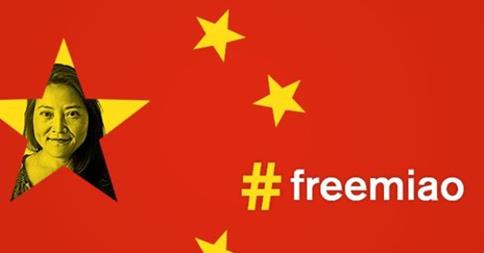
Die Zeit held off from publishing this story for a long time: “A Chinese woman working as an assistant to DIE ZEIT has been detained for more than 12 weeks. We didn’t want to complicate diplomatic efforts being made to secure her release. But since these have yet to yield any result, we consider it necessary to make public now the fate of our colleague Zhang Miao. Angela Köckritz, our Beijing correspondent, is no longer in China. In this article, she describes her experiences with Chinese authorities”.
How my assistant got into trouble with Beijing’s security apparatus and I got to know the Chinese authorities
One day three months ago, on October 1, 2014, I saw my friend and assistant Zhang Miao for the last time. It was 9 a.m. when she knocked on the door of my hotel room in Hong Kong. I was still in my pajamas. We had been out until late at night reporting on the Occupy Central protests. Miao was on her way back to Beijing, but I wanted to stay longer. We hugged. “Take good care of yourself,” I said. “I will,” she assured me with a smile. “And you, too. We’ll see each other again soon, anyway.”
Since then, Miao has disappeared. She’s being held in custody.
During my four years as a correspondent, I’ve often had to write about justice and injustice in China. I’ve attended press conferences at which government officials have told us that China is a country based on the rule of law, or what’s known in specialist circles as a Rechtsstaat. I’ve spoken to farmers who’ve been expropriated, who’ve tried to seek redress but failed, and instead been beaten and carted off to a black jail for supposedly fomenting unrest. I’ve interviewed civil rights activists who’ve sought, with infinite tenacity, to make China into what it pretends to be: a country based on the rule of law. I’ve visited dissidents who’ve been threatened and then vanished one day. Flipping through my telephone book, I see the names of many who are simply gone. When I mentioned this to a Chinese acquaintance, he shrugged his shoulders. Those kind of things happened to dissidents, but not to normal people, he said. Still, after a series of unfortunate circumstances, even the most guileless person can run into trouble with the justice system and security apparatus. It’s like with cancer: Everyone thinks they won’t get it. It’s always other people who are put in prison.
This time, it happened to Miao. And therefore to me, as well. I’d already known that laws in China are only valid when they serve the government’s interests. But experiencing it firsthand was something altogether different.
Miao is 40 years old; I’ve known her for six years. She lived in Germany for a long time. She had a German residence permit. In Hamburg, she was my Chinese teacher. We became friends. When she went back to Beijing two years ago, she started working in the office of DIE ZEIT. Returning wasn’t easy for her. Much seemed foreign to her, and she had grown apart from some of her old friends. But she soon made new friends in Songzhuang, an artists’ colony she lives in near Beijing.
Zhang Miao and Angela Koeckritz in Hong Kong covering the Umbrella Movement
Miao and I traveled frequently for the newspaper. We’d been through a lot together. In self-mockery, we and our photographer sometimes called ourselves san jian ke, the Three Musketeers.
Miao and I had flown to Hong Kong on Sept. 24, 2014. We’d been able to track how the protests had changed. On Sunday, Sept. 28, the police fired tear gas for the first time. We spent that night running through the streets until 5 a.m.
Troubled by the news that police had used tear gas, Hong Kong residents were driven into the streets. The crowds grew larger by the minute. The urban expressway, streets, pedestrian crossings and bridges were full of people. No one would have dreamed that there would be so many. That night, many– including Miao – believed Beijing would send in tanks. She kept on shaking her head in disbelief. “It’s just like back then,” she said. “In ’89, we also would’ve never thought the tanks would come.”
Miao was in grade school in 1989 when students demonstrated on Beijing’s Tiananmen Square. She lived nearby, and she often took water to the protesters. Late on the night of June 3, when the tanks started advancing, they passed by her apartment building. One can make out bullet holes in the building’s walls even today.
But on that night in Hong Kong, no tanks would come. Nor would they come on the next night or the one after that. Instead, in the following days, more and more people crowded into the streets. Fear gave way to euphoria. Strangers smiled at each other and took countless photos because they just couldn’t believe it: crowds of people wherever they looked, the biggest demonstrations on Chinese soil since 1989. “Wow! That’s incredible,” Miao kept saying. She was exhilarated, happy. A girl handed her a yellow ribbon, the symbol of the movement. She pinned it on herself. I could understand her, but I still asked her to take it off. “We’re journalists,” I said, and she took it off with a smile. A few hours later, she’d put it back on in another place.
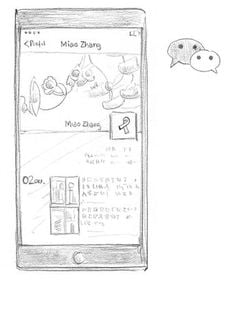
Like so many people from mainland China, Miao had bought an iPhone 6 in Hong Kong. She would take photos with it and then post them on WeChat, a Chinese social network. Miao is an Internet addict. I’ve never met anyone who posts and comments online as much as she does. But we’d learned that the Chinese police had been questioning and detaining people from mainland China upon their return after taking photos in Hong Kong and transmitting them via WeChat. “Miao, please stop doing that,” I begged her repeatedly. She would just smile and put her phone aside. And then start back up again shortly thereafter.
After a week, Miao’s visa for Hong Kong had expired. She had to go back to Beijing, but I wanted to stay. She left on October 1, China’s National Day.
The next morning, I was in the middle of an interview when I received a WeChat message from Miao. It was a photo taken the previous evening. It showed Miao and four men. All of them had pinned on yellow ribbons and crossed their arms over their chests just like the student leader Joshua Wong had done on the morning of October 1 when the Chinese flag was being hoisted in Hong Kong. “The one on the left has been arrested,” Miao had written below the photo. “A poet.”
“Oh, God!” I thought. Then I checked to see if she had posted the photo on her public account. She had. And she had also changed her profile picture. It now showed a yellow ribbon.
I wish I could turn back the clock on what happened in the next 45 minutes. At some point during that span of time, Miao must have gotten out of a car in Beijing even though she saw police on the side of the road. I’m not sure I could have stopped her. I would have at least liked to try.
During that 45-minute period, I had finished one interview and rushed to the next. The day was jam-packed with appointments. Internet reception was poor on the subway. I couldn’t find the place I had agreed to meet the next interview subject. I was wandering through a huge shopping center. I absolutely wanted to speak with Miao, but I couldn’t find any time to do so. In retrospect, it seems like my brain was preoccupied with the dumbest trifles. I was like someone racing though the city to a dry cleaner’s to pick up a clean shirt while utterly failing to notice the tidal wave rising above me.
At last, I’m standing in front of the café we had arranged to meet at. I try Miao’s number as my interview subject hurries toward me. We had hardly sat down for coffee when the news about Miao’s arrest reaches me almost simultaneously via two channels. The editorial office in Hamburg was on the line, saying: “One Mr. Zhang from the Chinese security authorities called. He says Miao has been arrested.” Miao’s brother sent me a message with the same news. No one knew exactly what had happened.
I’m glued to the phone. In the days to follow, I hardly do anything else. I barely eat; I barely sleep. I have to get Miao out, somehow. I contact the German Embassy, the Foreign Correspondents’ Club, Miao’s family, friends, the editorial office, Mr. Zhang from the security services. Zhang works for the Exit & Entry Administration of the Ministry of Public Security, which issues visas to foreigners. It also occasionally summons foreign journalists and threatens not to extend their visa if the government doesn’t like their reporting. So far, I haven’t had any trouble with them.
“Mr. Zhang, what’s going on?” I ask.
“I’m not exactly sure,” he replies. “She was involved in a village squabble. Inciting a public disturbance or something like that.”
“Village squabble? I can’t imagine that. Could you please give me the number of the police station in charge?”
“I can’t do that.”
“How can I get it?”
“I can’t tell you that, either.”
“But someone must have called you.”
“You know what? I’ll ask around. Then I’ll call you back.”
In the meantime, I make another round of calls. I find out that Miao was arrested in the artists’ colony while on the way to a reading of poetry in support of the demonstrators in Hong Kong. At that point, no one can tell me anything more.
Mr. Zhang is back on the phone. He sounds triumphant. “Zhang Miao is a Chinese citizen; she doesn’t have a German passport,” he says. “And she wasn’t officially registered as your assistant.”
“No, she wasn’t,” I admit. Quite a few editorial offices haven’t registered their assistants for some time because that would have meant more monitoring from the Ministry of State Security – and it’s also more expensive. Now I’m wondering if that would have somehow protected her. The authorities will undoubtedly exploit this fact. I feel guilty.
“What happened has nothing to do with you,” Zhang says.
“Of course it does,” I respond. “She’s my assistant. I’m responsible.”
“The case has nothing to do with journalistic work. I was told that she was abusive,” he says with disgust. “That she shoved police officers and bad-mouthed them wildly. Appalling.”
“Excuse me, Mr. Zhang, but I can’t imagine that,” I say.
“In any case,” he answers, “Zhang Miao is a completely normal Chinese citizen. And we will treat her like we deal with Chinese citizens.”
The next day, I fly to Beijing late in the evening. I get home at around 4 a.m. It’s Saturday, October 4. When I get up at noon, I see on my display that Mr. Zhang has already called several times. “Come by,” he says. “We want to chat.” He uses the word liaotian, to chat, as if one were going to meet with friends in a café.
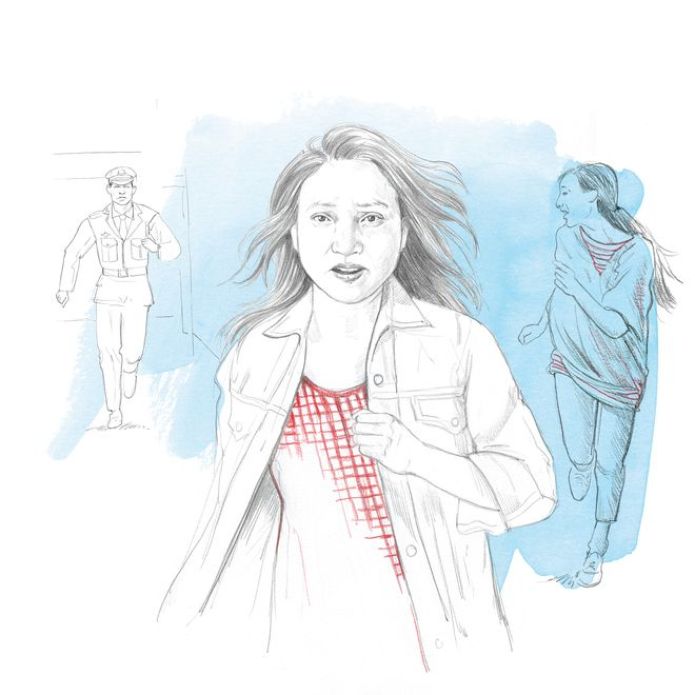
By this time, I have figured out which of Miao’s friends has information about the course of events. I call them, as I want to be prepared before going in for questioning. Three witnesses tell me the following: On the morning of October 2, Miao goes with some friends to the house of the poet, who had been arrested the previous day. They want to visit with his family. When they get there, the police are already waiting, and a heated exchange of words ensues. Afterwards, Miao and a friend, a woman who works as an assistant for the BBC, want to go to the reading in support of the Hong Kong protests. An artist friend drives them there and stops to drop them off. Police are already standing at the entrance to the road. Miao and her friend get out of the car. The artist friend watches as they hasten toward the event venue. The police chase after them. The women make a run for it. The police catch them. They are slammed against the police vehicle. That’s all the driver was able to see. The police ordered him to drive away. Miao apparently succeeded in getting away, as she called another friend a few minutes later. The conversation is interrupted several times. “They want to arrest us!” she shouts. “They hit us!”
Then the line goes dead. Miao is no longer reachable. The woman she was with is released at the entrance to Songzhuang. All traces of Miao have been lost.
In the following months, more and more people across China are arrested for supporting Occupy Central. According to information from civil rights activists, there are more than 200 of them. Ten people have been arrested in Songzhuang. All of them are somehow connected to the poetry reading. I know four of them.
I drive to Mr. Zhang’s police station. He escorts me to a windowless room. Two young colleagues are already sitting there: one Mr. Xu and a male clerk. They have notebooks in front of them. I take mine out and write down their identification numbers. “What’s that all about?” Zhang asks. “This is not an interview!” They speak Mandarin with me.
“I’d like to document this case,” I say. “I read a lot about the development of the rule of law in China, and now I’m experiencing it in person. I hope to be able to write an upbeat story.”
“Yes,” Mr. Xu responds, “be upbeat. You’ll see that the Chinese constitutional state will give you every reason to do so.”
They question me: How did I meet Miao? What did we do in Hong Kong? Who did we interview? Did I know about what had happened in Beijing? During the course of the interrogation, Miao goes from being a suspected agitator to a de facto one.
“Why do you always say ‘the agitator’?” I ask. “There hasn’t been any court ruling yet.”
“I already said ‘alleged’!” Zhang barks at me. “Am I supposed to repeat that now every time or what? This here is a conversation among friends. But you’re not behaving that way. And enough with all that note-taking. This isn’t an interview!”
“Sorry,” I say, “but the word ‘alleged’ is a very important word.”
Now Zhang gets even more furious. “What’s that about?” he asks. “Who do you think you are, anyway? Are you really German? You’re very different from the other Germans!”
“Really?”
“They are honest.”
“And I’m not?”
“No, you aren’t. You’re odd. Very odd. It has always been very pleasant with the other German journalists.”
“That’s not what they’ve told me.”
“With you, it’s not pleasant at all. If I were in your position, I’d pull myself together.”
While Xu gradually assumes the good cop role in this conversation, Zhang morphs into the bad cop. When I mention that to the two, Zhang flips out. “You’ll be dealing with us more often,” he says. “Such as when you apply for your visa for next year. There could be problems. Pull yourself together!”
“I’d like to know where Miao is,” I respond. “According to China’s Criminal Procedure Law, the family must be informed within 48 hours of arrest. But we haven’t heard anything yet.”
Mr. Xu smiles at me beamingly. “Her case has absolutely nothing to do with you,” he says. “Don’t let it be a concern to you. Have faith in the rule of law in China. It is perfect.”
Zhang leaves the room angrily, while Xu escorts me out. He shakes my hand, but then he doesn’t release it. “Don’t worry about Zhang. He can get emotional sometimes. You see, he studied in Germany, and he has a very high opinion of Germans. Next time, I’ll invite you for a coffee, OK? A little chat?”
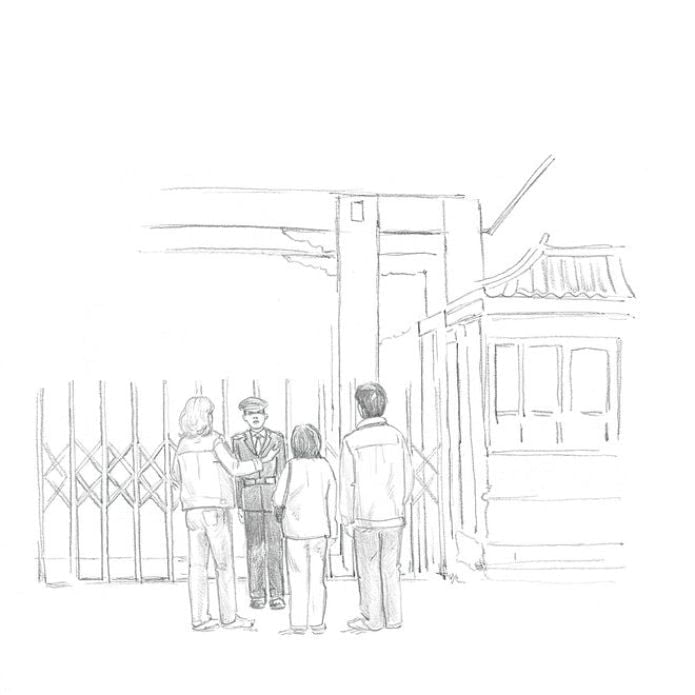
The next day, we still know nothing about Miao. Her brother gets a tip that she might be in Beijing’s First Detention Center. A few hours later, we are standing outside the building: me, her brother and her stepmother. She has brought along a bag full of warm clothes, as the nights have grown cold. The prison is on the outskirts of Beijing. In front of it are dreary yellow apartment buildings. Tall trees grow behind a high wall. We can’t see much.
The security guard is a young guy in a ragged uniform.
“We’d like to inquire about the whereabouts of a prisoner,” I say.
“Come back after the holidays,” he responds.
“After the holidays?”
“Yeah, in a few days.”
“But there aren’t any holidays in the prison, are there?”
“No, there are.”
“Are the prisoners on holiday?”
“No.”
“And the guards?”
“Not them, either.”
“Then there has to be someone who can provide us with further assistance.”
“Come back some other time,” he says with a yawn.
“I’m writing a story about the rule of law in China. Do you want me to quote you as saying that and mention your identification number?”
The security guard springs to life and lets us through to the doorman. He also mentions the holidays. After what seems like an eternity, he calls his superiors: two men and a woman. One of the men writes down detailed personal information about us. He takes his time flipping through his notebook before shutting it with a grave expression.
“I could look to see whether she is there, but there are holidays,” he says, before starting to turn away.
“But,” I say, “according to Chinese regulations for criminal proceedings, you are obliged to notify us within 24 of the arrest. The 24 hours are up.”
He eyes me with a bored expression before saying: “There are holidays.”
“And the rule of law?” I reply. “Is it on holiday, too?”
Now he looks almost disgusted. “I have absolutely nothing to say to you,” he replies. “You aren’t a family member or a lawyer. Go away.”
I telephone Mr. Xu. “Didn’t you say that China as a state under the rule of law is perfect?” I ask. “I’m experiencing a situation here right now that doesn’t seem so perfect to me. I’m standing in front of the prison…”
“Listen, just let it go, OK?” he says. “This is none of your business. We’ll deal with it.”
“This is my business,” I reply. “I’d like to speak with someone in charge now, someone higher up.”
“We can’t help you. We don’t have a name or a number.”
“But there has to be a department. Which department is entrusted with this case? Which public prosecutor?”
“We don’t know. Just go home,” he says. And then he hangs up.
The police officers outside the prison won’t speak with me anymore. They treat Miao’s family condescendingly. We go away. As we are sitting in the car, I am beside myself with rage.
“These guys…,” I say.
Miao’s brother shrugs his shoulders. “They weren’t so bad,” he says. “At least they didn’t scream at us like usual…”
Meanwhile, Miao’s lawyer, Zhou Shifeng, is working feverishly to get an appointment to meet with the detainee. The meeting isn’t approved, so Zhou keeps at it and files a complaint. Things will go on like this for months.
“How can that be?” I ask him.
“The law says that state security officials have to notify the family within 48 hours of the arrest,” he says. “But then there is the passage ‘unless further investigation is required.’”
“So, does that mean that the police can always invoke an exception?” I ask.
“When lawmakers make laws, they do it for their own interests and not because they are concerned about those of the public.”
“Do the security authorities have to announce that they are invoking an exception or get it authorized?”
“No,” Zhou responds. In principle, he continues, the security apparatus can find an exception clause for every law. Citizens don’t have any legal entitlement to be protected vis-à-vis the state and its representatives.
On Wednesday, October 8, the family is served the formal detention order. It says that Miao is being held in Beijing’s First Detention Center, that she’s suspected of inciting a public disturbance. Law enforcement likes to use this criminal offence whenever they take aim at nonconformists. In the worst cases, it can be punished with up to 10 years in prison. We continue to hope that Miao will be released in a few days.
That week, the German and Chinese governments are preparing for Premier Li Keqiang’s state visit to Germany. He will travel to Berlin on Thursday, October 9, with several of his ministers. This is being billed as the biggest government consultations in the history of both countries. In the preceding days, several media outlets have telephoned me, including the South China Morning Post and the New York Times. They want to publish stories about Miao. Her family asks that only a little be made public. Now the question arises whether I should writes stories about Miao’s situation in the run-up to Li Kequiang’s visit. Everyone gives me different advice. The more I think about it, the clearer it is: No one can tell if reporting on it will do any good. This is a state ruled by arbitrariness. The agonizing uncertainty I’m feeling is intentional.
The German Embassy in Beijing is working hard on Miao’s behalf. I’m learning to highly appreciate the diplomatic service. The Federal Chancellery and the Federal Foreign Office are dealing with Miao’s case, and all of the federal ministers have been informed about it. On this Thursday evening, the German wire service dpa will report on Miao’s situation. I will write a small piece for ZEIT ONLINE myself.
On Thursday morning, I get a call from Mr. Xu. I’m supposed to come by – to chat. As I enter the small, windowless room, there are already three men sitting there: two investigators and a clerk. They are of a different caliber than Zhang and Xu, older, more experienced. The investigators say their names are Li and Guan. Li is the talker. He has dark rings around his eyes and an unusual face. He can alter his expression in seconds – now enticing, now flattering, now threatening. Guan is more of the bulldog type, hard-nosed, monosyllabic, persistent. Li says he is the deputy head of the division. But I’m guessing he’s from even higher up the chain. I’m not given a chance to check their real identities.
Li evidently wants to start with a relaxed conversation. He wants to talk about hobbies, about philosophy and culture. It’s not clear to me why we have to do this in a windowless room at the police station. And, in any case, the security apparatus already knows how I spend my free time.
“I’m a passionate equestrian,” Li says. “In your opinion, what makes a good equestrian?”
“I’d imagine perhaps sensitivity,” I respond.
“A good rider knows how to bring his horse under absolute control,” he says while looking at me intensely. “Then it does everything he wants.”
Mr. Li loves equestrian metaphors. He will frequently use them during the conversation, and he always looks at me when he does, as if to say: I am the rider; you are the horse. Li chats a bit more and then threatens that my journalist visa won’t be extended. I shrug my shoulders and say: “Then I’ll just go to Hong Kong and report from there.”
“Then I will visit you there,” he responds sharply. “Do not believe that you can elude me.”
He repeatedly asks me how I met Miao, whether I trust her.
He follows several threads of conversation at the same time. His voice has different registers, different pitches. He tries to lure me out of my emotional shell. I ask him why our lawyer can’t see Miao. “You shouldn’t have such overblown worries. We’re investigating the case. It just needs a little time,” he says.
Mr. Li wants to know what German reunification was like for me. Whether I was happy when the two Germanys grew back together. Whether I am a patriot. He says that he is fervent patriot. “The unity of the fatherland is more important to me than anything else,” he says. I try to explain to him that most Germans have had a problem with the term “patriotism” since Hitler. That there are things I love about Germany and other things that I find problematic.
“I love everything about Chinese culture,” Li ardently says.
“Everything?” I ask.
“Everything,” he responds in a sure voice.
“Even the Great Leap Forward? Even the Cultural Revolution?”
Li closes his notebook without saying a word and leaves the room. I think he’s mad.
The bulldog takes over. He doesn’t want to chat about philosophy. He asks hard, terse questions. At the end of the interrogation, he insists that I sign a statement. It’s written in Chinese on four or five pages. I decline. He insists. This back and forth seems to last forever.
I slowly read through the document three or four times. Mr. Xu, the nice guy, comes back in. He generally comes in whenever the mood has hit rock bottom. He is Mr. Sunshine at the police station. Now he’s not wearing a uniform. He talks to me while I’m reading in an attempt to distract me.
I say to Guan, the police officer, that there will be reporting on Miao before Li Keqiang’s visit.
“That could have negative consequences,” he says.
“What kind of negative consequences?”
“Negative consequences. Think it over.”
The questioning has lasted four and a half hours. Exhausted, I step out of the room and into the hallway, where all the policemen are standing.
They laugh. They joke. All of a sudden, they are incredibly nice.
Mr. Li says he would like to invite me out for a private meal some time. “It’s so nice to chat with you,” he says.
“To be honest, the questionings with you are enough for me,” I respond.
“Nevertheless, we’d like to see you tomorrow. We would like to speak with you about the coverage,” he says with a laugh.
Xu takes my hand again and adds: “We’re all old friends, aren’t we?”
Back in Germany, Li Keqiang lands in Berlin at noon local time. At that very moment, the dpa story is running on the ticker. Other media sources pick up the story. Amnesty International calls for Miao to be released. The next morning, a German journalist asks Li Keqiang about the case during a joint press conference with Angela Merkel. Foreign Minister Frank-Walter Steinmeier brings the issue up with Li.
But Miao doesn’t go free.
On the morning of Friday, October 9, I get two calls at once. Security officials want to see me, and so does the Chinese Ministry of Foreign Affairs. “How am I supposed to manage that?” I ask the foreign ministry employee. “My interrogation yesterday lasted four and a half hours.”
“Come right afterwards,” he says. “It’s urgent.”
I start making my way to the police station. The rings around Mr. Li’s eyes are even darker than they were yesterday.
“We were sitting here until two in the morning,” he says. “We thought a lot about you. We asked ourselves who you are – I mean, who you really are.”
We’re alone in the room.
“We won’t be beating around the bush today,” he says. “Let’s get to the point.”
I nod.
“What’s the most important thing in horse racing?” he asks.
“No idea.”
“The jockey must win the horse’s trust within a very short time.”
“Aha.”
“Do you trust me?”
“Don’t take it personally, but no.”
“But you said you trust Miao, right?”
“Yes.”
“What if she’s completely different than what you think?”
“I don’t believe it.”
“Miao has testified that you organized everything. The events in support of Occupy Central. That the two of you went to Hong Kong to organize protests there. That she worked for you personally, and not for the newspaper.”
“She never said that!”
“But she did. We have proof.”
“I’d like to hear that in person from Miao’s own mouth. We all know that confessions in Chinese prisons often aren’t voluntary.”
“You organized everything.”
“I did not.”
“We know you did.”
“As I see it, there are three possibilities,” I say. “Either Miao was forced to give this testimony. Or she didn’t tell the truth. Or you aren’t telling the truth.”
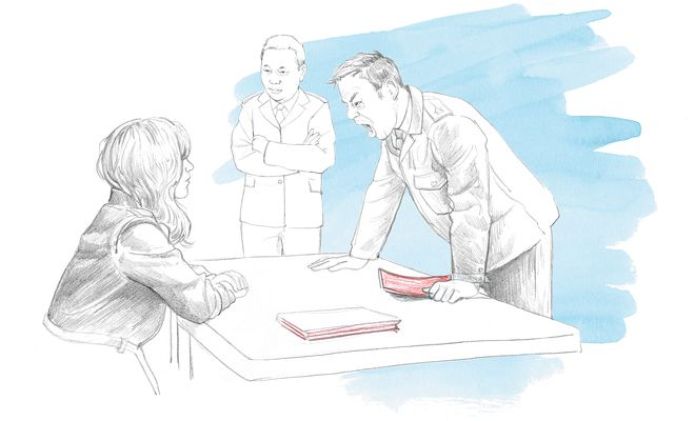
“There’s a fourth possibility, as well,” he replies softly. Then he suddenly shouts: “You’re lying! You’re lying! You’re lying!”
He stands up and grows louder: “You’re lying! You’re lying! You’re lying!”
I turn to the side. Does he seriously think that? Will he declare that I’m an agent provocateur, a spy?
Possibility one: He’s trying to intimidate me, to destroy the trust between Miao and me.
Possibility two: They really do want to brand me a spy. One thing speaks against this conclusion: Relations with Germany are important to China. If they were looking for a scapegoat, it would probably be someone of another nationality, a Japanese person perhaps. On the other hand, these are special times. State security is in a state of alarm. The leadership is about to pass a big new anti-espionage law. From the beginning, it has said that Occupy Central is a “color revolution” backed by foreign powers. Its argument would be more credible if it could produce a suspected spy. Maybe me?
They don’t have any proof. But the Chinese security apparatus has plenty of options: It can use other laws as a fallback, twist evidence, launch character-assassination campaigns or resort to mafia methods. An American journalist was informed through back channels that he and his family were no longer safe in Beijing.
“I’d like to break off this conversation now,” I say. “I will only speak with you in the presence of an embassy employee. I’m calling the press attaché.”
The first press attaché promises to send the second one over.
“We won’t let him in,” the police say.
“Whatever,” I respond. “He’s on his way over now.”
Li leaves the room, and Guan takes over. He wants to learn everything about Miao’s activities on WeChat. He wants me to name names. I refuse to say anything. He gets pissed. I walk to the door, but the policemen rush over and block my path. The phone rings. It’s the foreign ministry. They want to talk with me now.
“Yeah, yeah. I know your matters with her are also important,” Guan says like a big brother talking to his little brother. He’s annoyed. He wants me to sign a statement. I refuse to do so.
Waiting for me outside is Mr. Sunshine himself, Xu, in a stellar mood. “You’re just too sensitive,” he says.
In comparison, my meeting with the Chinese diplomats is positively pleasant. They’re not thrilled that reports about Miao’s case have been published right when there’s a state visit, but they remain polite, civilized. The difference between them and my new acquaintances with state security could not be bigger. Sitting in the foreign ministry are the doves, the worldly people; but their ministry is the weakest in China. The Ministry of State Security, on the other hand, is extremely powerful.
On the next day, Saturday, October 11, I get yet another call from Xu. I’m supposed to come in for questioning. For a chat.
“I’m ill,” I tell him.
“Come anyways,” he responds.
“That doesn’t work. I’d infect you all.”
On Sunday, he writes me a text message, saying: “Dress warm. The weather is going to change. Don’t forget to rest. Your policeman, Xu.”
That weekend, I read a lot of upbeat newspaper articles about how China is a country based on the rule of law. The third party plenum is about to be held. Its motto is “The Rule of Law.” We still haven’t heard anything about Miao.
On Monday, October 12, it’s Xu on the phone again. He wants to chat. This time, I insist that we don’t speak Chinese anymore. I’m accompanied by a press attaché from the embassy and a translator. “You should get yourself a lawyer now,” the diplomat says on the way there. “If they want to put you in pretrial detention, we can’t do anything about it – except protest.”
Three men are waiting in the interrogation room. One is the investigator who has been questioning Miao. Short hair. A broad, fleshy face. The skin of a chain-smoker. To the right of him sits a man in a Nappa leather jacket who doesn’t introduce himself. We ask who he is. He smirks mysteriously.
“I am everywhere,” he says. “I know you all. One can see me in many photos.”
Though he says little, he is the menacing one. He must hold the highest rank. None of the men say which division they belong to. When I ask the brawny one that question, he smiles in such a flattered and humble way that what he says just can’t be true: “I’m just a simple cop.”
His questions are terse and tough. Lying in front of him are pages and pages of statements taken from Miao’s WeChat account, a whole pile of them. His questions are pointed in the following direction: Miao was my private assistant. I’m more than a journalist. I’m pursuing an entirely different agenda. We met with critics of the regime. Separatists. We gave them money.
I notice how he is fastening the noose tighter and tighter around my neck. His questions are supported by facts. Yes, I did meet with regime critics. Yes, after an interview, I gave 70 euros to a severely ailing civil rights lawyer for medicine; state security had beaten her so badly that she is now confined to a wheelchair. But I was always traveling as a journalist and not a spy or agent provocateur, as the brawny one keeps insinuating.
Now I’m starting to experience firsthand something that I’ve read a lot about: their skill at twisting the meaning of things. They might have enough material on me. They’ve been eavesdropping on me for four year – on my phone, in my apartment. They read my emails and monitor what I post on social networks. They sometimes let me know that they’ve searched through my home: The box of business cards I keep on my desk will have somehow ended up outside on the mailbox. A door I’d locked is now open. The time setting on my computer has been changed from Beijing to Seoul. These things happen to other correspondents, too.
It’s an ugly thought, but I usually didn’t let it bother me all that much. How else was I going to be able to live here? But now that I know they aren’t just gathering information, but are also going to use it, things are starting to look different. I think about all the sensitive work-related data from Miao’s cellphone and email account. Now the state security has it. I start feeling sick. The Internet makes citizens transparent to Chinese authorities.
I ask how Miao is doing, why the Criminal Procedure Law is being ignored.
“Don’t worry about that. She’s doing fine.”
“I doubt it.”
“You journalists think Occupy Central is the reason. But it’s about more than that. It’s about the security of the state, about its territorial integrity. That’s why the Criminal Procedure Law doesn’t apply.”
“I was told that she was merely involved in a village squabble.”
“This is about inciting unrest, and that’s a matter of national interest.”
The brawny one’s questions about Miao get more and more persistent. I demand a lawyer. Now they want me to sign a 10-page statement written in Chinese. They don’t supply a translated version, nor are we allowed to take an original copy with us to get it translated ourselves. We remain steadfast in our refusal.
“Translate it here. Verbally. We have time. We can stay here all night.”
We argue for another hour. They eventually let us go. We are incensed.
“Phew!” the translator says as we’re leaving. “They sure did pile it all on you: separatism, antagonism, Hong Kong. Sure doesn’t look good for you at all.”
“I wanna fly out tomorrow,” I say.
“Hopefully you’ll even make it out of there tomorrow,” says the press attaché accompanying me. “We should escort you to the airport gate so they don’t still try to nab you.”
That night, I frantically pack all my things together: notebooks, data, letters. I know there will be an orgy of searching once I’m gone. The next day, two embassy employees take me to the airport gate.
While I’m at the airport, a fellow correspondent calls me. She tells me that Phoenix TV, a station in Hong Kong, has mentioned a German journalist who was traveling on the island as an agent provocateur. Right after I hang up, I get a text message from Xu, the policeman: “What’s your WeChat ID? Send it so we can keep in touch for a long time. Welcome back to Beijing.”
We don’t hear anything about Miao for a long time despite countless attempts by the lawyer. In the course of his inquiries, he learns that she is no longer being held in the First Detention Center. We fear she’s ended up in a black prison. These illegal prisons are beyond the reach of the law. Security personnel can do whatever they like; inmates are often beaten up or sexually assaulted.
Several days later, we find out that Miao has been transferred to the prison in Tongzhou, a suburb of Beijing. The law forbids police officers and guards to abuse inmates. But they often avail themselves of certain cell mates who will mistreat other inmates in the knowledge or at the request of the guards.
On December 10, the lawyer is finally allowed to see Miao. He indicates that we can’t speak freely on the phone, but he does share with me that Miao is suffering both physically and psychologically. Her spirit is strong, he says, adding that security officers want to force her to sign a statement in which she declares that our ties have been severed.
Day 100…
Yesterday’s Lennon Wall Chalking in support of the 14 year old protestor that the police want removed from her family and placed in care has been crudely washed away. Why crudely, because symptomatic of the general decline in the quality of work carried out by HK’s civil servants and those contracted to it – the cleaning is only partial done and the graphics are still visible.
The tented protest area continues to grow with over 100 tents with 100+ regulars staying every night and more staying when they can.